
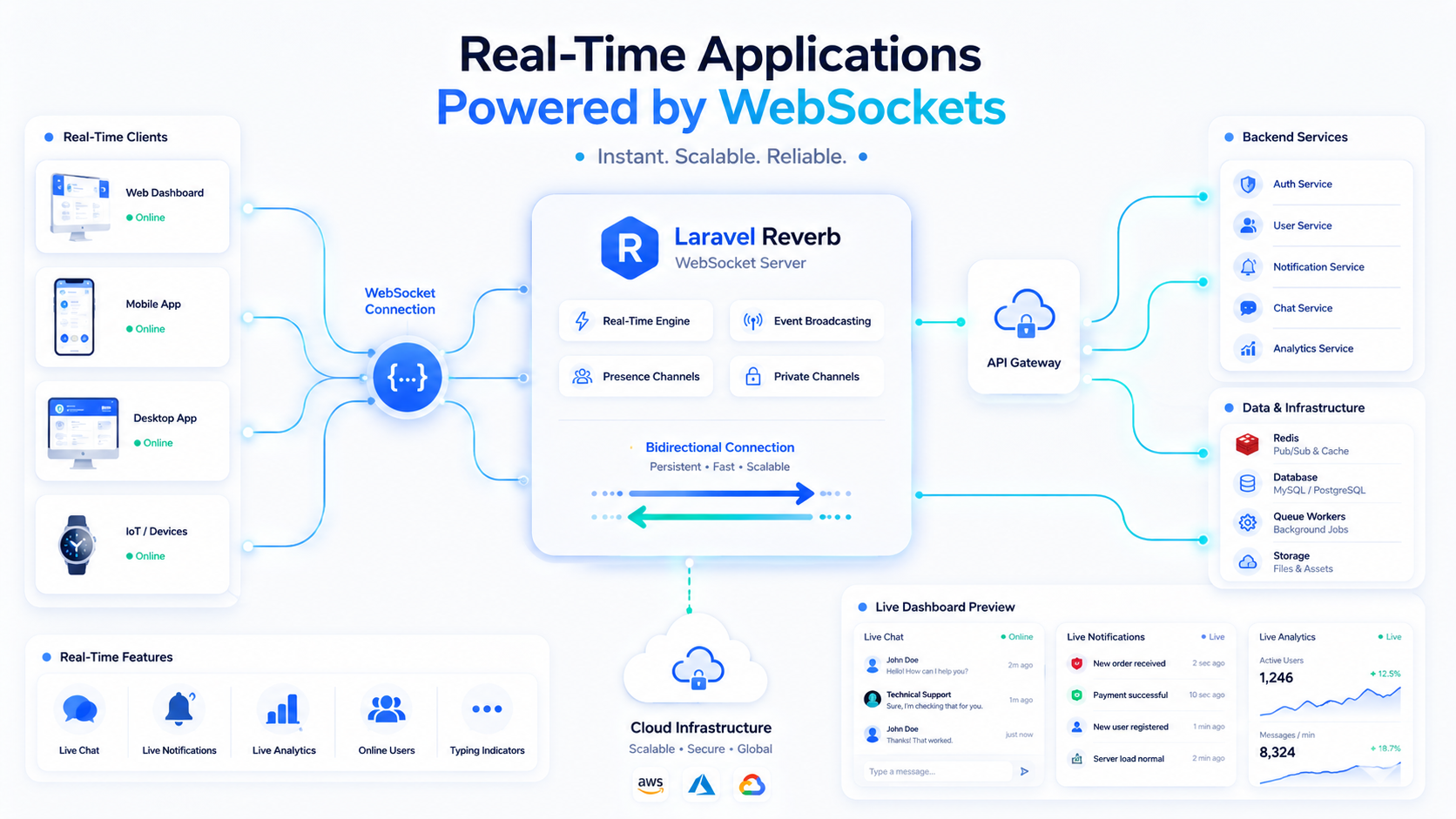
Real-time functionality has become an essential part of modern web applications. From live chat and instant notifications to collaborative workspaces, financial dashboards, delivery tracking, and online gaming, users expect updates to appear instantly without refreshing the page. Traditional HTTP communication relies on repeated requests between the client and server, which can introduce delays and unnecessary network traffic. WebSockets solve this problem by creating a persistent, two-way communication channel that enables real-time data exchange with minimal latency.
Unlike traditional request-response models, WebSockets allow servers to push updates directly to connected clients the moment new data becomes available. This approach improves application performance, enhances user experience, and reduces server overhead, making it the preferred technology for building interactive, scalable, and responsive applications. Modern frameworks such as Laravel Reverb, Socket.IO, and Pusher have also made implementing WebSockets easier than ever for developers.
In this comprehensive guide, we'll explore how WebSockets work, why they're different from HTTP, where they should be used, and how to build secure, high-performance real-time applications using Laravel and modern web technologies. Whether you're developing a SaaS platform, enterprise dashboard, chat application, or live monitoring system, this guide will help you understand when and how to leverage WebSockets effectively in 2026.
Introduction
Modern web applications are no longer expected to simply display information—they're expected to react instantly. Whether you're chatting with customer support, receiving a payment notification, tracking a food delivery, collaborating on a document, or monitoring a live analytics dashboard, users expect updates to appear immediately without manually refreshing the page.
Traditional web communication was designed around a simple request-response cycle. A browser sends a request to the server, the server processes it, and a response is returned. While this approach works well for standard websites, it becomes inefficient for applications that require continuous updates. Repeatedly sending requests to check for new data increases server load, consumes unnecessary bandwidth, and introduces delays that negatively impact user experience.
This is where WebSockets transform modern application development.
WebSockets provide a persistent, full-duplex communication channel between the client and the server. Instead of constantly asking the server if new data is available, the server can instantly push updates whenever changes occur. This enables true real-time communication with significantly lower latency and improved efficiency.
Today, WebSockets power many of the applications we use every day, including messaging platforms, collaborative editing tools, online gaming, financial trading systems, IoT dashboards, healthcare monitoring platforms, logistics tracking systems, and enterprise SaaS products. They have become one of the most important technologies for developers building modern interactive applications.
In this guide, you'll learn how WebSockets work, why they outperform traditional HTTP communication for real-time systems, how Laravel Reverb simplifies implementation, and the best practices for building secure, scalable, production-ready applications in 2026.
Why Real-Time Communication Matters
User expectations have changed dramatically over the last decade.
People no longer want to refresh a page to see new information.
Instead, they expect applications to update automatically.
Common examples include:
• Live messaging
• Team collaboration
• Stock prices
• Sports scores
• Delivery tracking
• Ride-sharing applications
• Live auctions
• Multiplayer games
• Customer support dashboards
• AI chatbot conversations
Without real-time communication, these experiences would feel slow and outdated.
Businesses also benefit from real-time systems because they improve customer engagement, reduce response times, and enable faster decision-making.
As SaaS platforms continue to evolve, real-time functionality has become a competitive advantage rather than an optional feature.
What Are WebSockets?
WebSockets are a communication protocol that enables continuous, bidirectional communication between a client and a server over a single, persistent TCP connection.
Unlike traditional HTTP requests, which open and close a connection for every interaction, WebSockets keep the connection alive after it has been established.
This allows both the client and the server to exchange information instantly whenever new data becomes available.
Instead of following a request-response model, WebSockets enable event-driven communication.
Once connected, either side can send messages at any time without waiting for another request.
This dramatically reduces latency and improves application responsiveness.
Traditional HTTP Communication
Before understanding WebSockets, it's important to understand how traditional HTTP works.
The communication flow is straightforward:
Browser
↓
Request
↓
Server
↓
Response
↓
Connection Closed
Every interaction requires opening a new connection.
Imagine a notification system that checks for updates every five seconds.
The browser repeatedly sends requests like:
"Do I have any new notifications?"
Most of the time, the answer is "No."
This results in thousands of unnecessary requests throughout the day.
While functional, this approach wastes bandwidth and increases server workload.
How WebSockets Change the Process
With WebSockets, the connection is established only once.
Browser
↓
WebSocket Handshake
↓
Persistent Connection
↓
Instant Two-Way Communication
Once connected, the server immediately sends updates whenever data changes.
There is no need for continuous polling.
The result is:
• Faster updates
• Lower latency
• Reduced bandwidth usage
• Better scalability
• Improved user experience
This is why nearly every modern real-time platform relies on WebSockets.
How a WebSocket Connection Is Established
Every WebSocket connection begins as a standard HTTP request.
The client sends a request asking the server to upgrade the connection.
If the server supports WebSockets, it accepts the upgrade.
After the handshake is complete, HTTP communication ends.
A persistent WebSocket connection is established.
From that point forward:
• The browser can send messages.
• The server can send messages.
• Both sides communicate independently.
This persistent connection remains active until either the client or server closes it.
Key Features of WebSockets
Persistent Connection
A single connection remains open for the lifetime of the session.
This eliminates repeated connection overhead.
Bidirectional Communication
Both the client and server can initiate communication at any time.
Low Latency
Messages are delivered almost instantly.
Minimal Network Overhead
Only application data is transmitted.
Repeated HTTP headers are eliminated.
Efficient Resource Usage
Servers process fewer requests while supporting more connected users.
Real-Time Event Handling
Applications react immediately when new information becomes available.
Common Real-Time Applications
WebSockets are used across many industries.
Popular use cases include:
Live Chat Applications
Users receive messages instantly without refreshing the browser.
Online Collaboration
Multiple users can edit the same document simultaneously.
Financial Trading Platforms
Stock prices update in real time.
Delivery Tracking
Customers can monitor orders as drivers move.
IoT Dashboards
Connected devices continuously transmit sensor data.
Gaming
Player actions synchronize instantly across multiple users.
Healthcare Monitoring
Patient information updates in real time for medical staff.
Customer Support Systems
Support agents receive live conversations instantly.
AI Applications
Streaming AI responses provide a more natural conversational experience.
Why HTTP Polling Is No Longer Ideal
Many older applications use polling.
The client repeatedly asks:
"Has anything changed?"
For example:
Every 3 seconds
↓
Request
↓
No Changes
↓
Wait
↓
Request Again
Even if nothing changes for hours, requests continue.
This creates unnecessary server traffic.
As applications scale to thousands of users, polling becomes increasingly inefficient.
WebSockets eliminate this problem by allowing servers to notify clients only when necessary.
Benefits of Using WebSockets
Modern development teams choose WebSockets because they provide significant technical advantages.
Major benefits include:
• Faster application responsiveness
• Reduced server load
• Lower bandwidth consumption
• Better user experience
• Efficient real-time communication
• Improved scalability
• Interactive interfaces
• Live notifications
• Streaming updates
• Reduced infrastructure costs
These advantages make WebSockets one of the core technologies behind modern SaaS products and enterprise applications.
Why Developers Love WebSockets
Developers appreciate WebSockets because they simplify the creation of interactive experiences.
Instead of building complicated polling systems, applications simply listen for incoming events.
Whenever data changes, the server broadcasts an event, and connected clients update automatically.
This event-driven architecture leads to cleaner code, better performance, and easier maintenance.
Combined with modern frameworks like Laravel Reverb, Laravel Broadcasting, Socket.IO, and Redis, implementing WebSockets has become significantly easier than it was just a few years ago.