
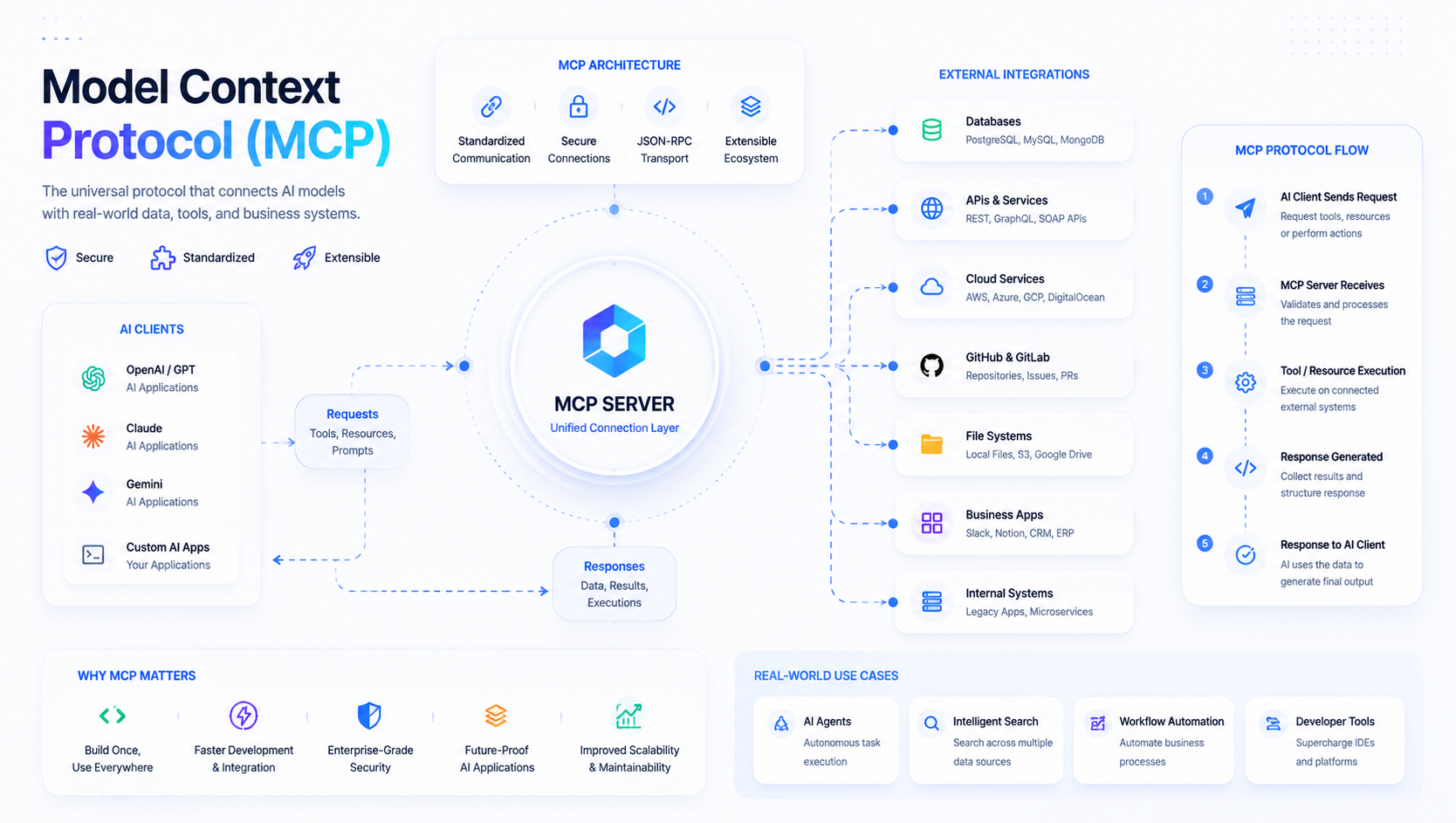
Large Language Models (LLMs) have transformed the way developers build intelligent applications, but integrating AI with external tools, databases, APIs, and business systems has often been complex and inconsistent. Most AI-powered applications require custom integrations for every service, resulting in increased development time, higher maintenance costs, and limited scalability. As AI becomes a core part of modern software, developers need a standardized way to connect AI models with real-world data and business workflows.
Model Context Protocol (MCP) is emerging as the industry standard for solving this challenge. It provides a unified protocol that enables AI models to securely communicate with external resources, tools, databases, cloud services, file systems, and enterprise applications. Instead of building separate integrations for every AI provider, developers can create MCP-compatible servers that work seamlessly across multiple AI platforms, making applications more flexible, maintainable, and future-ready.
In this complete developer guide, you'll learn what Model Context Protocol (MCP) is, how it works, why it has become an essential technology for AI agents, and how to implement it in modern applications. We'll cover MCP architecture, clients, servers, tools, resources, security best practices, real-world use cases, Laravel integration, and practical examples to help you build scalable AI-powered software in 2026.
Introduction
Artificial Intelligence has rapidly evolved from simple conversational chatbots into intelligent systems capable of performing complex tasks, analyzing business data, generating software, and assisting users with real-world decision-making. Large Language Models (LLMs) such as OpenAI GPT, Claude, and Gemini have significantly improved developer productivity, but they all share one common limitation—they cannot directly access external systems without additional integrations.
For many years, developers have relied on custom APIs, plugins, middleware, and proprietary connectors to provide AI models with access to databases, cloud storage, business applications, documentation, and enterprise tools. While these integrations work, they often require significant development effort, are difficult to maintain, and usually only support a single AI platform.
As AI applications continue to grow, developers need a standardized way for language models to communicate with external resources securely and efficiently. This is exactly the problem that Model Context Protocol (MCP) was designed to solve.
Model Context Protocol is quickly becoming one of the most important technologies in modern AI development. It introduces a universal communication standard that allows AI models to interact with tools, APIs, databases, file systems, cloud services, and business applications through a consistent interface. Instead of building custom integrations for every project, developers can build once using MCP and connect multiple AI platforms with minimal additional work.
Whether you're building AI assistants, enterprise automation systems, developer tools, customer support platforms, or intelligent SaaS products, understanding MCP has become an essential skill for software engineers in 2026.
This guide explains everything you need to know about Model Context Protocol, including its architecture, core components, implementation strategies, real-world applications, security considerations, and how it is transforming the future of AI-powered software development.
The Evolution of AI Integrations
The way AI systems connect with external applications has changed dramatically over the last few years.
Initially, most AI applications worked in isolation. Developers would send a prompt to an AI model and receive a response without any connection to business data, databases, or internal systems. While useful for content generation and simple conversations, these models lacked access to real-time information.
As businesses demanded smarter AI solutions, developers began creating custom integrations for nearly every service.
Typical AI integrations included:
• CRM systems
• Database connections
• Cloud storage
• Internal APIs
• Calendar services
• Email platforms
• GitHub repositories
• Documentation portals
• Payment gateways
• Analytics platforms
Each integration required separate authentication, API management, error handling, and maintenance. As the number of connected systems increased, applications became increasingly complex and expensive to maintain.
This fragmented approach created unnecessary development overhead and made it difficult to support multiple AI providers within the same application.
Developers needed a universal standard.
Why Traditional AI Integrations Become Difficult
Imagine building an AI assistant for a growing business.
The assistant needs access to:
• Customer information
• Product catalog
• Company documentation
• GitHub repositories
• Support tickets
• Project management tools
• Cloud storage
• Email systems
• Internal APIs
Without a standard protocol, every integration must be developed separately.
Each service requires:
• Different authentication methods
• Different API formats
• Different response structures
• Separate maintenance
• Individual security configurations
• Independent updates
As applications grow, these custom integrations become increasingly difficult to manage.
Adding support for another AI model often means rebuilding large portions of the integration layer.
This not only slows development but also increases operational costs and long-term maintenance.
What Is Model Context Protocol (MCP)?
Model Context Protocol (MCP) is an open communication standard that enables AI models to securely interact with external tools, resources, databases, APIs, and business applications through a consistent interface.
Rather than creating a unique integration for every AI model and every external service, developers can build MCP-compatible servers that expose functionality in a standardized format.
Think of MCP as a universal language that allows AI systems to understand how to access external capabilities regardless of where the data lives.
Instead of asking:
"How do I integrate OpenAI with this database?"
Developers begin asking:
"Does this system expose an MCP server?"
If the answer is yes, compatible AI applications can immediately understand how to interact with it.
This dramatically reduces integration complexity while improving portability and maintainability.
Why MCP Is Becoming So Important
The rapid growth of AI agents has created new challenges.
Modern AI systems no longer generate text alone.
They perform actions.
Examples include:
• Reading files
• Searching databases
• Creating GitHub issues
• Sending emails
• Updating CRM records
• Running SQL queries
• Managing cloud resources
• Scheduling meetings
• Generating reports
• Executing business workflows
Every new capability previously required a custom connector.
MCP replaces this fragmented ecosystem with a standardized communication layer.
This allows developers to spend less time building integrations and more time creating valuable AI experiences.
Core Components of Model Context Protocol
Model Context Protocol is built around several key components that work together to enable secure communication between AI models and external systems.
The primary components include:
MCP Client
The client is the AI application that requests information or performs actions through the protocol.
Examples include:
• Claude Desktop
• Cursor IDE
• AI Coding Assistants
• Enterprise AI Platforms
• Custom Chat Applications
MCP Server
The server exposes tools, resources, and functionality that AI models can access.
An MCP server may provide access to:
• Databases
• APIs
• Documents
• Cloud Storage
• GitHub
• Local File Systems
• Business Applications
Resources
Resources represent information that AI models can read and understand.
Examples include:
• Documentation
• Configuration Files
• Company Policies
• Knowledge Bases
• Database Records
• Markdown Files
Tools
Tools allow AI models to perform actions instead of simply reading information.
Examples include:
• Execute SQL Queries
• Send Emails
• Create Calendar Events
• Deploy Applications
• Update CRM Records
• Generate Reports
• Call External APIs
Prompts
Prompts define reusable instructions that guide AI behavior while interacting with connected systems.
This separation of responsibilities creates a flexible and scalable architecture that works across multiple AI platforms.
How Model Context Protocol Works
At a high level, the communication process is straightforward.
1. A user asks an AI assistant to complete a task.
2. The AI determines whether external information or actions are required.
3. The AI communicates with an MCP server.
4. The MCP server exposes available tools and resources.
5. The AI selects the appropriate tool.
6. The requested operation is executed securely.
7. The response is returned to the AI.
8. The AI generates a natural language response for the user.
This workflow allows AI systems to move beyond static conversations and become intelligent assistants capable of interacting with real-world applications.
Instead of simply answering questions, AI can actively retrieve information, automate workflows, update business systems, and perform meaningful tasks while maintaining a secure and standardized communication model.