
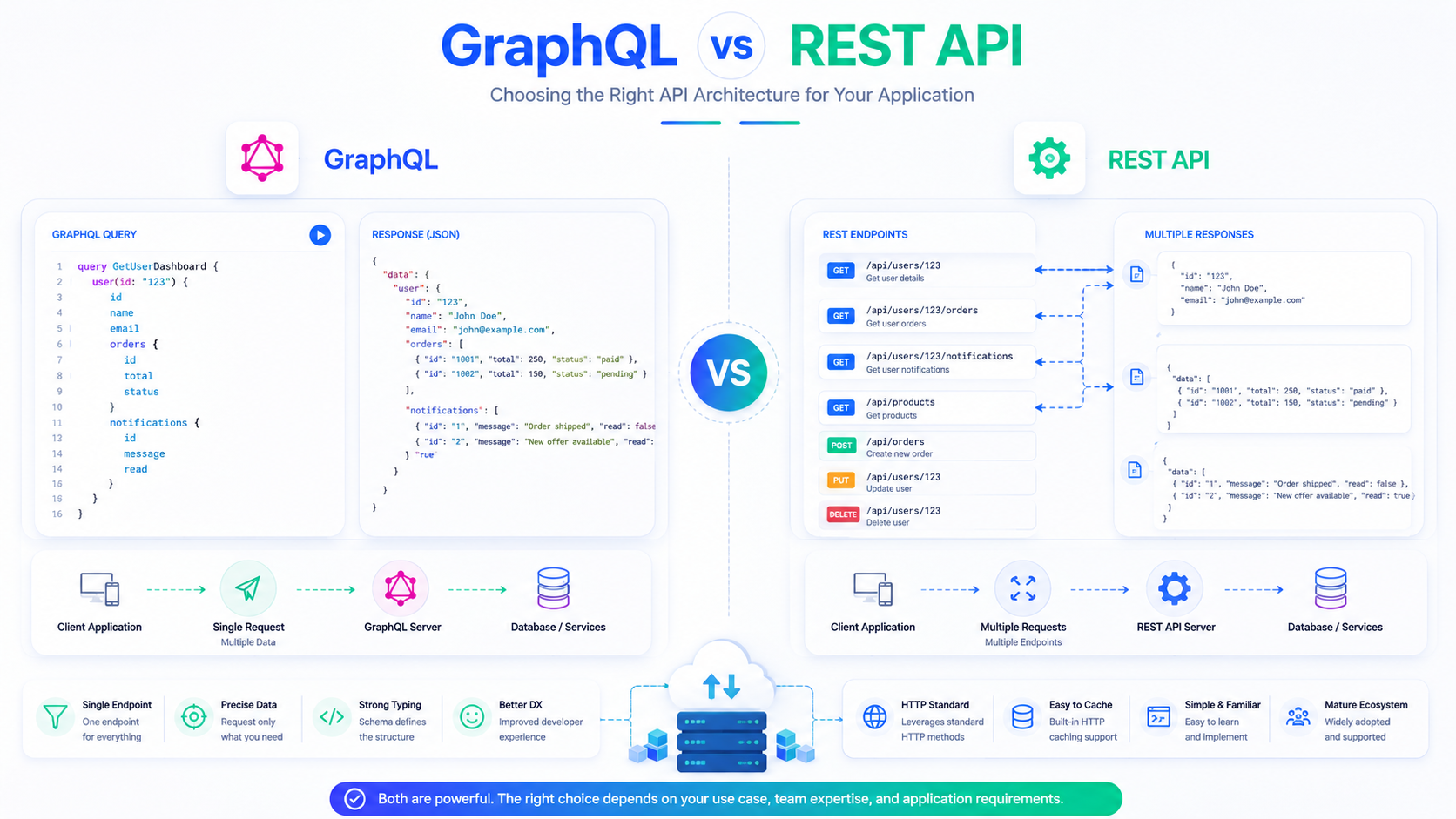
APIs are the backbone of modern web and mobile applications, enabling seamless communication between frontend interfaces, backend services, third-party platforms, and cloud infrastructure. For years, REST has been the industry standard for API development, powering everything from eCommerce platforms and SaaS products to enterprise software and mobile applications. However, GraphQL has emerged as a powerful alternative, offering more flexible data fetching, improved performance, and a better developer experience for complex applications.
Choosing between GraphQL and REST isn't about deciding which technology is universally better—it's about understanding which architecture best fits your project's requirements. Factors such as scalability, client-side performance, caching, security, development speed, and maintenance all influence the right choice. While REST continues to be a reliable solution for many applications, GraphQL is increasingly being adopted for data-intensive platforms that require greater flexibility and efficiency.
In this comprehensive guide, we'll compare GraphQL and REST API from every angle, including their architecture, request and response models, performance, security, caching strategies, Laravel integration, real-world use cases, advantages, limitations, and best practices. By the end, you'll have a clear understanding of which API architecture is the right choice for your next web, mobile, or SaaS application in 2026.
Introduction
APIs have become the backbone of modern software development. Whether you're building a web application, mobile app, SaaS platform, enterprise solution, or AI-powered product, APIs enable different systems to communicate seamlessly. They connect frontends with backends, integrate third-party services, exchange data between applications, and power millions of digital experiences every day.
For nearly two decades, REST (Representational State Transfer) has been the dominant architecture for building web APIs. Its simplicity, scalability, and compatibility with HTTP made it the preferred choice for developers and organizations worldwide. Today, thousands of applications, including social media platforms, banking systems, healthcare applications, and eCommerce websites, continue to rely on REST APIs.
As applications became more complex, however, developers began facing new challenges. Mobile applications required multiple API requests to display a single screen. Frontend developers often received either too much unnecessary data or too little information, forcing them to make additional requests. These limitations led to increased network traffic, slower performance, and more complicated frontend logic.
To solve these challenges, GraphQL was introduced as a modern query language for APIs. Instead of relying on multiple endpoints, GraphQL allows clients to request exactly the data they need through a single endpoint. This gives frontend developers greater flexibility while reducing unnecessary network requests and improving application performance.
Today, both REST and GraphQL are widely used across modern software development. Rather than competing technologies, they are different architectural approaches designed to solve different types of problems. Understanding their strengths, weaknesses, and ideal use cases is essential for choosing the right solution for your next project.
In this guide, we'll compare GraphQL and REST API from a practical developer's perspective, covering architecture, performance, security, scalability, Laravel integration, real-world use cases, and best practices for building modern applications in 2026.
Why API Architecture Matters
Choosing an API architecture is one of the most important technical decisions during application development.
Your API directly impacts:
• Application performance
• Development speed
• Scalability
• Security
• Maintenance
• Developer productivity
• Mobile application efficiency
• Third-party integrations
• Future feature development
Selecting the wrong architecture can increase development costs and make scaling more difficult as your application grows.
On the other hand, choosing the right API design creates a flexible foundation that supports future enhancements without major rewrites.
For startups, selecting the appropriate API architecture can significantly reduce development time and infrastructure costs.
For enterprises, it ensures long-term maintainability and supports large-scale distributed systems.
What Is REST API?
REST, which stands for Representational State Transfer, is an architectural style introduced by Roy Fielding in 2000.
REST APIs organize application resources into URLs known as endpoints.
Each endpoint represents a specific resource.
Examples include:
• /users
• /products
• /orders
• /customers
• /payments
Applications communicate with these endpoints using standard HTTP methods.
GET
Retrieve information.
POST
Create new data.
PUT
Update existing records.
PATCH
Modify specific fields.
DELETE
Remove resources.
REST APIs typically exchange data using JSON, making them easy to integrate with virtually every programming language and platform.
One of REST's greatest strengths is its simplicity.
Developers already understand HTTP, making REST APIs easy to learn, document, and maintain.
This simplicity is one reason REST remains the industry standard for thousands of web services.
Key Characteristics of REST APIs
REST follows several architectural principles.
Stateless Communication
Every request contains all information required to complete the operation.
The server does not store client session information between requests.
Client-Server Architecture
Frontend and backend remain independent.
This separation allows both systems to evolve independently.
Resource-Based Design
Everything is treated as a resource.
Examples include:
• Users
• Orders
• Products
• Categories
• Invoices
• Messages
Standard HTTP Methods
REST relies on HTTP verbs that developers already understand.
Cache Support
Responses can be cached by browsers, CDNs, and reverse proxies, significantly improving application performance.
Uniform Interface
Consistent endpoint naming makes APIs easier to understand and maintain.
What Is GraphQL?
GraphQL is a query language and runtime for APIs originally developed by Facebook and later released as an open-source technology.
Unlike REST, GraphQL exposes a single endpoint through which clients can request exactly the information they need.
Instead of receiving fixed responses from multiple endpoints, clients define their own data requirements.
For example, a frontend application may request:
• User profile
• Recent orders
• Notifications
• Wishlist
• Shopping cart
• Account settings
—all within a single request.
This flexibility dramatically reduces unnecessary data transfer while simplifying frontend development.
GraphQL is especially valuable for applications with complex user interfaces where different screens require different combinations of data.
How GraphQL Works
GraphQL revolves around schemas.
A schema defines:
• Data types
• Relationships
• Queries
• Mutations
• Subscriptions
When a client sends a request, it specifies exactly which fields should be returned.
The server processes the request and returns only those fields.
This eliminates both over-fetching and under-fetching of data.
Developers gain complete control over API responses without creating additional endpoints.
REST vs GraphQL Philosophy
Although both technologies serve the same purpose, their design philosophies are fundamentally different.
REST focuses on resources.
GraphQL focuses on data requirements.
REST asks:
"Which resource do you need?"
GraphQL asks:
"What information do you need?"
This difference influences every aspect of API design.
REST organizes applications around endpoints.
GraphQL organizes applications around schemas.
REST generally requires multiple requests for related information.
GraphQL can retrieve everything in one request.
Neither approach is universally better.
Each excels in different scenarios depending on application complexity, performance requirements, and team expertise.
When REST Is the Better Choice
REST remains an excellent solution for many projects.
It works particularly well for:
• CRUD applications
• Public APIs
• Banking systems
• Payment gateways
• Content Management Systems
• Government portals
• Healthcare systems
• Enterprise integrations
• Traditional web applications
REST also benefits from extensive documentation, mature tooling, widespread adoption, and excellent caching support.
For many business applications, REST continues to provide a reliable, scalable, and maintainable architecture.
When GraphQL Excels
GraphQL shines in applications requiring flexible and dynamic data retrieval.
Examples include:
• Social media platforms
• SaaS dashboards
• Mobile applications
• Real-time analytics
• AI-powered applications
• E-commerce platforms
• Project management systems
• Customer portals
• Enterprise dashboards
GraphQL reduces network requests while giving frontend developers complete control over the data returned by the server.
This often results in improved application performance and a better user experience, especially on mobile networks.