
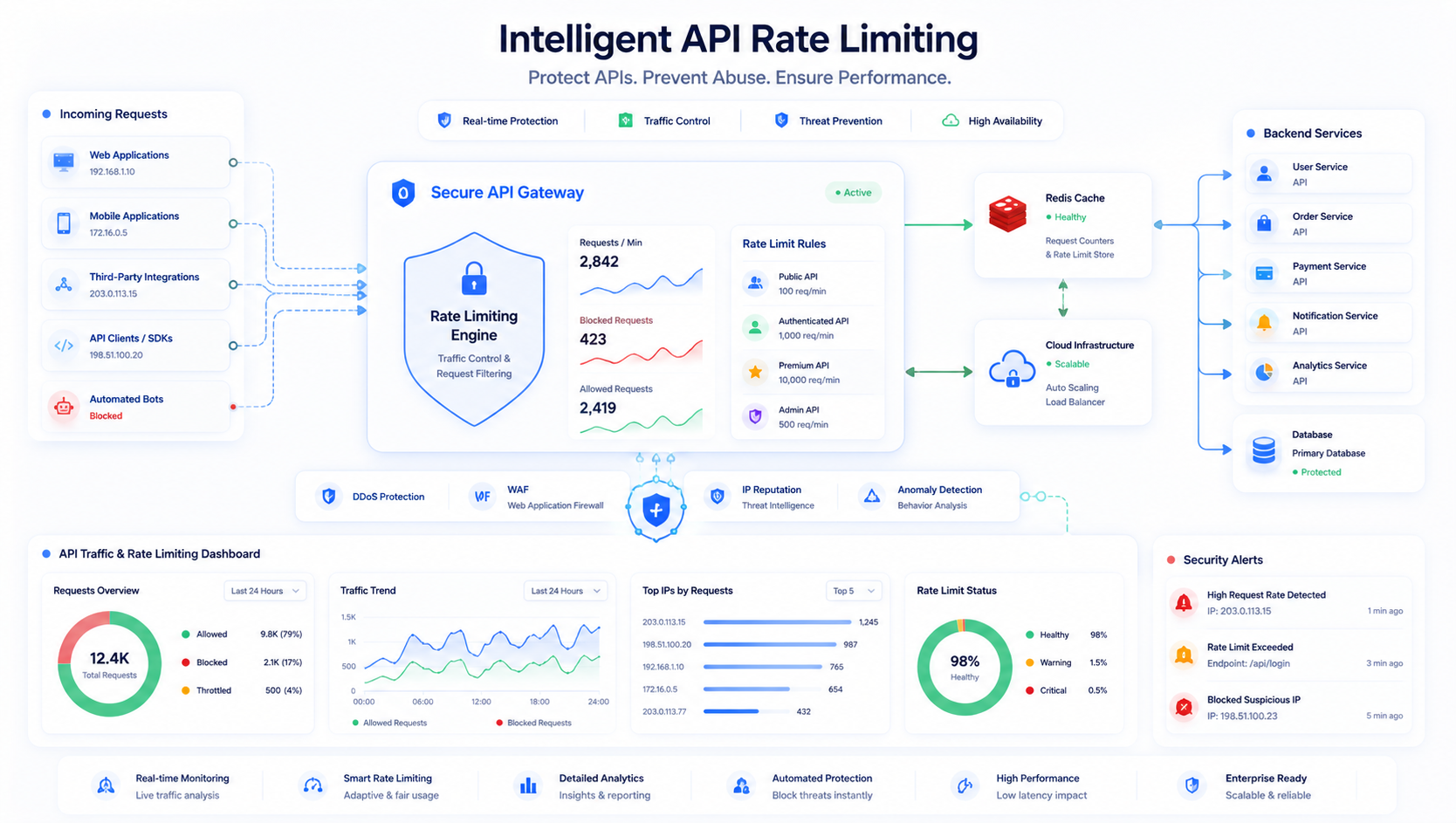
Modern applications rely on APIs to power everything from mobile apps and SaaS platforms to AI services, payment gateways, and third-party integrations. As API traffic continues to grow, protecting backend services from excessive requests, malicious bots, and abusive clients has become a critical responsibility for every development team. Without proper safeguards, APIs can quickly become vulnerable to performance degradation, unexpected downtime, brute-force attacks, and unnecessary infrastructure costs.
API rate limiting is one of the most effective techniques for maintaining application stability and security. By controlling how many requests a client can make within a defined time period, developers can prevent abuse, ensure fair resource usage, and deliver a consistent experience for legitimate users. Modern frameworks like Laravel, API gateways, Redis, and cloud platforms provide powerful tools for implementing flexible and scalable rate limiting strategies that protect applications without impacting normal users.
In this comprehensive guide, we'll explore what API rate limiting is, why it's essential for modern web applications, the most widely used rate limiting algorithms, Laravel implementation strategies, Redis-powered throttling, API gateway integration, security best practices, monitoring techniques, and practical recommendations for building secure, scalable, and production-ready APIs in 2026.
Introduction
APIs have become the foundation of modern software development. Whether you're building a SaaS platform, mobile application, eCommerce solution, AI-powered service, fintech product, or enterprise software, APIs enable different systems to communicate efficiently and exchange data in real time. Almost every digital product today depends on APIs to connect users, applications, third-party services, payment gateways, cloud platforms, and business tools.
As applications continue to grow, APIs receive thousands—or even millions—of requests every day. While this growth is a sign of success, it also introduces new security and performance challenges. Not every request comes from a legitimate user. Automated bots, malicious attackers, poorly configured applications, and abusive clients can overwhelm your backend services if proper safeguards are not in place.
One of the most effective ways to protect an API is through rate limiting.
API rate limiting controls how many requests a client can make within a specific time period. Instead of allowing unlimited access, the server enforces predefined limits to ensure fair usage, maintain performance, and protect infrastructure from abuse. It is one of the simplest yet most powerful security mechanisms available for modern applications.
Today, nearly every major technology platform—including GitHub, Stripe, OpenAI, Google Cloud, AWS, Shopify, and countless SaaS providers—implements rate limiting to ensure service reliability and prevent misuse.
In this guide, you'll learn how API rate limiting works, why it's essential, the most common algorithms, implementation strategies, Laravel integration, Redis-powered throttling, API gateway configuration, monitoring techniques, and best practices for building secure, scalable APIs in 2026.
Why APIs Need Protection
APIs are publicly accessible entry points into your application.
Every request consumes server resources such as:
• CPU
• Memory
• Database queries
• Network bandwidth
• Cache operations
• Queue workers
• External API calls
Without any restrictions, a single client could continuously send requests until the server becomes overloaded.
This may lead to:
• Slow response times
• Increased infrastructure costs
• Database bottlenecks
• Application downtime
• Service interruptions
• Poor user experience
Even if the requests are not malicious, an unexpected traffic spike can negatively affect every legitimate user.
Rate limiting prevents these situations by ensuring that no individual client can consume an unfair amount of resources.
What Is API Rate Limiting?
API rate limiting is a mechanism that restricts the number of requests a client can send to an API during a defined period of time.
For example:
100 requests per minute
500 requests per hour
10,000 requests per day
If the client exceeds the configured limit, the server temporarily blocks additional requests until the time window resets.
Instead of processing unlimited traffic, the API responds with an HTTP status code indicating that the request limit has been exceeded.
The most common response is:
HTTP 429
Too Many Requests
This tells the client that they should wait before making additional requests.
Many APIs also include helpful response headers showing:
• Remaining requests
• Maximum request limit
• Reset time
These headers help developers build applications that respect rate limits automatically.
How Rate Limiting Works
The basic workflow is simple.
Client
↓
API Request
↓
Rate Limiting Middleware
↓
Request Counter
↓
Within Limit?
↓
Yes → Continue
↓
No → Return HTTP 429
The server tracks how many requests each client has made during a defined period.
Clients may be identified using:
• IP Address
• User ID
• API Key
• OAuth Token
• JWT Token
• Session ID
Each request increments the counter.
If the counter exceeds the configured limit, additional requests are rejected until the timer resets.
Benefits of API Rate Limiting
Implementing rate limiting provides numerous advantages for modern applications.
Improved Security
Rate limiting helps reduce the effectiveness of automated attacks.
Fair Resource Allocation
Every client receives a reasonable share of server resources.
Lower Infrastructure Costs
Unnecessary requests are blocked before consuming expensive backend services.
Improved Performance
Servers remain responsive even during periods of high traffic.
Protection Against Abuse
Bots and malicious clients cannot overwhelm your application.
Better User Experience
Legitimate users experience faster and more reliable APIs.
Compliance With Third-Party Services
Many external APIs enforce request quotas.
Internal rate limiting helps prevent exceeding those limits.
Common Threats That Rate Limiting Prevents
Brute Force Attacks
Attackers repeatedly attempt different username and password combinations.
Without rate limiting, thousands of login attempts may occur within minutes.
Rate limiting significantly slows these attacks.
Credential Stuffing
Attackers use leaked credentials from other websites to access user accounts.
Limiting authentication requests reduces the likelihood of successful attacks.
API Scraping
Competitors or bots continuously extract product information, pricing, or business data.
Request limits make large-scale scraping much more difficult.
Denial-of-Service Attempts
Repeated requests consume server resources and reduce application availability.
Although rate limiting does not replace DDoS protection, it helps reduce many smaller attacks.
Spam Requests
Public APIs often receive excessive automated requests.
Rate limiting filters abusive traffic before it reaches business logic.
Real-World Examples
Almost every technology company implements rate limiting.
GitHub
Limits API requests based on authentication status.
Stripe
Protects payment APIs from abuse while maintaining high availability.
OpenAI
Uses request limits based on subscription plans and API usage.
Google Maps
Applies quotas to prevent excessive map requests.
Cloudflare
Offers advanced rate limiting at the edge before traffic reaches your server.
AWS API Gateway
Allows developers to configure request throttling for every API endpoint.
These examples demonstrate that rate limiting is considered a standard best practice rather than an optional feature.
Choosing the Right Rate Limits
Different APIs require different request limits.
Public APIs
Typically use lower limits.
Example:
100 requests per minute.
Authenticated Users
Can receive higher limits.
Premium Customers
Often receive significantly larger request quotas.
Internal APIs
May not require strict limits if protected behind authentication.
Administrative APIs
Should implement aggressive rate limiting because of their elevated permissions.
Rather than using identical limits everywhere, successful applications apply different policies based on user roles and business requirements.
Where Should Rate Limiting Be Applied?
Modern applications often enforce rate limiting at multiple layers.
Application Layer
Frameworks like Laravel apply middleware before executing business logic.
API Gateway
Gateways such as Kong, NGINX, AWS API Gateway, or Cloudflare reject excessive traffic before it reaches the application.
Authentication Layer
Login, registration, password reset, and OTP verification endpoints should always include stricter limits.
Third-Party Integrations
Applications should also limit outbound requests to external APIs to avoid exceeding provider quotas.
Using multiple layers provides stronger protection and improves overall application resilience.
Why Every Modern API Should Use Rate Limiting
As applications become more connected, APIs face increasing traffic from users, mobile devices, automated systems, AI agents, and third-party integrations.
Without proper request controls, even a small bug or malicious script can overwhelm backend services.
Rate limiting provides a simple yet highly effective safeguard that protects infrastructure, improves stability, reduces operational costs, and ensures every user receives a consistent experience.
Whether you're building a Laravel application, enterprise API platform, SaaS product, or AI-powered service, implementing well-designed rate limiting should be considered a fundamental part of your API architecture rather than an afterthought.