
The Slack message every SaaS founder dreads arrived for one of our clients last quarter: "Our AWS bill jumped to $14,200 this month. Up from $9,800 last month. Same traffic."
This isn't unusual. It's the defining infrastructure story of 2026. SaaS founders are reopening cloud decisions made years ago — and many are discovering they're paying 5–10x more than they need to. The big three hyperscalers (AWS, Azure, GCP) built their pricing around enterprise willingness-to-pay. For a 30-person SaaS startup with predictable workloads, that pricing structure is hostile to your unit economics.
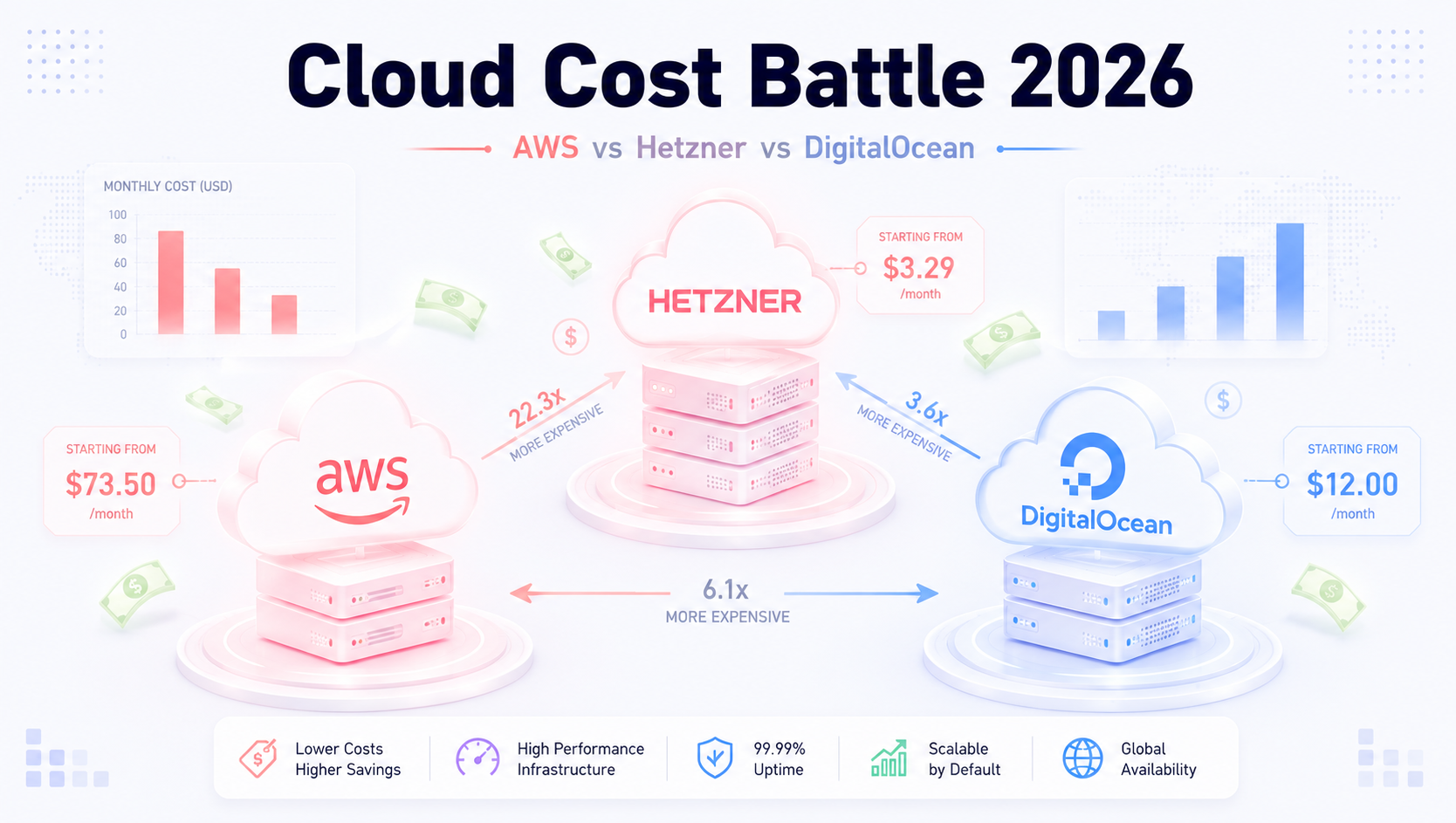
In 2026, there are three cloud providers most SaaS startups seriously evaluate: AWS (the default), Hetzner (the price disruptor), and DigitalOcean (the developer-friendly middle ground). This guide walks through real costs, real tradeoffs, real production stories — and the decision framework we use with every founder.
The Cloud Cost Crisis Hitting SaaS Startups in 2026
A few forces converged this year to make cloud costs unbearable for startups on hyperscalers:
- AI workloads exploded budgets. GPU instances and managed AI services on AWS cost 3–10x what equivalent compute costs elsewhere
- Egress fees stayed extortionate. AWS still charges $0.09/GB out — devastating for media-heavy SaaS
- Managed service multipliers compounded. RDS, ElastiCache, SQS, OpenSearch — each adds a 2–4x premium over self-managed equivalents
- VC-subsidized free credits expired. Many startups burned through AWS Activate credits and faced full pricing reality
- Hetzner expanded aggressively. New data centers in the US (Ashburn, Hillsboro) joined existing EU and Singapore footprints, finally making Hetzner viable for global SaaS
- Bare-metal economics crushed virtualization. Dedicated servers at Hetzner deliver 5–10x the performance-per-dollar of comparable cloud instances
The result: a generation of SaaS startups questioning whether the hyperscaler premium is worth what it once was.
The Three Providers in Plain Language
Amazon Web Services (AWS) — The market leader. ~200 services, every conceivable capability, dominant in enterprise. Sophisticated, comprehensive, expensive. Hosts most SaaS that's later acquired or went public.
Hetzner — German bare-metal and cloud provider. Famous for absurdly low pricing — dedicated servers at fractions of AWS pricing. Smaller service catalog but covers 90% of what SaaS actually needs. Recently expanded into US data centers.
DigitalOcean — Developer-friendly mid-tier. Cleaner UX than AWS, broader managed services than Hetzner, predictable pricing. Strong on Kubernetes (DOKS), databases, and one-click apps.
These aren't the only options. Linode (Akamai), Vultr, Scaleway, OVHcloud, Fly.io, and Railway all compete in this space. But these three dominate SaaS founder decisions in 2026.
Head-to-Head Comparison
| Dimension | AWS | Hetzner | DigitalOcean |
|---|---|---|---|
| Hosting model | Hyperscaler cloud | Cloud + bare-metal | Mid-tier cloud |
| Service breadth | ~200+ services | ~15 core services | ~30 services |
| Pricing model | Pay-per-use, complex | Flat monthly, transparent | Flat monthly, transparent |
| Compute (4 vCPU, 16GB RAM) | ~$120/mo (t3.xlarge) | ~$30/mo (CCX23) | ~$84/mo (Premium Intel) |
| Managed Postgres (medium) | ~$140–250/mo (RDS) | ~$45/mo | ~$60/mo |
| Egress fees | $0.09/GB | First 20TB free per server | $0.01/GB after free tier |
| Global regions | 30+ | 5 (EU, US, SG) | 14 |
| Edge/CDN | CloudFront | None native | Spaces CDN |
| Kubernetes | EKS ($73/mo + nodes) | None managed | DOKS (free control plane) |
| Serverless | Lambda, App Runner, Fargate | None | App Platform |
| AI/ML services | Bedrock, SageMaker, etc. | None | GenAI Platform (newer) |
| Enterprise compliance | SOC2, ISO27001, HIPAA, FedRAMP, PCI | SOC2, ISO27001 | SOC2, HIPAA, PCI |
| Support quality | Tiered (paid tiers excellent) | Email-based, capable | Strong for SMB |
| Learning curve | Very steep | Low | Low |
| Best for | Enterprise SaaS, complex needs | Budget-conscious scale | Developer-friendly SMB SaaS |
Real Cost Snapshots Across SaaS Stages
Let's model a typical Laravel SaaS at three growth stages. These are ballpark figures — your mileage will vary, but the ratios are consistent across most production deployments.
Stage 1: MVP / Early Stage (10–500 users)
Infrastructure needs: 1 app server, 1 small database, basic object storage, CDN
| Provider | Estimated Monthly Cost |
|---|---|
| AWS (t3.medium + RDS db.t3.small + S3 + CloudFront) | $180–280 |
| Hetzner (CX22 + managed DB + Object Storage) | $20–40 |
| DigitalOcean (Basic Droplet + Managed DB + Spaces) | $45–75 |
Verdict: Hetzner or DigitalOcean. AWS at this stage is paying for capability you don't yet need.
Stage 2: Growth Stage (500–10,000 users)
Infrastructure needs: 2–3 app servers + load balancer, primary DB + read replica, Redis cache, queue workers, object storage, CDN, monitoring
| Provider | Estimated Monthly Cost |
|---|---|
| AWS (multiple EC2 + RDS Multi-AZ + ElastiCache + S3 + CloudFront + observability) | $1,800–3,500 |
| Hetzner (3x CCX23 dedicated + managed DB + self-hosted Redis + Object Storage + Cloudflare CDN) | $200–400 |
| DigitalOcean (3x Premium Droplets + Managed DB Cluster + Managed Redis + Spaces + monitoring) | $450–850 |
Verdict: This is where the conversation gets serious. Hetzner saves $15K–35K/year. DigitalOcean strikes a balance between cost and operational simplicity.
Stage 3: Scale Stage (10,000–100,000 users)
Infrastructure needs: Auto-scaling app fleet, primary DB cluster with multiple replicas, distributed caching, multiple regions, advanced monitoring, log aggregation, AI/embeddings workloads
| Provider | Estimated Monthly Cost |
|---|---|
| AWS (auto-scaling EC2/Fargate + RDS Aurora + ElastiCache cluster + S3 + CloudFront + observability + AI services) | $12,000–35,000 |
| Hetzner (dedicated server fleet + clustered managed DB + self-hosted Redis cluster + Object Storage + Cloudflare CDN + self-hosted observability) | $1,200–4,500 |
| DigitalOcean (Droplet fleet + DB cluster + Managed Kafka + Spaces + observability) | $3,500–10,000 |
Verdict: At this scale, the cost delta becomes a strategic decision. AWS premium can be justified for unique features (Aurora, deep AI integration, global edge). Hetzner economics become irresistible for teams with DevOps maturity. DigitalOcean stays competitive for teams that want managed services without AWS's complexity.
Beyond Cost: What Each Provider Actually Gets Right
What AWS Wins On
- Service breadth. Need niche compliance, edge ML, IoT, satellite communications? AWS has it
- Global presence. 30+ regions with deep capabilities in each
- Enterprise procurement comfort. "We're on AWS" closes deals nobody admits
- Acquisition optionality. Acquirers prefer targets on AWS — easier integration
- Aurora and DynamoDB. Genuinely best-in-class managed databases for specific workloads
- Bedrock and AI ecosystem. Native integration with multiple foundation models in one bill
- IAM granularity. Permission systems that scale to enterprise complexity
- SOC2/HIPAA/FedRAMP. Compliance shortcuts that matter when selling to regulated industries
What Hetzner Wins On
- Raw price-performance. Often 5–10x cheaper for equivalent compute
- Bare-metal access. Dedicated CPUs that don't share with noisy neighbors
- Bandwidth. 20TB free egress per server — game-changing for media-heavy SaaS
- Transparent pricing. No surprise bills, no hidden fees, no egress shock
- EU data residency. Default European hosting with strong GDPR posture
- Stability. Boring, reliable, no constant API changes
- Quality hardware. Modern EPYC and Xeon CPUs in standard offerings
What DigitalOcean Wins On
- Developer experience. Clean UI, sensible defaults, fast learning curve
- Predictable pricing. Flat monthly costs without invoice surprises
- DOKS (Kubernetes). Free control plane, simpler than EKS
- One-click apps. Pre-configured Laravel, WordPress, Node.js setups
- App Platform. Heroku-style PaaS for teams without DevOps
- Documentation. Genuinely excellent tutorials and runbooks
- GenAI Platform. New managed AI agent service competitive for early-stage AI builders
- Community. Active forum, responsive support, founder-friendly culture
The Honest Decision Framework
Use this practical decision tree:
Choose AWS if:
- You sell to large enterprises that ask "are you on AWS?"
- You need features no one else has (Aurora, Bedrock, SageMaker, FedRAMP)
- You have $50K+/year to spend on infrastructure
- Your team has at least one experienced AWS engineer
- You're optimizing for acquisition optionality
- You have unpredictable, spiky workloads that benefit from auto-scaling
- Compliance requirements (HIPAA, FedRAMP) demand AWS-specific certifications
Choose Hetzner if:
- You're cost-conscious and DevOps-capable
- Your workload is steady-state (not extremely spiky)
- Most of your users are in EU, US East, or Singapore regions
- You're comfortable running your own Redis, queue workers, observability
- You value bare-metal performance
- You generate significant egress traffic (media, downloads)
- You're scaling but not yet at the "we need 20 regions" stage
Choose DigitalOcean if:
- You want simplicity without AWS-tier costs
- You want managed services without managing them deeply
- Your team is small and pragmatic
- You need Kubernetes without EKS complexity
- You're shipping a SaaS MVP that needs to look polished
- You want a single bill with predictable cost growth
- You're prototyping AI features and want GenAI Platform's quick-start
The most underrated answer: you don't have to pick one forever. Many production SaaS in 2026 run hybrid setups — Hetzner for compute, AWS for specific managed services, Cloudflare for edge/CDN. We'll cover that pattern shortly.
Step-by-Step: Deploying a Laravel SaaS on Each Provider
Option A: AWS Production Stack
Architecture:
- EC2 Auto Scaling Group (Application servers running Laravel + Octane)
- RDS PostgreSQL Multi-AZ
- ElastiCache Redis
- S3 + CloudFront
- SQS for queues
- ALB (load balancer)
- CloudWatch + AWS X-Ray for observability
Deployment approach: Laravel Vapor (serverless) for hands-off ops, or Forge + manual EC2 setup for control.
Time to production: 1–2 weeks if AWS-experienced, 4–6 weeks otherwise.
Option B: Hetzner Production Stack
Architecture:
- 2–3 Hetzner CCX dedicated cloud servers (Laravel + Octane + Nginx)
- Hetzner Managed Database for PostgreSQL OR self-managed Postgres on dedicated server
- Self-hosted Redis on dedicated server (or Upstash for managed)
- Hetzner Object Storage (S3-compatible)
- Cloudflare in front for CDN + DDoS + edge
- Self-hosted Grafana + Prometheus, or Better Stack for observability
Deployment approach: Laravel Forge supports Hetzner natively, or Ansible/Pulumi for infrastructure-as-code.
Time to production: 1–2 weeks for typical SaaS.
# Sample Nginx config for Laravel on Hetzner
server {
    listen 443 ssl http2;
    server_name yoursaas.com;

    root /var/www/yoursaas/public;
    index index.php;

    ssl_certificate /etc/letsencrypt/live/yoursaas.com/fullchain.pem;
    ssl_certificate_key /etc/letsencrypt/live/yoursaas.com/privkey.pem;

    location / {
        try_files $uri $uri/ /index.php?$query_string;
    }

    location ~ \.php$ {
        fastcgi_pass unix:/run/php/php8.3-fpm.sock;
        fastcgi_index index.php;
        include fastcgi_params;
        fastcgi_param SCRIPT_FILENAME $document_root$fastcgi_script_name;
    }
}
Option C: DigitalOcean Production Stack
Architecture:
- 2–3 Premium Droplets behind DO Load Balancer
- Managed PostgreSQL Database Cluster
- Managed Redis
- DO Spaces (S3-compatible) + CDN
- App Platform for staging environments
- DO Monitoring + integrations to Grafana Cloud or Better Stack
Deployment approach: Laravel Forge, or DO App Platform for serverless deploys.
Time to production: 3–7 days for typical SaaS.
# Sample doctl deployment config
name: yoursaas
region: nyc1
services:
  - name: web
    github:
      branch: main
      repo: yourorg/yoursaas
    build_command: composer install --no-dev && npm run build
    run_command: php artisan octane:start --host=0.0.0.0 --port=8080
    instance_size_slug: professional-xs
    instance_count: 2
    envs:
      - key: APP_ENV
        value: production
databases:
  - name: db
    engine: PG
    production: true
Real Business Examples
Case 1 — A B2B project management SaaS: Migrated from AWS to Hetzner over 6 weeks. Pre-migration: $4,800/month AWS bill. Post-migration: $580/month Hetzner + Cloudflare. Annual savings: $50,640. Used the savings to hire a part-time DevOps contractor and still came out massively ahead.
Case 2 — An AI-powered analytics startup: Stayed on AWS specifically for Bedrock and Aurora. Cost is high ($18,000/month at growth stage) but justified by faster feature shipping and enterprise contracts that wouldn't have closed on smaller providers. ROI positive on the AWS premium.
Case 3 — A creator-economy SaaS: Went with DigitalOcean from MVP through Series A. At $2,400/month with 8,000 paying users, the team values operational simplicity over cost squeeze. Their engineering team is 5 people; one weekend lost to infrastructure debugging is worth more than $5K/month in saved hosting.
Case 4 — A media-heavy SaaS (video transcripts): Moved from AWS to Hetzner specifically for egress. AWS bandwidth bill alone was $7,200/month. Hetzner included egress saved them $86K/year. Compute migration was secondary — the egress alone justified the move.
The pattern: match the provider to your bottleneck. Egress-bound? Hetzner. Compliance-bound? AWS. Operationally simple-bound? DigitalOcean.
The Hybrid Pattern: Best-of-Three Architectures
Many SaaS in 2026 don't pick one provider — they assemble a stack across multiple. Common patterns:
Compute on Hetzner + CDN on Cloudflare + Email on Resend/Postmark: The "frugal European stack." Low cost, high performance, simple operations.
App on DigitalOcean + AI on AWS Bedrock: Simple base infrastructure with deep AI integration only where needed.
App on Hetzner + Database on Neon/Supabase + Vector on Pinecone: Modern serverless data layer with cheap dedicated compute.
App on AWS + Edge on Cloudflare Workers + AI on Anthropic API direct: Enterprise-credible AWS backend with edge-layer performance and decoupled AI economics.
The key: don't conflate provider with category. You can buy your databases from one vendor, your compute from another, your CDN from a third. The teams that do this best typically save 40–70% versus a single-provider deployment without sacrificing capability.
Best Practices for Cloud Infrastructure in 2026
- Audit your bill quarterly. Cloud costs drift upward silently. Make someone responsible for cost review
- Tag everything. Per-service, per-feature, per-tenant tagging is essential for attribution
- Use reserved/committed pricing strategically. AWS Savings Plans and Hetzner annual commits cut costs 30–60% for steady workloads
- Avoid managed services you don't need. Self-managed Redis on a dedicated server is sometimes the right call
- Centralize observability. Don't pay for CloudWatch + Datadog + Sentry simultaneously
- Right-size aggressively. Most workloads are over-provisioned by 30–50%. Measure actual CPU/memory usage
- Plan migrations carefully. Cloud-to-cloud migrations are 4–12 weeks of work. Budget appropriately
- Build infrastructure-as-code from day one. Terraform, Pulumi, or Ansible — pick one and commit. Manual cloud setup ages badly
- Set spend alerts. AWS Budgets, DigitalOcean billing alerts, and Hetzner notifications should fire at 50%, 80%, 100%
- Document your architecture decisions. Future-you and your replacement engineer will need the rationale
Common Mistakes Teams Make
- Defaulting to AWS without evaluating alternatives. Path of least resistance, highest long-term cost
- Over-using managed services. Every managed service is a 2–4x premium. Use them where they save material engineering time
- Ignoring egress costs. This single line item has driven more migrations than anything else
- Multi-region too early. A single region serves 95% of SaaS just fine until $1M+ ARR
- Auto-scaling without limits. A runaway scale event can produce a $50K bill before someone notices
- Not turning off staging at night. Dev environments running 24/7 quietly drain budget
- Skipping reserved pricing. Six months of on-demand pricing while planning a "permanent" architecture
- No DR/backup strategy. Until the day a database deletion or region outage hits — then it's an existential issue
- Mixing IaC with manual changes. Configuration drift kills reproducibility
- Picking based on what big companies use. Your $5M ARR SaaS does not need Netflix's stack
Security and Compliance Considerations
- AWS: Strongest compliance certification breadth (SOC2 Type II, ISO 27001, HIPAA BAA, FedRAMP, PCI-DSS Level 1). Required for federal contracts and many healthcare deals
- DigitalOcean: SOC2 Type II, HIPAA BAA available (Business plans), PCI-DSS. Sufficient for most B2B SaaS
- Hetzner: SOC2 Type II, ISO 27001, GDPR-native. Strong for European customers, sufficient for general B2B
- All three support VPC isolation, mutual TLS, encryption at rest and in transit, and audit logging — these are table stakes
- Compliance gotcha: "Available" isn't "enabled." HIPAA BAAs must be signed. Encryption must be configured. Audit logs must be retained. Default settings rarely satisfy auditors
Performance Tips for Cost-Efficient SaaS
- Use Cloudflare in front of any provider. Free tier is generous, edge caching offloads massive traffic from origin
- Implement aggressive HTTP caching. Cache headers + CDN cuts origin requests 60–90%
- Use Octane on Laravel. RoadRunner or Swoole gives 4–10x throughput per server, drastically reducing compute spend
- Queue everything offline. Background jobs on dedicated workers, not request servers
- Co-locate database and app servers in the same region/data center — cross-region DB calls are infrastructure death
- Use connection pooling. PgBouncer or RDS Proxy slashes database resource needs
- Compress aggressively. Brotli at the edge, gzip at origin — bandwidth savings compound
- Pre-compute heavy queries. Materialized views, denormalized reports, snapshot tables — trade storage for compute
Future Trends: Cloud Infrastructure Heading Into 2027
- Multi-cloud abstraction layers mature. Tools like Pulumi, SST, and OpenTofu make provider-agnostic infrastructure realistic
- Edge-first architectures dominate new SaaS. Cloudflare Workers + lightweight origin becomes the default for startups
- Bare-metal renaissance continues. As workloads stabilize, dedicated hardware economics keep winning
- AI infrastructure consolidates. Specialized providers (Lambda Labs, Together AI, Modal) increasingly handle AI compute separately from app compute
- Sovereign cloud requirements grow. Region-specific compliance (EU, India, China) forces multi-provider strategies
- FinOps becomes a discipline. "Cloud Cost Engineer" emerges as a discrete role in startups over $5M ARR
- Serverless tradeoffs revisited. Cold-start costs and managed-service premiums push teams back toward containerized compute on cheaper providers
- Cloudflare R2 + Workers + Hyperdrive emerge as a complete cheap-and-fast SaaS backend stack
A 30-Day Cloud Cost Audit Plan
If your cloud bill is feeling out of control, here's the recommended sequence:
Week 1 — Visibility:
- Tag every resource by service, feature, and environment
- Set up daily cost reports
- Identify the top 10 line items consuming budget
Week 2 — Easy Wins:
- Delete orphaned resources (unattached EBS volumes, unused snapshots, dead load balancers)
- Right-size obvious over-provisioning
- Turn off dev/staging environments outside work hours
- Move logs/archives to cheaper storage tiers (S3 Glacier, equivalent)
Week 3 — Architectural Wins:
- Add Cloudflare in front to offload bandwidth and cache
- Evaluate moving Redis off managed services to self-hosted
- Consolidate observability tools to one platform
- Negotiate reserved/committed pricing for steady workloads
Week 4 — Strategic Decisions:
- Evaluate full or partial migration to a cheaper provider
- Audit managed-service-vs-self-managed tradeoffs
- Set quarterly cost review process going forward
Most teams cut their cloud bill 30–50% in 30 days with this sequence — without any architectural risk.
FAQs
Q1: Is AWS really worth the premium in 2026? For some SaaS, yes — for many, no. AWS earns its premium for enterprise compliance (FedRAMP, HIPAA at scale), unique services (Aurora, Bedrock), and acquisition optionality. For a typical $5M ARR B2B SaaS without those needs, the premium is rarely justified.
Q2: Can Hetzner really replace AWS for production SaaS? Yes, for most workloads. The catch: you need DevOps capability that AWS partially abstracts away. Hetzner's smaller managed-service catalog means more self-hosting. For teams with at least one infrastructure-comfortable engineer, the savings are massive and the reliability is excellent.
Q3: Is DigitalOcean enterprise-ready in 2026? For SMB and mid-market enterprise, absolutely. SOC2 Type II, HIPAA BAA, and PCI compliance are available. For Fortune 500 procurement, AWS still wins more often, but DO has closed much of the gap and earns trust for many regulated B2B deals.
Q4: How long does a cloud migration take? Realistically: 4–12 weeks for a typical Laravel SaaS, including stress testing and DNS cutover. Smaller apps can migrate in 1–2 weeks. Plan for 1.5x your initial estimate.
Q5: Should I use managed databases or self-host? At under $200/month database spend, managed almost always wins (DigitalOcean Managed, RDS, Hetzner Managed). At higher tiers, self-hosting on dedicated servers becomes attractive — but only with a competent on-call team.
Q6: What about Vercel, Fly.io, Railway, and Render? These are excellent platform-as-a-service offerings for specific workloads. Vercel for Next.js frontends, Fly.io for edge-distributed apps, Railway and Render for early-stage SaaS. They abstract away infrastructure for a premium — great for tiny teams, prohibitive at scale.
Q7: How do I avoid the AWS bill shock that haunts so many startups? Three things: (1) Set strict billing alerts. (2) Avoid auto-scaling without ceilings. (3) Review your bill in detail every month — not skim, actually review line items. Most bill shocks are accumulated over months of unnoticed drift.
Conclusion
The "what cloud should I use" question doesn't have one right answer — but in 2026, the default answer of "AWS, obviously" no longer holds. The economics shifted. The alternatives matured. The operational complexity of building on AWS no longer guarantees a competitive edge.
For most SaaS startups today, the honest recommendation is this: start where your team is most productive, and revisit when your bill hurts. If you're a Laravel team with one DevOps-capable engineer, Hetzner saves you so much money it can fund another engineer. If you're optimizing for procurement velocity at enterprise scale, AWS still earns the premium. If you want simplicity and predictability above all, DigitalOcean is hard to beat.
The best cloud is the one that lets you ship features, sleep at night, and not dread your monthly invoice. In 2026, more than ever, that's a choice worth making deliberately — not by default.
CTA Section
Watching your cloud bill spiral while your engineering team is stuck firefighting?
Softtechover's senior DevOps and Laravel team helps SaaS startups audit their cloud infrastructure, identify cost-cutting opportunities, and execute migrations between providers — including AWS-to-Hetzner moves that save clients $50K–$200K annually. We architect for your business stage, not vendor marketing.
👉 Book a Free Cloud Cost Audit 👉 Hire Laravel + DevOps Engineers 👉 Contact Our SaaS Experts