
A few years ago, AI coding tools mostly generated snippets.
Developers used AI for:
- autocomplete
- boilerplate code
- simple debugging
- documentation help
In 2026, the workflow looks completely different.
Today, developers are building:
- SaaS platforms
- mobile apps
- internal tools
- AI products
- APIs
- automation systems
with AI handling large portions of the development process.
The biggest shift is not:
AI writing codeThe real shift is:
AI participating in software development workflowsModern developers increasingly use AI to:
- design architecture
- generate features
- refactor repositories
- debug systems
- create tests
- automate deployments
- manage documentation
- analyze production issues
Software engineering is evolving from:
manual implementationAI-assisted orchestrationThis guide explores how developers are building full applications using AI in 2026 and what this means for the future of software engineering.
The Rise of AI-Native Development
The development process itself is changing.
Traditional workflow:
Idea
↓
Manual coding
↓
Testing
↓
Deployment
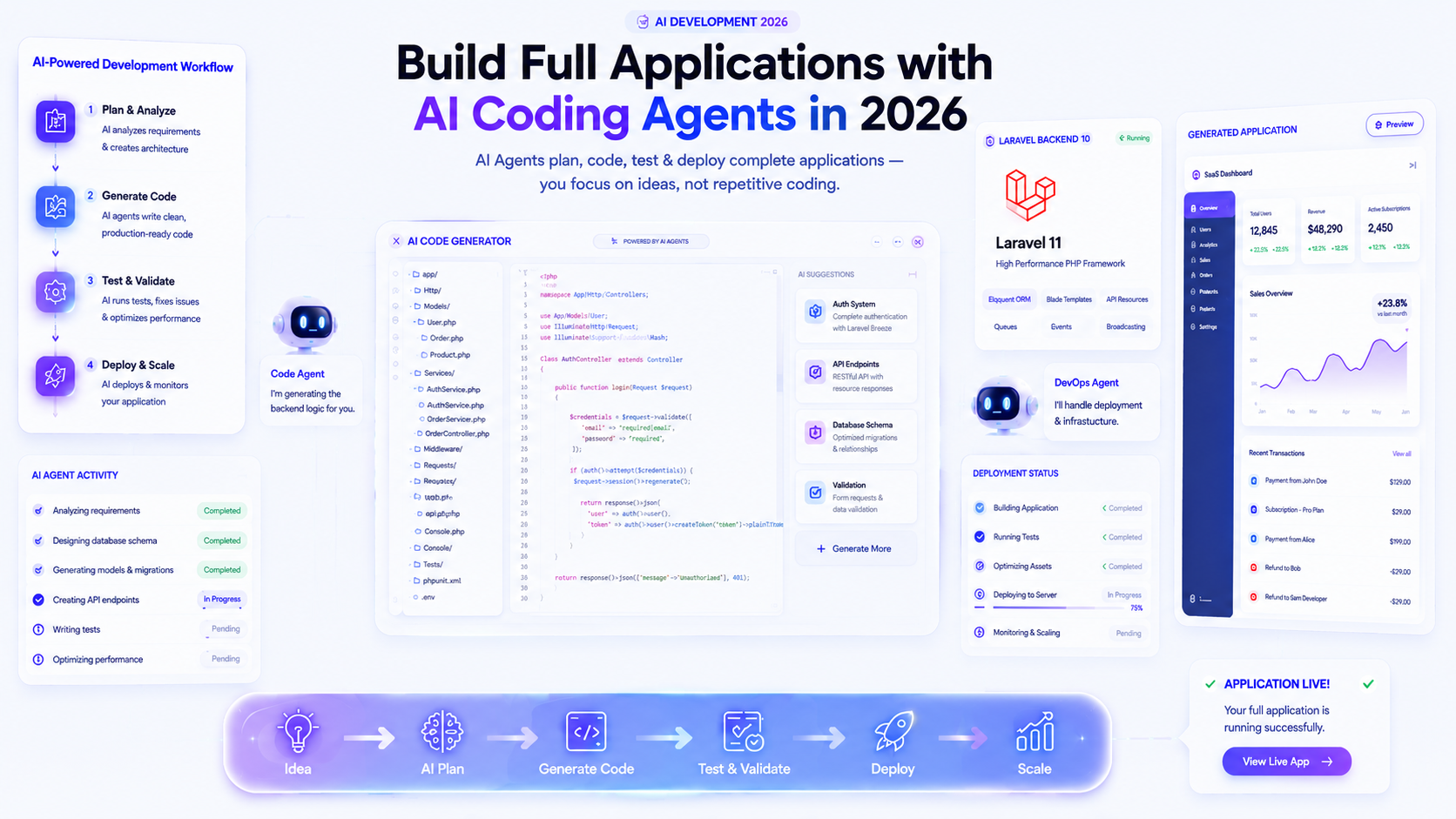
Modern AI-assisted workflow:
Idea
↓
AI architecture planning
↓
AI-assisted implementation
↓
AI-generated tests
↓
AI debugging
↓
Automated deployment
The developer increasingly acts as:
system architect + workflow orchestratorinstead of writing every line manually.
Why AI Development Exploded in 2026
Several major trends accelerated adoption:
- Better LLM reasoning
- Larger context windows
- Repository-aware AI tools
- AI coding agents
- Lower API costs
- Faster developer workflows
The result:
Small teams now ship products faster than entire engineering departments did a few years ago.
The New AI Development Stack
Modern AI-powered development often includes:
| Layer | Technology |
|---|---|
| Frontend | Next.js / Vue / React |
| Backend | Laravel / Node.js |
| AI APIs | OpenAI / Claude |
| AI Coding Tools | Cursor / Copilot / Claude Code |
| Database | PostgreSQL |
| Vector Search | pgvector / Qdrant |
| Deployment | Docker / Kubernetes |
| Automation | GitHub Actions |
AI increasingly participates across every layer.
The Biggest Shift: AI Coding Agents
AI tools are moving beyond autocomplete.
Modern AI coding agents can:
- understand repositories
- edit multiple files
- generate features
- update architecture
- debug systems
- write tests
- optimize codebases
This dramatically changes development speed.
Real Examples of AI-Assisted Development
Example 1 — SaaS MVP Development
A founder can now:
- describe the product
- generate authentication systems
- build CRUD operations
- create APIs
- generate dashboards
within days instead of months.
Example 2 — Laravel Backend Development
AI tools now help developers:
- generate migrations
- create Eloquent models
- build API Resources
- write queue systems
- optimize controllers
Cursor and Claude are especially strong here.
Example 3 — Frontend UI Generation
AI increasingly generates:
- responsive layouts
- component systems
- dashboard interfaces
- Tailwind CSS structures
with minimal manual effort.
The Rise of “Vibe Coding”
One of the most discussed trends in 2026:
vibe codingInstead of manually planning every implementation detail, developers increasingly:
- describe outcomes
- guide workflows
- refine generated systems
AI handles large parts of execution.
This approach dramatically increases iteration speed.
AI Is Compressing Development Timelines
Estimated Development Time Reduction Using AI
Typical time savings reported by modern AI-assisted engineering teams.
0%20%40%60%80%Boilerplate Devel...API DevelopmentTestingDocumentationDebuggingUI Development
The biggest productivity gains usually come from:
- repetitive engineering tasks
- scaffolding
- workflow automation
- documentation generation
How AI Changes the Role of Developers
Developers are not disappearing.
But the role is evolving rapidly.
Modern engineers increasingly focus on:
- architecture
- system design
- workflow orchestration
- validation
- infrastructure
- product thinking
AI handles more implementation detail.
Complex Architecture Decisions
AI can assist, but senior engineering judgment still matters heavily.
Security
AI-generated code often requires:
- validation
- auditing
- optimization
Production Infrastructure
Scaling systems still requires operational expertise.
Business Context
AI does not fully understand:
- customer behavior
- product strategy
- operational tradeoffs
Common AI Development Workflows in 2026
AI Pair Programming
Developers collaborate with AI continuously.
AI Refactoring
Large repository updates automated by AI agents.
AI Testing
AI generates:
- unit tests
- integration tests
- edge-case validation
AI Documentation
Documentation increasingly generated automatically.
AI Debugging
AI analyzes:
- logs
- stack traces
- performance bottlenecks
Laravel + AI Development
Laravel became surprisingly effective for AI-powered development.
Why?
Because modern apps still need:
- authentication
- billing
- APIs
- queues
- multi-tenancy
- workflow orchestration
Laravel handles these operational layers extremely well.
Popular Laravel AI Architecture
Frontend
↓
Laravel API
↓
AI Service Layer
↓
OpenAI / Claude APIs
↓
Vector Database
↓
Workflow Engine
This architecture powers:
- AI SaaS platforms
- automation systems
- AI copilots
- semantic search
- AI agents
AI App Builders vs Real Engineering
A common misconception:
AI can fully replace developersIn reality:
AI-generated apps still require:
- infrastructure
- scaling
- monitoring
- security
- architecture
- operational engineering
AI accelerates engineering.
It does not eliminate engineering complexity.
Common Mistakes Developers Make
Blindly Trusting AI Code
AI-generated code still contains:
- security issues
- performance problems
- architecture mistakes
Over-Reliance on One Tool
Different AI systems excel at different workflows.
Ignoring System Design
Generated code without architecture creates long-term problems.
No Human Validation
Production systems still require experienced review.
The Economics of AI Development
AI dramatically reduces:
- development time
- MVP cost
- prototyping effort
This allows:
- solo founders
- small startups
- lean engineering teams
to compete much faster.
Why Startups Are Adopting AI Development Fast
AI gives startups:
- faster iteration
- lower staffing requirements
- quicker MVP validation
- accelerated experimentation
This is especially powerful for:
- SaaS startups
- AI agencies
- automation platforms
- internal business tools
Future Trends Beyond 2026
Several major shifts are accelerating:
Autonomous Coding Agents
AI systems handling complete engineering tasks.
AI-Generated Infrastructure
Infrastructure-as-code increasingly AI-managed.
Conversational Development
Developers building apps through natural language.
Self-Healing Applications
AI systems detecting and fixing operational issues automatically.
Multi-Agent Engineering Teams
Specialized AI agents collaborating together.
The Future Developer Workflow
Future engineering may increasingly look like:
Describe feature
↓
AI generates architecture
↓
AI implements feature
↓
AI generates tests
↓
Human validates
↓
AI deploys system
The developer becomes:
director of intelligent systemsinstead of only writing raw code manually.
Decision Framework for Developers
Use AI heavily for:
- scaffolding
- repetitive tasks
- documentation
- testing
- debugging assistance
Use human expertise heavily for:
- architecture
- security
- scalability
- product design
- operational decisions
The best developers in 2026 are not:
developers competing against AIThey are:
developers amplified by AIFAQs
Q1: Are developers really building full apps with AI now?
Yes. Many developers now use AI across architecture, coding, testing, debugging, and deployment workflows.
Q2: Which AI coding tools are most popular?
Cursor AI, GitHub Copilot, and Claude Code dominate most professional developer workflows.
Q3: Is AI replacing software engineers?
No. AI is increasing productivity but still requires human oversight and engineering expertise.
Q4: What frameworks work best with AI development?
Laravel, Next.js, React, Node.js, and FastAPI are all commonly used.
Q5: What is “vibe coding”?
A development style where developers guide AI systems conversationally while AI handles large parts of implementation.
Q6: Can solo founders build SaaS products using AI?
Absolutely. AI dramatically reduces MVP development time and operational complexity.
Q7: What are the biggest risks of AI-generated code?
Security issues, poor architecture, scalability problems, and over-reliance on generated solutions.
Conclusion
Software development in 2026 looks fundamentally different than it did just a few years ago.
Developers are no longer simply:
- writing code
- managing files
- implementing boilerplate manually
They are increasingly orchestrating:
- AI workflows
- coding agents
- automation systems
- intelligent development pipelines
The most successful engineers are not resisting AI.
They are learning how to:
- guide it
- validate it
- scale it
- integrate it into operational workflows
AI is not replacing developers.
It is transforming software engineering into a faster, more automated, and more strategic discipline.
The future belongs to developers who learn how to build with AI instead of competing against it.
CTA Section
Building AI-powered applications or looking to accelerate your software development workflows?
Softtechover’s Laravel and AI engineering team helps startups and enterprises build scalable SaaS platforms, AI-native applications, automation systems, AI copilots, vector search infrastructure, and production-grade backend architectures.