
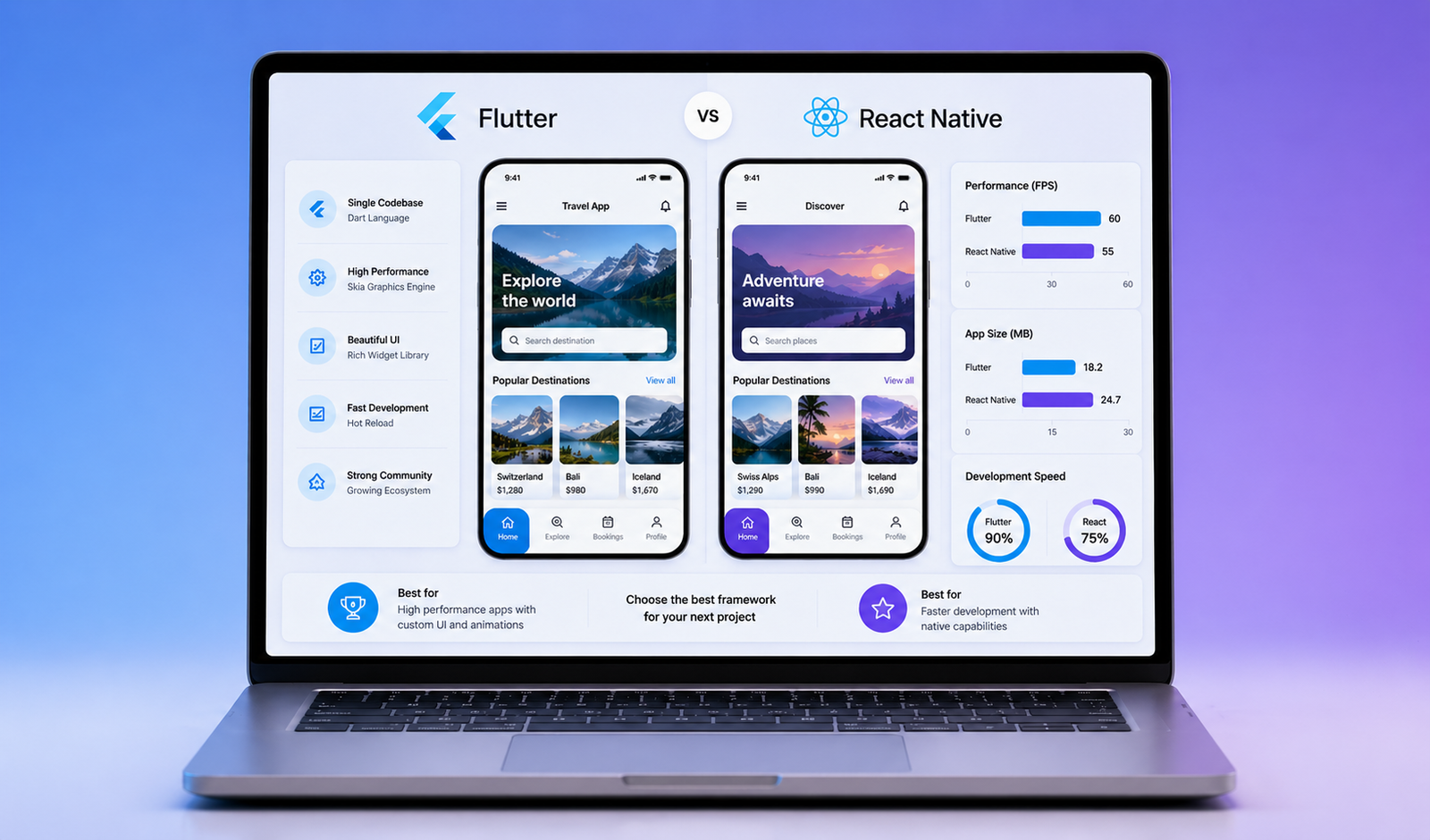
The Current Landscape of Cross-Platform Development in 2026
Cross-platform development is no longer about choosing the "lesser evil" for performance. Today, both Flutter and React Native deliver near-native experiences, but they approach architecture, UI rendering, and state management very differently. Understanding these core philosophical differences is essential before committing code to your next repository.
Performance and Architecture: How They Stack Up
Flutter: Direct Compilation and Impeller
Flutter continues to leverage Google’s Dart language and compiles directly to native machine code.
The Engine: With the mature adoption of the Impeller rendering engine, Flutter completely eliminates historical jank caused by shader compilation issues on iOS and Android.
UI Consistency: Because Flutter draws every pixel on its own canvas using Skia/Impeller, your UI looks and behaves pixel-for-identically across every single device, regardless of OS fragmentation.
React Native: The New Architecture and Bridgeless Mode
React Native relies on JavaScript/TypeScript and bridges UI components to native elements.
Bridgeless Operation: The fully realized New Architecture (featuring JSI and Bridgeless mode) has eliminated the traditional asynchronous bridge bottleneck, enabling synchronous communication between JavaScript and native modules.
Native Look and Feel: React Native maps directly to native platform primitives, meaning buttons, scroll views, and navigation feel inherently native out of the box.
Developer Experience and Ecosystem Support
Tooling, Hot Reload, and State Management
Flutter: Offers a unified development experience with excellent hot reload, deeply integrated widget testing, and a comprehensive out-of-the-box UI component library (Material Design and Cupertino).
React Native: Benefits from the massive npm ecosystem. If you need a specific package, authentication helper, or analytics integration, chances are a well-maintained community library already exists. However, managing dependency compatibility across upgrades can occasionally require extra configuration.
Hiring and Team Scalability
Finding developers proficient in JavaScript/TypeScript for React Native is generally faster due to the web development crossover. Meanwhile, training web or mobile developers on Dart and Flutter widgets typically takes less than a couple of weeks because of Dart's clean, modern syntax.
Real-World Insights from 30+ Apps
When to Choose Flutter
UI-Heavy Applications: If your app features custom animations, unique brand identity designs, complex graphics, or branded dashboards that must look identical on all devices.
Startup MVPs: When you need a single codebase to launch simultaneously on iOS, Android, and web with minimal platform-specific configuration.
When to Choose React Native
Deep Native Integration: If your app heavily relies on complex background native services, heavy AR/VR integrations, or deep system-level hardware modules.
Existing Web Teams: If your engineering team already has strong React expertise and wants to leverage shared state logic or architectural patterns.
Final Verdict: Which One Should You Choose?
Both Flutter and React Native are exceptional production-ready choices in 2026. Choose Flutter if your priority is bulletproof UI consistency and high-performance custom animations. Choose React Native if you lean heavily on existing JavaScript talent, native platform UI guidelines, and a massive third-party package ecosystem.