
Every modern AI application in 2026 eventually hits the same problem.
The AI model works.
The chatbot responds correctly.
The demo looks impressive.
Then production traffic arrives.
Why Vector Databases Matter
Modern AI systems rely heavily on:
context retrieval.
Large language models alone are not enough.
AI applications increasingly require:
Long-term memory
Semantic retrieval
Hybrid search
Personalization
Contextual understanding
This is where vector databases become critical.
What Vector Databases Store
Vector databases store:
embeddings.
Embeddings are numerical representations of:
Text
Images
Documents
Audio
Products
User behavior
Similarity search allows AI systems to retrieve relevant context quickly.
Why Traditional Databases Struggle
Traditional SQL databases were not designed for:
Semantic similarity
Nearest-neighbor search
Embedding retrieval
High-dimensional indexing
Vector databases are optimized specifically for:
ANN search
Semantic matching
AI-scale retrieval
Filtering workloads
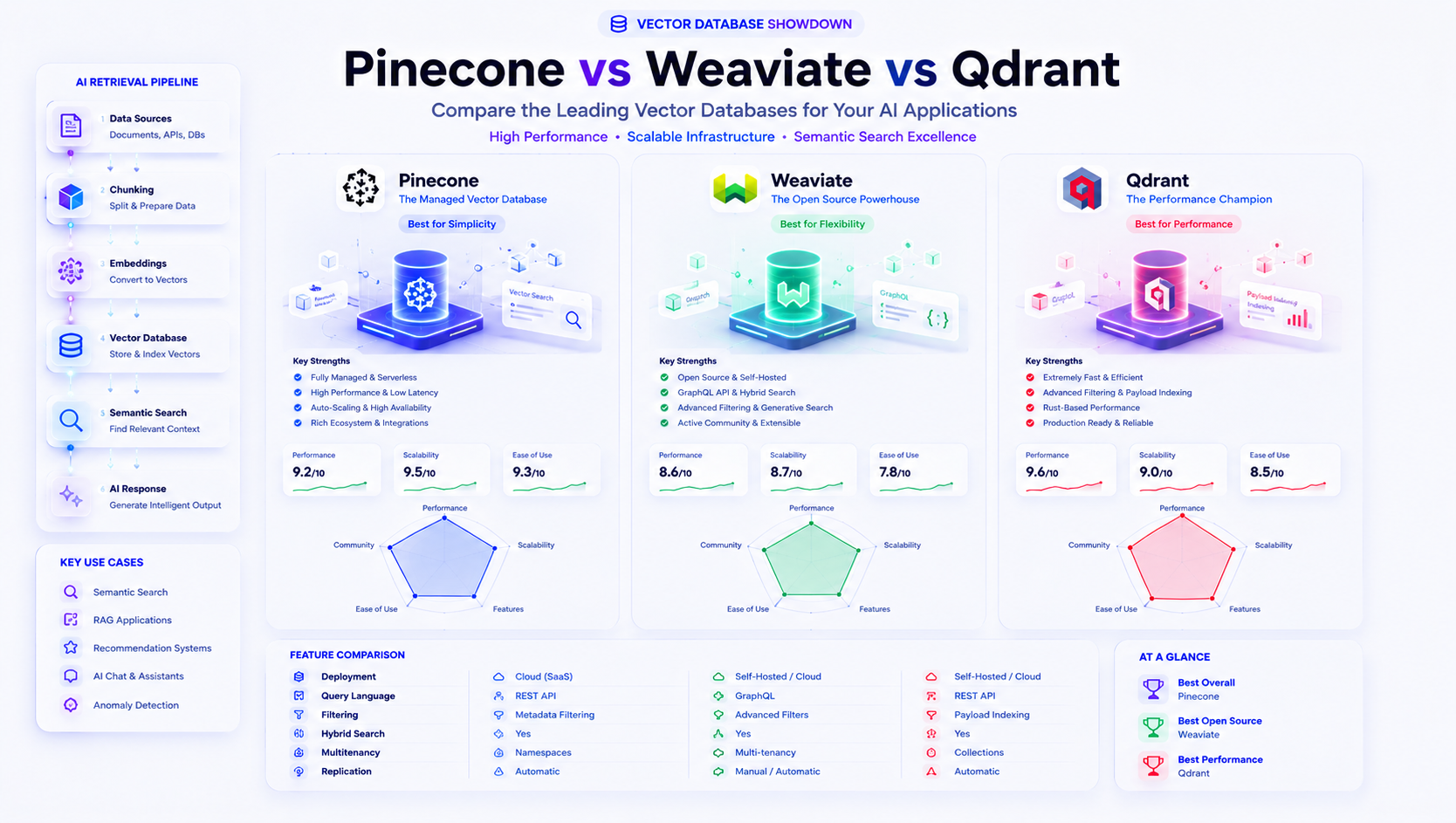
Quick Overview
Pinecone
Pinecone is a fully managed vector database platform.
Best For:
Enterprise AI systems
Fast deployment
Teams avoiding DevOps complexity
Weaviate
Weaviate combines:
Vector search
Hybrid retrieval
Graph-like relationships
Modular AI integrations
Best For:
Advanced semantic architectures
Metadata-heavy systems
Enterprise knowledge platforms
Qdrant
Qdrant focuses heavily on:
Filtering performance
Developer experience
Open-source flexibility
High-speed retrieval
Best For:
AI SaaS platforms
Multi-tenant systems
Filter-heavy workloads
Head-to-Head Comparison
| Feature | Pinecone | Weaviate | Qdrant |
|---|---|---|---|
| Hosting | Managed | Self-hosted + Cloud | Self-hosted + Cloud |
| Open Source | No | Yes | Yes |
| Filtering | Good | Excellent | Excellent |
| Hybrid Search | Yes | Excellent | Excellent |
| Ease of Setup | Excellent | Moderate | Excellent |
| Laravel Integration | Good | Moderate | Excellent |
| Scaling | Excellent | Excellent | Excellent |
| Multi-Tenant Support | Good | Good | Excellent |
| Operational Complexity | Low | Medium | Low-Medium |
Biggest Trend in 2026
AI agents are driving vector database growth rapidly.
Modern AI agents require:
Long-term memory
Semantic recall
Workflow context
User history
Operational state
This increases:
Vector volume
Retrieval complexity
Filtering requirements
Pinecone
Pinecone became popular because teams wanted:
AI infrastructure without infrastructure headaches.
Where Pinecone Excels
Fast production deployment
Managed scaling
Infrastructure simplicity
Enterprise reliability
Pinecone handles:
Replication
Scaling
Indexing
Infrastructure maintenance
Pinecone Weaknesses
Vendor lock-in
Higher costs at scale
Less infrastructure flexibility
Weaviate
Weaviate behaves more like an AI-native data platform than a traditional vector database.
Where Weaviate Excels
Hybrid search
Connected semantic systems
Modular AI ecosystem
Knowledge graph architectures
Strong integrations include:
OpenAI
Cohere
Hugging Face
Reranking systems
Weaviate Weaknesses
Higher operational complexity
Larger infrastructure footprint
Steeper learning curve
Qdrant
Qdrant became extremely popular among SaaS startups because it balances:
Speed
Simplicity
Filtering
Flexibility
very effectively.
Where Qdrant Excels
Metadata filtering
Multi-tenant SaaS systems
Payload queries
Developer experience
Qdrant works especially well for:
AI SaaS products
Enterprise applications
Customer-isolated systems
Qdrant Weaknesses
Smaller ecosystem
Some advanced features still maturing
Which Database Performs Best?
Performance depends heavily on:
Infrastructure setup
Indexing strategy
Workload type
Filtering complexity
However, Qdrant increasingly performs extremely well in real SaaS environments.
Best Database for RAG Systems
Pinecone
Best for:
Managed infrastructure
Fast deployment
Enterprise reliability
Weaviate
Best for:
Hybrid semantic retrieval
Connected data systems
Advanced architectures
Qdrant
Best for:
SaaS RAG applications
Multi-tenant retrieval
Metadata-heavy filtering
Laravel Integration
Laravel developers increasingly use:
OpenAI APIs
Pinecone
Qdrant
pgvector
for AI SaaS applications.
Example AI Workflow
User Query
↓
Generate Embedding
↓
Search Vector Database
↓
Retrieve Context
↓
Send Context to LLM
↓
Generate AI Response
This architecture powers:
AI chat systems
Semantic search
Enterprise copilots
AI automation tools
Infrastructure Costs
| Scale | Pinecone | Weaviate | Qdrant |
|---|---|---|---|
| Small Startup | Moderate | Low-Medium | Low |
| Mid SaaS | High | Medium | Medium |
| Enterprise Scale | Very High | High | High |
The hidden cost is usually:
vector storage growth — not query volume.
Common Mistakes Teams Make
Choosing Enterprise Infrastructure Too Early
Most startups don’t need massive clusters initially.
Ignoring Filtering Performance
Metadata filtering becomes critical at scale.
No Multi-Tenant Strategy
Tenant isolation matters heavily in SaaS AI systems.
Over-Embedding Data
Too many embeddings increase costs rapidly.
No Retrieval Evaluation
Many teams never properly measure retrieval quality.
Security & Compliance
Vector databases increasingly store sensitive business information.
Key concerns include:
Embedding leakage
Unauthorized retrieval
Tenant isolation
Prompt injection
Insecure APIs
Best Practices
Encrypt sensitive embeddings
Add permission layers
Audit retrieval activity
Use region-based deployment
Future Trends Beyond 2026
Several trends are accelerating rapidly:
Multi-modal retrieval
AI memory systems
Hybrid graph + vector systems
Compression improvements
Edge retrieval systems
AI retrieval is becoming more advanced and distributed.
Decision Framework
Choose Pinecone If:
You want managed infrastructure
Your team lacks DevOps resources
Fast deployment matters most
Choose Weaviate If:
You need advanced semantic architectures
Hybrid retrieval is important
Your systems rely on connected data
Choose Qdrant If:
You build AI SaaS products
Multi-tenancy matters
Filtering performance is critical
You want strong developer experience
FAQs
Which vector database is best overall in 2026?
For most AI SaaS applications, Qdrant currently offers one of the best balances of performance, filtering, and simplicity.
Is Pinecone worth the higher cost?
Yes, especially for teams prioritizing managed infrastructure and fast scaling.
What makes Weaviate unique?
Its hybrid retrieval and AI-native architecture make it strong for advanced semantic systems.
Can Laravel apps use vector databases easily?
Absolutely. Laravel integrates well with Pinecone, Qdrant, pgvector, and OpenAI APIs.
Are vector databases mandatory for AI apps?
Not always, but modern AI systems increasingly require retrieval and semantic memory.
What is the biggest scaling challenge?
Filtering performance and vector storage growth usually become the largest bottlenecks.
Which vector DB is best for startups?
Qdrant and pgvector are often the best starting points because of cost efficiency and flexibility.
Conclusion
The vector database market in 2026 is becoming core infrastructure for AI-native applications.
The best choice depends on:
Your workload
Your infrastructure strategy
Your operational complexity
Your development team
Pinecone dominates managed enterprise deployments
Weaviate excels in advanced semantic systems
Qdrant continues winning among SaaS startups and AI-native products
because of its balance of:
Performance
Filtering
Flexibility
Simplicity
The most important lesson:
Don’t over-engineer too early.
Choose the vector database that helps your team ship faster today.
CTA
Building AI search systems, RAG platforms, AI agents, or semantic retrieval infrastructure?
Softtechover’s AI and Laravel engineering team helps startups build production-grade AI architectures using Pinecone, Qdrant, pgvector, OpenAI APIs, vector search systems, and scalable AI SaaS infrastructure.