
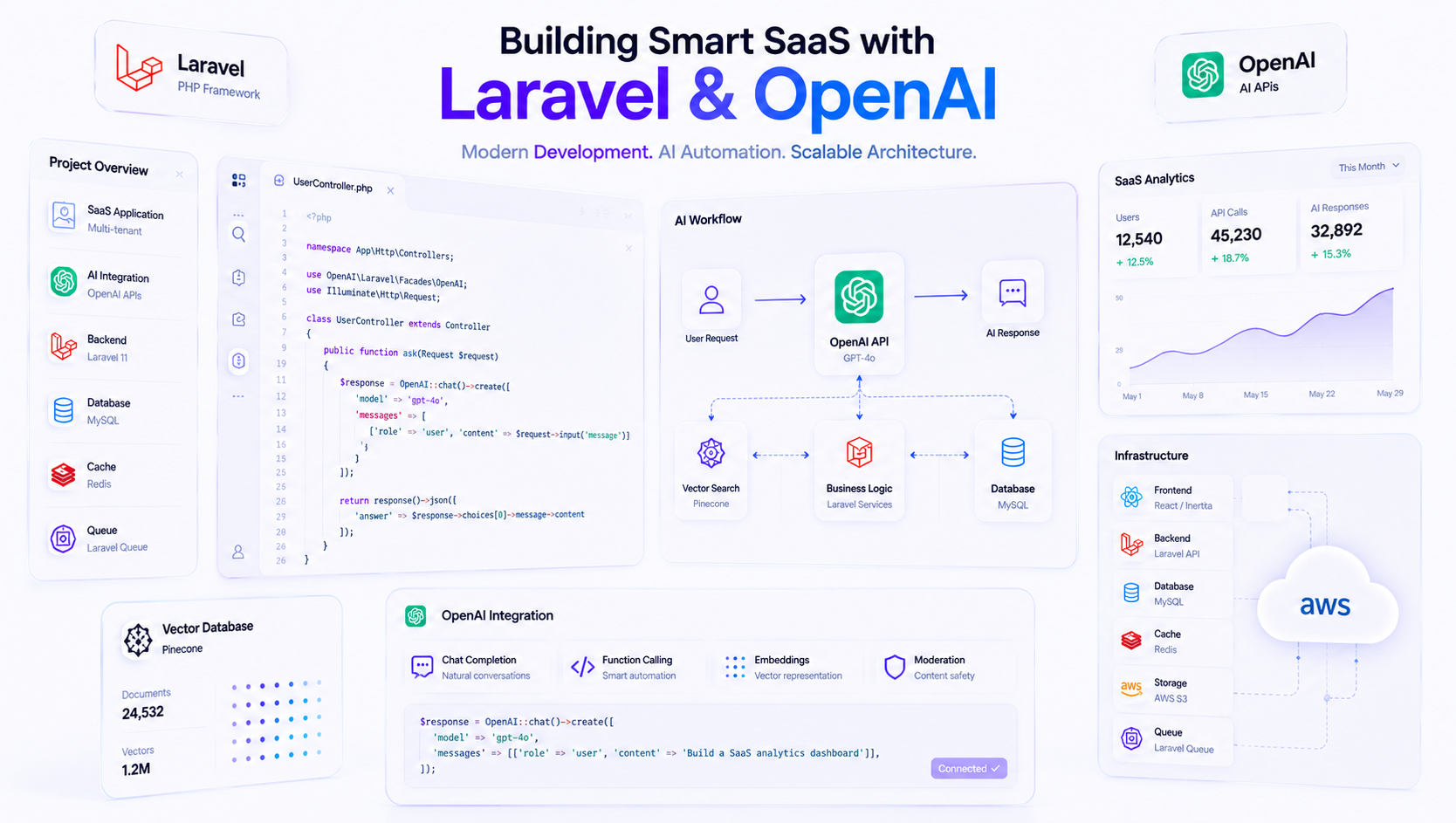
Launching a SaaS startup no longer requires massive engineering teams or huge infrastructure budgets.
In 2026, developers can build production-grade AI SaaS products using Laravel, OpenAI APIs, and modern cloud tools much faster than before.
Small teams can now create:
AI writing tools
Customer support agents
AI search platforms
Workflow automation tools
AI copilots
Recommendation systems
without training machine learning models from scratch.
Laravel has become one of the strongest frameworks for building AI-powered SaaS applications.
Why Laravel Works Well for AI SaaS
Python dominates AI model training and data science.
But production SaaS applications require much more than AI models.
They need:
Authentication
Billing
APIs
Queues
Permissions
Multi-tenancy
Notifications
Laravel handles these problems extremely well.
What Makes Laravel Ideal
Rapid Development
Laravel helps teams launch MVPs quickly.
Strong Ecosystem
Laravel offers packages for:
Billing
Permissions
APIs
Queues
Monitoring
Multi-tenancy
Queue System
AI workloads are asynchronous by nature.
Laravel Queues help process:
AI jobs
Embeddings
Background tasks
Workflow automation
API-Friendly
Laravel integrates smoothly with:
OpenAI APIs
Claude APIs
Vector databases
AI orchestration tools
Core AI SaaS Architecture
A modern AI SaaS stack typically includes:
| Layer | Technology |
|---|---|
| Frontend | Next.js / Vue / React |
| Backend | Laravel |
| AI Provider | OpenAI APIs |
| Database | PostgreSQL |
| Vector DB | pgvector / Pinecone |
| Queue System | Redis + Horizon |
| Billing | Stripe |
| Storage | S3 |
| Deployment | Docker / Kubernetes |
AI is only one layer of the product.
The real challenge is connecting everything together efficiently.
Step 1 — Define the Workflow First
Many AI startups fail because they focus on technology before solving workflows.
Instead of:
“Let’s add GPT to our app.”
Ask:
“What repetitive workflow can AI automate?”
Successful AI SaaS products solve:
Manual repetitive work
Information overload
Operational bottlenecks
Time-consuming processes
Popular AI SaaS Ideas
AI Customer Support
Automated support systems using RAG workflows.
AI Document Analysis
PDF summaries, invoice extraction, legal review.
AI Knowledge Bases
Semantic company search systems.
AI Sales Assistants
CRM automation, lead scoring, email generation.
AI Content Automation
Marketing workflows powered by AI.
Step 2 — Building the Laravel Backend
Laravel becomes the operational center of the SaaS.
Typical modules include:
Authentication
Billing
Multi-tenancy
AI orchestration
API gateway
Job queues
Usage tracking
Rate limiting
Step 3 — Authentication & Multi-Tenancy
Most AI SaaS platforms are multi-tenant from day one.
Laravel works well with:
Sanctum
Passport
Tenancy packages
Tenant isolation matters because AI data is highly sensitive.
Step 4 — AI Workloads Need Queues
A major mistake founders make is running AI tasks synchronously.
AI processing should use:
Queues
Workers
Async pipelines
Typical queued jobs:
Embedding generation
AI summaries
PDF processing
Workflow automation
Laravel Horizon becomes extremely valuable here.
Step 5 — Add Vector Search
Modern AI products increasingly require:
Semantic search
AI memory
Retrieval systems
Personalization
Popular vector databases:
pgvector
Pinecone
Qdrant
Vector Database Use Cases
| Feature | Why It Matters |
|---|---|
| AI Chatbots | Context retrieval |
| Document Search | Semantic understanding |
| AI Agents | Long-term memory |
| Recommendations | Similarity matching |
| Internal Search | Natural-language retrieval |
Step 6 — Manage OpenAI API Costs
One of the biggest AI SaaS challenges is token cost management.
Common problems:
Large prompts
Huge context windows
Duplicate embeddings
Cost Optimization Tips
Cache responses
Use smaller models when possible
Summarize context
Queue heavy workloads
Track per-tenant usage
Every AI SaaS should monitor:
Tokens
Requests
Embeddings
AI costs
Production Infrastructure
AI workloads stress infrastructure differently than normal SaaS apps.
Common challenges:
Queue spikes
API rate limits
Worker scaling
Memory pressure
Recommended Stack
| Component | Recommendation |
|---|---|
| VPS | Hetzner / AWS |
| Database | PostgreSQL |
| Cache | Redis |
| Workers | Laravel Horizon |
| Monitoring | Sentry + Prometheus |
| CDN | Cloudflare |
AI SaaS Security Best Practices
Security becomes critical in AI products.
Key concerns:
Prompt injection
Data leakage
API abuse
Tenant isolation
Best Practices
Validate AI outputs
Add rate limiting
Encrypt sensitive data
Audit AI activity
Always log:
Prompts
Responses
Workflow execution
AI actions
Common Startup Mistakes
Building Too Much Infrastructure Early
Most startups do not need Kubernetes initially.
Ignoring AI Costs
OpenAI expenses scale rapidly.
No Usage Limits
Unlimited AI access destroys margins.
No Queue System
Async infrastructure is mandatory.
Realistic AI SaaS Economics
Most early AI SaaS startups operate with:
Small teams
API-first architecture
Low infrastructure cost
Fast iteration cycles
The largest expense is usually:
AI inference cost — not servers.
Future Trends
The next wave of AI SaaS includes:
AI agents
Multi-model systems
Voice interfaces
Personalized AI
Workflow automation
Many products now combine:
OpenAI
Claude
Gemini
for different tasks.
Practical MVP Roadmap
Week 1
Authentication
Billing
Basic dashboard
Week 2
OpenAI integration
AI workflows
Queue setup
Week 3
Vector search
File uploads
Semantic retrieval
Week 4
Monitoring
Rate limiting
Production deployment
FAQs
Is Laravel good for AI startups?
Yes. Laravel handles APIs, billing, queues, authentication, and multi-tenancy extremely well.
Do I need Python for AI SaaS?
Not always. Many AI SaaS platforms use Laravel with external AI APIs.
What is the biggest challenge in AI SaaS?
Managing AI costs, infrastructure, and orchestration at scale.
Which vector database is best?
pgvector is usually the best starting point for startups.
Should AI workloads use queues?
Absolutely. AI processing should almost always be asynchronous.
Can solo founders build AI SaaS products?
Yes. Modern APIs and frameworks greatly reduce development complexity.
Conclusion
The AI SaaS boom in 2026 is accelerating rapidly.
The winners are not necessarily companies with the best AI models.
They are companies that:
Solve real workflows
Move quickly
Optimize AI costs
Build scalable infrastructure
Ship products consistently
Laravel combined with OpenAI APIs creates a powerful stack for building modern AI SaaS platforms.
Today, founders need:
Strong architecture
Smart AI integration
Operational discipline
Fast execution
more than massive engineering teams.
CTA
Planning to launch an AI SaaS startup or integrate OpenAI workflows into your platform?
Softtechover’s Laravel and AI engineering team helps startups build scalable AI SaaS platforms, vector search systems, AI agents, workflow automation, and production-grade backend infrastructure.