
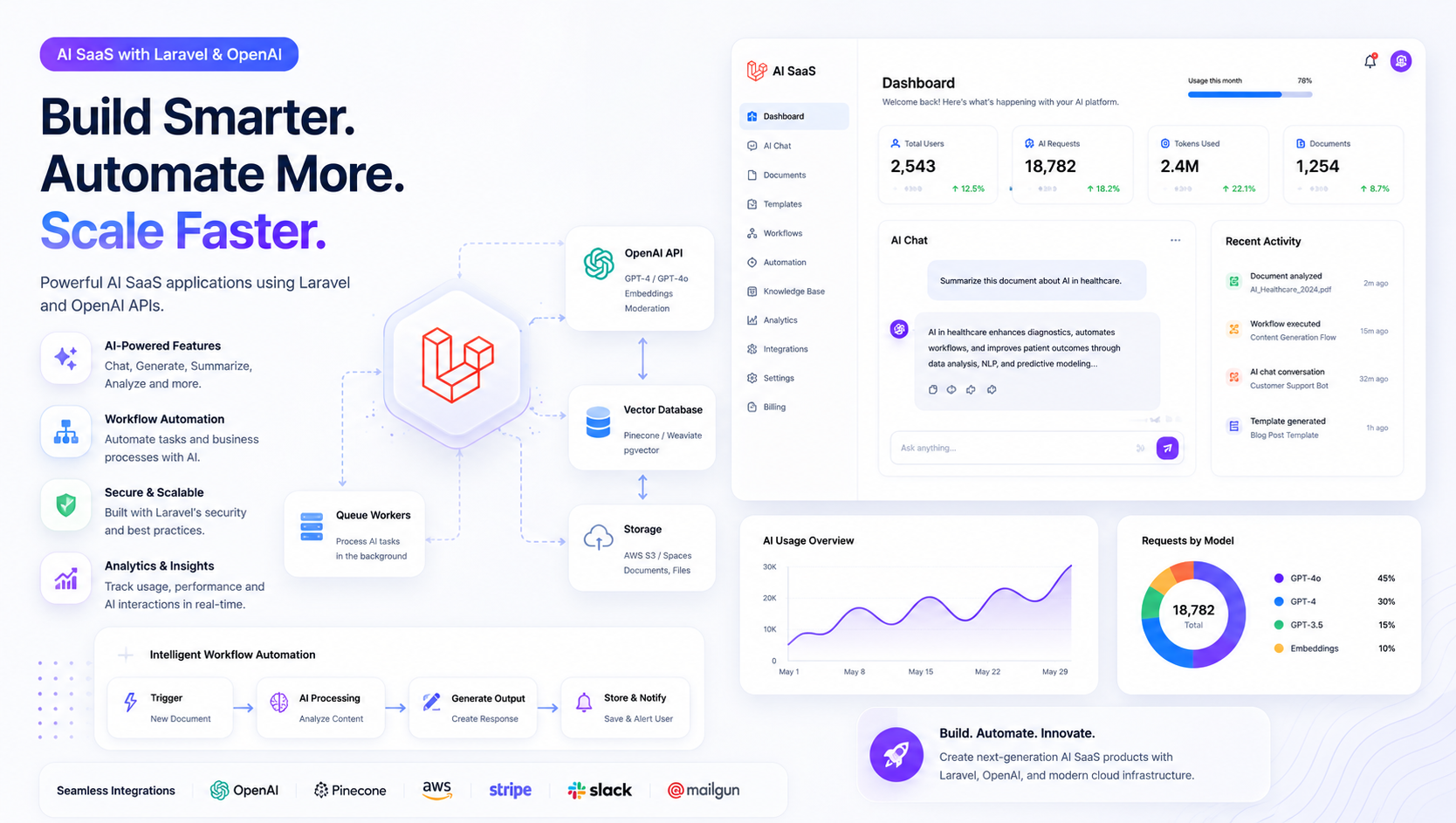
Artificial Intelligence is rapidly transforming the SaaS industry, enabling businesses to automate workflows, enhance customer experiences, and deliver smarter digital products. By combining Laravel's robust backend capabilities with OpenAI's powerful language models, developers can build scalable, secure, and feature-rich AI applications that solve real-world business challenges. From AI chatbots and content generation to workflow automation and intelligent search, the possibilities continue to expand in 2026.
Building an AI SaaS platform involves much more than simply integrating an AI API. A production-ready application requires authentication, subscription management, API security, background job processing, caching, monitoring, and scalable infrastructure. Laravel provides an excellent foundation for handling these core application features while OpenAI adds advanced intelligence that enhances user productivity and business efficiency.
In this guide, we'll walk through the complete process of building an AI SaaS application using Laravel and OpenAI. You'll learn the recommended architecture, API integration techniques, database design, security best practices, performance optimization strategies, deployment workflows, and practical tips for creating enterprise-grade AI software that is reliable, scalable, and ready for production.
Artificial Intelligence is no longer a futuristic concept—it has become one of the most valuable technologies driving modern software development. Businesses across industries are rapidly adopting AI-powered applications to automate repetitive tasks, improve customer engagement, generate valuable insights, and streamline daily operations. From intelligent chatbots and content generation platforms to workflow automation and predictive analytics, AI has transformed the way software products are designed and delivered.
At the same time, Laravel has continued to establish itself as one of the most trusted PHP frameworks for building secure, scalable, and enterprise-ready web applications. Its elegant syntax, robust ecosystem, built-in authentication, queue management, caching, scheduling, and API capabilities make it an ideal backend framework for AI-powered SaaS applications.
When Laravel is combined with OpenAI's powerful language models, developers gain the ability to build intelligent applications capable of understanding natural language, generating high-quality content, analyzing documents, automating workflows, answering customer questions, and assisting users with complex business tasks. This combination allows businesses to launch innovative products faster while maintaining high standards for security, scalability, and maintainability.
Today, building an AI SaaS platform requires much more than simply connecting to an AI API. Modern applications need reliable authentication systems, subscription billing, usage tracking, background processing, API security, caching, monitoring, scalable infrastructure, and seamless integrations with third-party services. Laravel provides the operational backbone, while OpenAI delivers advanced intelligence that enhances the overall user experience.
This guide explores how developers can build production-ready AI SaaS applications using Laravel and OpenAI in 2026. You'll discover recommended architecture patterns, essential development workflows, security best practices, deployment strategies, and practical recommendations that help transform an idea into a scalable AI-powered software product.
Why AI SaaS Applications Are Growing Rapidly
Software as a Service has evolved dramatically over the last decade. Traditional SaaS platforms primarily focused on providing digital tools that helped businesses manage processes more efficiently. Today, customers expect software to be intelligent, personalized, and capable of making informed decisions.
Artificial Intelligence has become the driving force behind this evolution.
Businesses are increasingly integrating AI into their products because it provides measurable value across multiple areas, including:
• Customer support automation
• AI-powered search
• Smart document processing
• Content generation
• Personalized recommendations
• Data analysis
• Workflow automation
• Virtual assistants
• Predictive analytics
These capabilities not only improve customer satisfaction but also reduce operational costs and increase productivity.
For startups, AI offers an opportunity to compete with larger organizations by delivering innovative experiences without requiring massive engineering teams.
For enterprises, AI enables digital transformation through automation, faster decision-making, and improved operational efficiency.
Why Laravel Is an Excellent Choice for AI Development
Laravel remains one of the most popular backend frameworks because it provides developers with a mature ecosystem that simplifies complex application development.
Instead of spending weeks building authentication systems, queue processing, email notifications, payment integrations, caching, and authorization logic from scratch, developers can focus on building valuable business features.
Laravel includes many production-ready features out of the box, including:
• Secure authentication
• Role & permission management
• REST API development
• Queue workers
• Scheduled jobs
• Event broadcasting
• File storage
• Email services
• Notification systems
• Database migrations
• Eloquent ORM
• Caching
• Validation
• Rate limiting
These capabilities significantly reduce development time while maintaining excellent code quality and long-term maintainability.
For AI-powered applications, these features become even more valuable because developers can spend their time building intelligent experiences rather than reinventing backend infrastructure.
Why OpenAI APIs Are Popular
OpenAI has become one of the leading providers of advanced language models capable of understanding and generating human-like text.
Developers use OpenAI APIs to build applications that can:
• Answer customer questions
• Generate marketing content
• Summarize documents
• Translate languages
• Analyze customer feedback
• Generate source code
• Create business reports
• Process large documents
• Build conversational assistants
• Automate repetitive workflows
Modern OpenAI models offer excellent reasoning capabilities, making them suitable for enterprise applications that require accuracy, flexibility, and scalability.
Combined with Laravel, OpenAI APIs become the intelligence layer that powers modern AI SaaS platforms.
Core Components of an AI SaaS Application
A production-ready AI application consists of several interconnected systems working together.
Typical components include:
Frontend
Responsible for user interaction through dashboards, forms, AI chat interfaces, and reporting screens.
Backend
Laravel manages authentication, business logic, APIs, subscriptions, database operations, notifications, queues, and integrations.
AI Layer
OpenAI processes prompts, generates responses, analyzes documents, summarizes information, and performs intelligent reasoning.
Database
Stores user accounts, application data, prompts, AI responses, billing information, and analytics.
Background Processing
Queue workers handle time-consuming AI requests without slowing down the user experience.
Monitoring
Logs application performance, API usage, AI costs, and system health.
Security
Protects sensitive information through authentication, authorization, encrypted storage, API validation, and rate limiting.
Together, these components create a scalable and reliable AI-powered SaaS platform capable of serving thousands of users efficiently.
Recommended AI SaaS Architecture
A modern Laravel AI application often follows a layered architecture.
User Interface
↓
Laravel Application
↓
Business Logic Layer
↓
AI Service Layer
↓
OpenAI API
↓
Database
↓
Queue Workers
↓
Monitoring & Analytics
This architecture separates responsibilities across multiple layers, making the application easier to maintain, scale, and extend as new AI capabilities are introduced.
Keeping AI interactions isolated inside dedicated service classes also makes it easier to switch between OpenAI, Claude, Gemini, or other providers in the future without affecting the rest of the application.
Benefits of Combining Laravel and OpenAI
Businesses choosing Laravel and OpenAI benefit from numerous advantages.
These include:
• Faster product development
• Secure backend architecture
• Rapid AI integration
• Scalable infrastructure
• Lower maintenance costs
• Improved customer experience
• Easier feature expansion
• Better developer productivity
• Strong community support
• Enterprise-ready architecture
This combination enables startups to launch MVPs quickly while giving enterprises the flexibility to build sophisticated AI-powered platforms capable of supporting long-term business growth.