
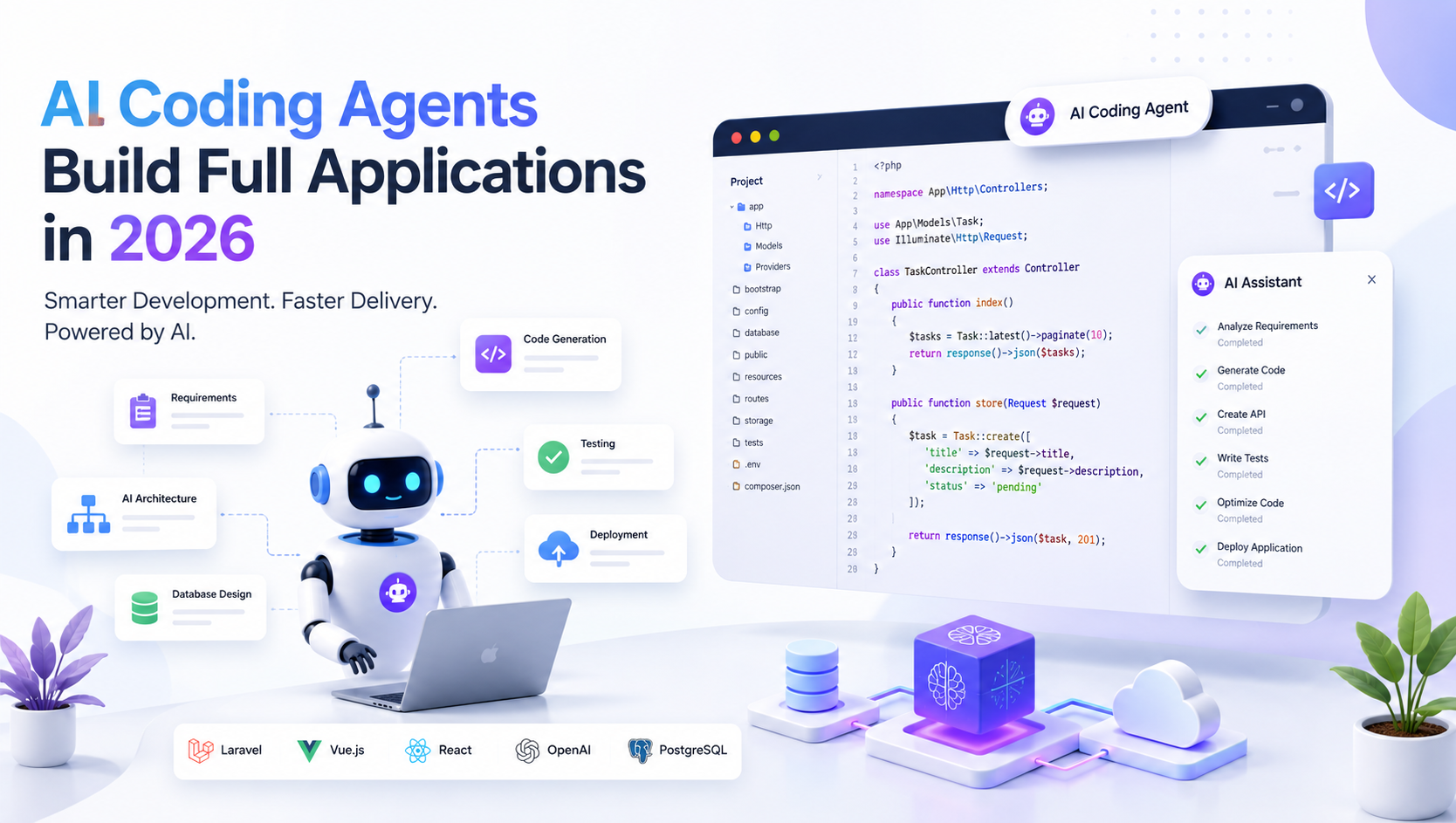
Artificial Intelligence has fundamentally transformed the way modern software is built. Just a few years ago, AI coding tools were primarily used for code completion, boilerplate generation, debugging assistance, and documentation. In 2026, AI has evolved far beyond simple code suggestions and become an active engineering partner capable of contributing throughout the entire software development lifecycle.
Today, developers are building complete SaaS platforms, APIs, mobile applications, enterprise software, and AI-powered products significantly faster than ever before. Modern AI coding agents can understand project architecture, generate production-ready code, write automated tests, optimize performance, debug complex issues, refactor repositories, and even assist with deployment workflows.
The biggest transformation isn't that AI can write code—it's that AI actively participates in software engineering workflows. This guide explores how developers are building full applications using AI coding agents in 2026, the technologies driving this evolution, practical development workflows, best practices, common mistakes, and what the future of AI-assisted software engineering looks like.
Introduction
Software development has entered a completely new era.
Only a few years ago, developers relied on AI mainly for autocomplete, boilerplate generation, debugging assistance, and documentation. Today, AI coding agents have become intelligent engineering assistants capable of participating throughout the entire software development lifecycle.
Instead of writing every feature manually, developers increasingly collaborate with AI to design application architecture, generate production-ready code, build APIs, write automated tests, optimize performance, produce documentation, debug production issues, and automate deployments.
Modern software engineering is no longer simply about writing code faster. It is about building smarter workflows where developers and AI work together to deliver secure, scalable, and high-quality applications.
This guide explores how developers are building complete applications using AI coding agents in 2026, the tools powering this transformation, practical workflows, real-world examples, and best practices for successful AI-assisted software development.
The Rise of AI-Native Development
The software development process has changed dramatically over the past few years.
Traditional engineering workflows required developers to manually implement nearly every part of an application—from planning and coding to testing and deployment.
Today, AI participates throughout the entire lifecycle.
Traditional Workflow
• Idea & Planning
• System Design
• Manual Development
• Testing
• Deployment
• Maintenance
Modern AI-Assisted Workflow
• Product Idea
• AI Requirement Analysis
• AI Architecture Planning
• AI Feature Generation
• AI Testing
• AI Debugging
• Automated Deployment
• Continuous Monitoring
Rather than replacing developers, AI has become an intelligent collaborator that accelerates development while allowing engineers to focus on architecture, product strategy, scalability, and user experience.
Why AI Development Exploded in 2026
Several major technological advancements accelerated AI adoption across software engineering.
The most significant drivers include:
• Better reasoning capabilities in Large Language Models
• Massive context windows capable of understanding large repositories
• Repository-aware AI coding agents
• Lower AI API costs
• Faster development workflows
• Better integrations with modern developer tools
The result is simple.
Small engineering teams can now deliver products at a speed that previously required much larger development departments.
From Code Completion to AI Coding Agents
Early AI tools focused mainly on predicting the next few lines of code.
Modern AI coding agents go much further.
Today's AI systems can:
• Understand entire repositories
• Analyze project architecture
• Generate complete application features
• Refactor multiple files
• Write automated tests
• Generate technical documentation
• Detect bugs
• Improve code quality
• Optimize application performance
This represents one of the biggest productivity improvements in modern software engineering.
The Modern AI Development Stack
Most AI-powered applications today follow a modern technology stack.
Frontend
• React
• Vue.js
• Next.js
Backend
• Laravel
• Node.js
• FastAPI
AI Models
• OpenAI GPT
• Claude
• Gemini
AI Coding Tools
• Cursor AI
• GitHub Copilot
• Claude Code
Database
• PostgreSQL
• MySQL
Vector Database
• Pinecone
• Weaviate
• Qdrant
Deployment
• Docker
• Kubernetes
• AWS
• GitHub Actions
Each layer benefits from AI-assisted automation and intelligent engineering workflows.
Building Full Applications Using AI
Developers rarely ask AI to generate random pieces of code.
Instead, they guide AI through structured engineering workflows.
A typical AI-assisted development process includes:
1. Understanding business requirements
2. Planning software architecture
3. Designing the database
4. Creating backend APIs
5. Building frontend interfaces
6. Writing automated tests
7. Debugging and optimization
8. Deployment automation
9. Production monitoring
The developer remains responsible for architecture, product decisions, and technical quality while AI accelerates implementation.
Real-World Example
Imagine building a SaaS project management platform.
Instead of manually creating authentication, dashboards, CRUD modules, APIs, reporting systems, documentation, and testing suites, developers now use AI coding agents to generate much of the repetitive engineering work while focusing on product quality and business logic.
Projects that previously required several months can often be delivered within weeks.
Laravel + AI Development
Laravel has become one of the strongest frameworks for AI-powered applications.
Modern AI products still require reliable backend systems for:
• Authentication
• Authorization
• Billing
• APIs
• Queue Systems
• Notifications
• Multi-Tenancy
• Background Jobs
• Workflow Automation
Laravel provides a mature ecosystem for these capabilities while AI dramatically accelerates implementation.
Common AI Development Workflows
Modern engineering teams increasingly rely on AI for:
AI Pair Programming
Developers collaborate with AI throughout the entire development process.
AI Refactoring
Large repositories can be updated automatically while maintaining business logic.
AI Testing
Generate:
• Unit Tests
• Integration Tests
• Edge Case Validation
• Regression Tests
AI Documentation
Automatically create:
• API Documentation
• Technical Guides
• Release Notes
• Project Documentation
AI Debugging
Analyze:
• Logs
• Stack Traces
• Database Queries
• Performance Bottlenecks
Best Practices
Successful engineering teams follow several important principles.
• Always review AI-generated code.
• Validate security before deployment.
• Maintain strong software architecture.
• Use detailed prompts with project context.
• Use AI for repetitive engineering tasks.
• Keep humans responsible for technical decisions.
Common Mistakes
Many developers make similar mistakes when adopting AI.
• Blindly trusting generated code.
• Ignoring software architecture.
• Skipping manual testing.
• Over-relying on a single AI tool.
• Neglecting security reviews.
• Treating AI as a replacement instead of a collaborative assistant.
Avoiding these mistakes leads to more reliable and maintainable software.
Security Considerations
AI-generated code should always undergo professional review before production.
Every project should include:
• Code Reviews
• Security Audits
• Dependency Scanning
• Performance Testing
• Architecture Validation
AI can accelerate development, but security remains a human responsibility.
Future of AI Coding Agents
The future of software engineering is becoming increasingly collaborative.
Emerging trends include:
• Autonomous Coding Agents
• AI-Generated Infrastructure
• Conversational Development
• Self-Healing Applications
• Multi-Agent Engineering Teams
• AI-Driven DevOps Automation
Developers who learn to effectively collaborate with AI will continue to build software faster while maintaining quality and scalability.
Conclusion
Software engineering in 2026 looks fundamentally different than it did only a few years ago.
Developers are no longer spending most of their time writing repetitive code. Instead, they collaborate with AI coding agents to design architectures, generate features, automate testing, optimize applications, and streamline deployments.
The most successful developers are not competing against AI.
They are learning how to direct it, validate its work, and combine human expertise with AI-powered engineering workflows.
AI is not replacing software developers.
It is transforming them into faster, more strategic, and more impactful engineers capable of building sophisticated applications at an unprecedented pace.
Ready to Build with AI?
Whether you're building an AI-powered SaaS platform, a custom Laravel application, enterprise automation software, or an intelligent business solution, our experienced development team can help you accelerate your product journey using modern AI coding agents and proven software engineering practices.
From architecture design and backend development to OpenAI integrations, vector databases, workflow automation, and production deployment, we build scalable applications that are secure, maintainable, and ready for long-term growth.