
A breach announcement in 2026 hits differently. Customers churn within 48 hours. Enterprise deals stall mid-procurement. Investors ask uncomfortable questions in your next board meeting. And the cause is almost always the same: someone trusted the wrong thing.
The traditional "castle and moat" security model — strong perimeter, soft interior — has been failing for a decade. In 2026, with distributed teams, third-party APIs, AI agents accessing systems autonomously, and supply-chain attacks at all-time highs, the perimeter doesn't exist anymore. The answer is zero-trust architecture: never trust, always verify, regardless of where the request comes from.
This isn't a theoretical exercise. Enterprise procurement teams now ask SaaS vendors directly: "Do you operate on zero-trust principles?" Saying yes — credibly — unlocks deals. Saying no closes doors.
Here's the practical guide to building zero-trust into your SaaS, even if you're a 5-person startup.
What Zero-Trust Actually Means (Beyond the Marketing)
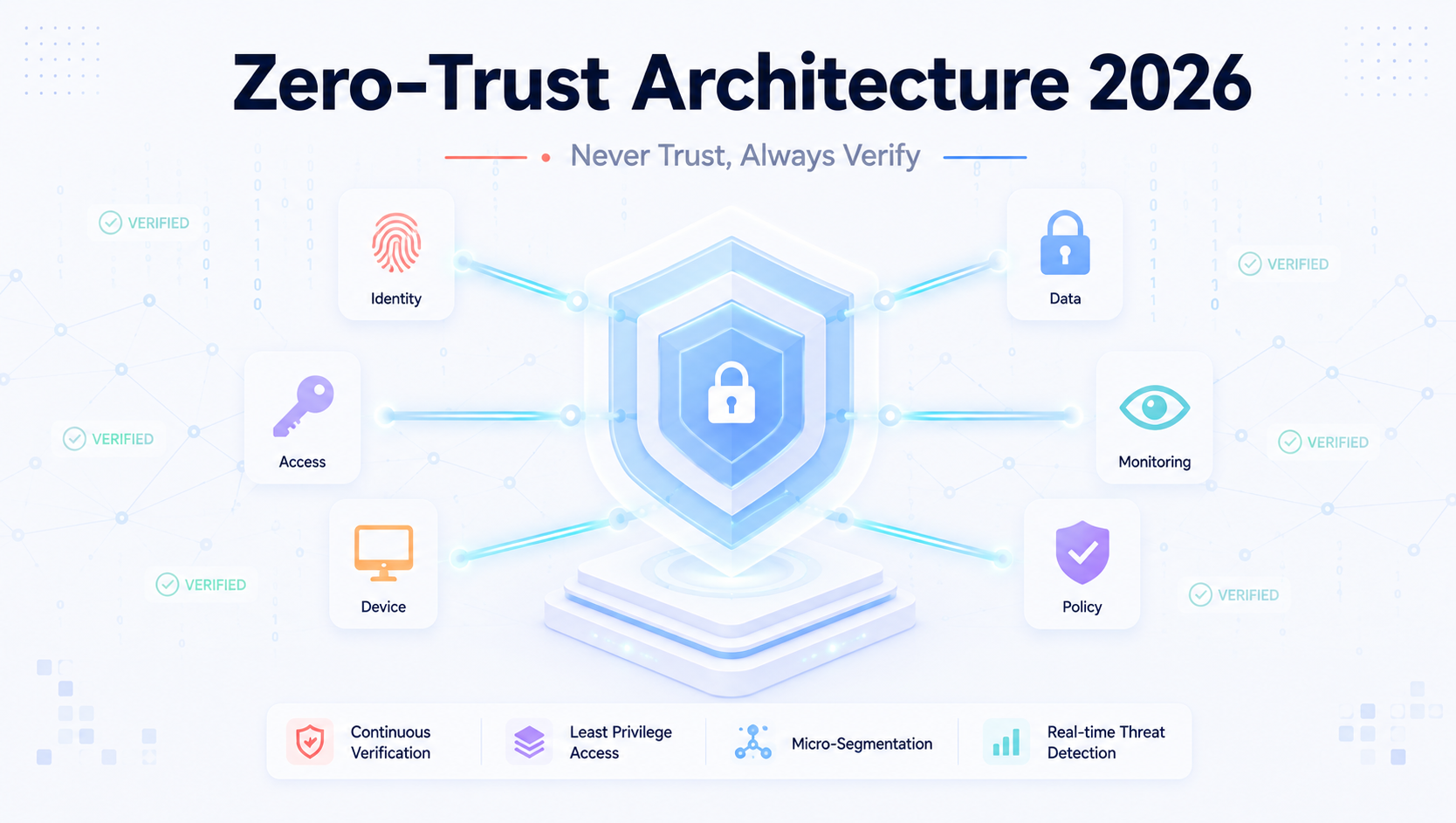
Zero-trust isn't a product. It's a principle: every access request must be authenticated, authorized, and validated, regardless of origin. Internal traffic gets the same scrutiny as external. Logged-in users get re-verified at every meaningful resource boundary. Trust is never assumed — it's continuously earned.
The five pillars of zero-trust, codified by NIST SP 800-207 and widely adopted in 2026:
- Identity — Every user, service, and device has a verified identity
- Devices — Device posture (patched, encrypted, compliant) is checked before access
- Network — No implicit network trust; every connection is authenticated
- Applications — Every service authenticates to every other service
- Data — Data access is policy-driven, contextual, and auditable
Most SaaS startups already do a small piece of this (HTTPS, JWT tokens). Zero-trust means doing it systematically — applying the same skepticism to every layer.
Why Zero-Trust Stopped Being Optional in 2026
Several forces converged this year:
- Supply chain attacks reached record highs. Compromised npm/Composer packages, malicious browser extensions, and CI/CD pipeline injections forced everyone to assume their tools are compromised
- AI agents access production systems. Every AI agent in your stack is a new identity that needs authentication and authorization
- Remote work is permanent. The office network as a trust boundary disappeared in 2020. Most teams just finally accepted it
- Enterprise procurement requires it. SOC 2, ISO 27001, HIPAA, and India's DPDP all increasingly assume zero-trust principles
- Insurance demands it. Cyber insurance premiums have doubled for non-zero-trust organizations
- Regulators codified it. US Executive Order 14028 made zero-trust the federal standard, and most large enterprises now require it from vendors
For a SaaS selling to mid-market and up, zero-trust has shifted from "nice security story" to "blocker on procurement reviews."
Traditional Security vs Zero-Trust: A Direct Comparison
| Dimension | Traditional (Perimeter) | Zero-Trust |
|---|---|---|
| Trust boundary | Network perimeter | None — every request verified |
| User authentication | Once at login | Continuous, context-aware |
| Lateral movement | Easy after breach | Blocked by per-resource policies |
| Service-to-service | Often implicit trust | Mutually authenticated |
| Device posture | Rarely checked | Required for sensitive access |
| Logging | Mostly at perimeter | Every access event logged |
| Default policy | Allow if inside network | Deny unless explicitly authorized |
| Recovery from breach | Often catastrophic | Contained, segmented |
The difference shows up most painfully when a credential leaks. In traditional security, a leaked password gives an attacker the kingdom. In zero-trust, it gives them one resource, briefly, and only with matching device posture and behavioral signals.
The 7 Core Components of a Zero-Trust SaaS
Here's the architecture stack you'll need.
Component 1: Strong Identity Provider (IdP)
A central identity source — Auth0, Clerk, WorkOS, Okta, or Microsoft Entra ID. Every user authenticates here. Every service trusts this single source.
Component 2: Multi-Factor Authentication (MFA) Everywhere
TOTP, WebAuthn/passkeys, or hardware keys. SMS is no longer acceptable as primary MFA in 2026 (SIM-swap attacks made it unreliable).
Component 3: Short-Lived, Scoped Tokens
JWT or opaque tokens with 15-minute lifetimes, narrowly scoped to specific actions. Long-lived sessions are refresh-token-based with revocation support.
Component 4: Policy Decision Point (PDP)
A centralized policy engine — Open Policy Agent (OPA), Cerbos, or AWS Verified Permissions — that decides "can user X do action Y on resource Z under context C."
Component 5: Service Mesh or Zero-Trust Network Layer
Istio, Linkerd, Cloudflare Zero Trust, Tailscale, or Twingate — for service-to-service mTLS and network-level zero-trust.
Component 6: Continuous Observability
Every access decision logged with full context. SIEM platforms (Datadog, Sumo Logic, Panther) consume and alert on anomalies.
Component 7: Device Trust Integration
For employees and privileged users: Kandji, Jamf, Microsoft Intune, or similar to verify device health before granting access.
Step-by-Step: Implementing Zero-Trust in a Laravel SaaS
Here's the practical path most SaaS teams follow.
Step 1: Centralize Identity
Replace your custom auth tables with an IdP. Don't roll your own.
// Laravel Socialite with WorkOS / Clerk / Auth0
use Laravel\Socialite\Facades\Socialite;

Route::get('/auth/redirect', function () {
    return Socialite::driver('workos')->redirect();
});

Route::get('/auth/callback', function () {
    $idpUser = Socialite::driver('workos')->user();

    $user = User::updateOrCreate(
        ['idp_id' => $idpUser->id],
        [
            'email' => $idpUser->email,
            'name' => $idpUser->name,
            'last_idp_sync_at' => now(),
        ]
    );

    auth()->login($user);
    return redirect()->intended('/dashboard');
});
The win: you stop managing passwords entirely. Password resets, MFA enrollment, account lockouts, audit trails — your IdP handles all of it correctly.
Step 2: Issue Short-Lived, Context-Rich Tokens
// app/Services/TokenService.php

class TokenService
{
    public function issueAccessToken(User $user, Request $request): string
    {
        return JWT::encode([
            'sub' => $user->id,
            'tenant' => $user->tenant_id,
            'roles' => $user->roles->pluck('name'),
            'device_id' => $request->header('X-Device-Id'),
            'ip' => $request->ip(),
            'iat' => time(),
            'exp' => time() + 900, // 15 minutes
            'jti' => Str::uuid()->toString(),
        ], config('app.jwt_secret'), 'RS256');
    }
}
Short lifetimes mean a leaked token expires fast. Refresh tokens stay server-side with revocation capability.
Step 3: Centralize Authorization with a Policy Engine
Use Open Policy Agent (OPA) or Cerbos. Define policies as code:
# policy.rego — Open Policy Agent example

package authz

default allow = false

allow {
    input.user.tenant_id == input.resource.tenant_id
    input.action == "read"
    "viewer" in input.user.roles
}

allow {
    input.user.tenant_id == input.resource.tenant_id
    input.action in ["read", "write", "delete"]
    "admin" in input.user.roles
    input.context.device_trusted == true
}
Then call it from Laravel:
// app/Services/AuthorizationService.php

class AuthorizationService
{
    public function authorize(User $user, string $action, $resource, array $context = []): bool
    {
        $response = Http::post(config('services.opa.url') . '/v1/data/authz/allow', [
            'input' => [
                'user' => [
                    'id' => $user->id,
                    'tenant_id' => $user->tenant_id,
                    'roles' => $user->roles->pluck('name'),
                ],
                'resource' => [
                    'id' => $resource->id,
                    'tenant_id' => $resource->tenant_id,
                    'type' => class_basename($resource),
                ],
                'action' => $action,
                'context' => $context,
            ],
        ]);

        return $response->json('result') === true;
    }
}
Every authorization decision is now centralized, auditable, and policy-as-code reviewable.
Step 4: Add Device Posture Checks for Sensitive Actions
// app/Http/Middleware/RequireTrustedDevice.php

class RequireTrustedDevice
{
    public function handle(Request $request, Closure $next): Response
    {
        $deviceId = $request->header('X-Device-Id');
        $device = Device::where('id', $deviceId)
            ->where('user_id', $request->user()->id)
            ->where('trusted', true)
            ->where('last_attested_at', '>', now()->subHours(24))
            ->first();

        if (!$device) {
            return response()->json([
                'error' => 'Device not trusted or attestation expired',
                'remediation_url' => '/devices/attest',
            ], 403);
        }

        return $next($request);
    }
}
Apply this middleware to high-risk endpoints (billing changes, data exports, user impersonation, admin actions).
Step 5: Service-to-Service Authentication with mTLS
For microservices or background workers calling other services:
// Outgoing service-to-service call with mTLS
$response = Http::withOptions([
    'cert' => [storage_path('certs/service.crt'), 'passphrase'],
    'ssl_key' => storage_path('certs/service.key'),
    'verify' => storage_path('certs/ca-bundle.crt'),
])->post('https://internal-api.yoursaas.com/v1/sync', $payload);
In Kubernetes environments, service mesh (Istio, Linkerd) handles this transparently — every service-to-service call is mTLS-encrypted and authenticated by default.
Step 6: Log Every Access Decision
// app/Listeners/LogAccessDecision.php

class LogAccessDecision
{
    public function handle(AccessDecisionMade $event): void
    {
        AuditLog::create([
            'user_id' => $event->user->id,
            'tenant_id' => $event->user->tenant_id,
            'action' => $event->action,
            'resource_type' => $event->resourceType,
            'resource_id' => $event->resourceId,
            'decision' => $event->allowed ? 'allow' : 'deny',
            'context' => [
                'ip' => $event->ip,
                'user_agent' => $event->userAgent,
                'device_id' => $event->deviceId,
                'risk_score' => $event->riskScore,
            ],
            'occurred_at' => now(),
        ]);

        if (!$event->allowed) {
            event(new AccessDeniedEvent($event));
        }
    }
}
Ship these logs to your SIEM. Set alerts on anomalies (denied access spikes, off-hours admin actions, new device + privileged operation).
Step 7: Continuously Validate Sessions
A login isn't a permanent pass. Re-evaluate session validity periodically:
// app/Http/Middleware/ContinuousSessionValidation.php

class ContinuousSessionValidation
{
    public function handle(Request $request, Closure $next): Response
    {
        $session = $request->user()?->currentAccessToken();

        if ($this->riskScoreFor($request) > 70) {
            return response()->json([
                'error' => 'Step-up authentication required',
                'mfa_required' => true,
            ], 401);
        }

        // IP changed mid-session? Force re-auth.
        if ($session?->last_ip && $session->last_ip !== $request->ip()) {
            event(new SuspiciousSessionEvent($request->user(), $request));
            return response()->json(['error' => 'Session anomaly detected'], 401);
        }

        return $next($request);
    }

    private function riskScoreFor(Request $request): int
    {
        // Combine device posture, geolocation, behavior baselines, etc.
        // Return 0–100 risk score
    }
}
Real Business Examples
Case 1 — A 30-person fintech SaaS: Implemented zero-trust over six months. Moved auth to WorkOS, OPA for policies, mTLS for internal services, device trust via Kandji. Two enterprise deals (each >$200K ARR) that had stalled in security review closed within 90 days of go-live. ROI on zero-trust investment: under 4 months.
Case 2 — A healthtech startup: Faced a stalled HIPAA audit due to traditional perimeter architecture. Shifted to identity-first zero-trust with strict device posture checks. Passed audit on the next attempt and unlocked their hospital-system pipeline.
Case 3 — A SaaS that suffered a vendor compromise: A third-party support tool was breached, exposing credentials. Because of zero-trust segmentation, the blast radius was contained to one minor service. Total customer impact: zero customers affected. Same attack at a perimeter-trust company the prior year took down 70% of the platform.
The pattern: zero-trust pays for itself in enterprise revenue unlocked and breach containment.
Best Practices for Zero-Trust SaaS
- Start with identity. Get IdP, MFA, and short-lived tokens right before anything else
- Adopt policy-as-code from day one. OPA, Cerbos, or AWS Verified Permissions — pick one and commit
- Apply least privilege everywhere. Roles should grant the minimum needed, never broader
- Segment your services. Each service should know which other services can call it, by identity not by IP
- Treat AI agents as identities. Every agent gets its own credentials, scopes, and audit trail
- Phase the rollout. Start with admin/privileged actions, expand outward
- Document your trust boundaries. Where is trust earned, refreshed, revoked?
- Run tabletop breach exercises quarterly. Test that segmentation actually limits blast radius
- Make denial signals user-friendly. Tell users why something is denied and how to remediate
- Automate access reviews. Quarterly automated reports of who has access to what
Common Mistakes Teams Make
- Treating zero-trust as a product purchase. It's an architecture, not a SKU
- Trying to do everything at once. Incremental adoption beats big-bang every time
- Forgetting service-to-service calls. Internal traffic is often the softest target
- Long-lived tokens with no revocation. Defeats the whole model
- Custom auth instead of an IdP. Roll-your-own auth is the leading cause of bugs and breaches
- No baseline behavioral signals. Without baselines, you can't detect anomalies
- Policies hidden in code. Zero-trust needs centralized, reviewable policy management
- Skipping audit logging "to save costs". You'll regret it during your first incident
- Forgetting offboarding. Departed employees with active tokens are a top breach cause
- No fallback for IdP outages. Plan break-glass procedures for when identity is down
Zero-Trust Security Tips for Production SaaS
- Use WebAuthn / passkeys as primary MFA — phishing-resistant by design
- Implement session binding so a stolen cookie alone isn't usable from another device
- Enforce just-in-time access for admin actions (Time-bound elevated permissions)
- Apply anomaly detection on access patterns (impossible travel, unusual hours, new devices)
- Enable encryption at rest and in transit universally — table stakes in 2026
- Use secret scanning in your CI/CD pipeline (GitHub Advanced Security, Trufflehog)
- Rotate service credentials automatically — never have static keys older than 90 days
- Apply rate limiting per identity, not just per IP — IPs change, identities don't
- Build honeytokens into your data layer — fake records that page you when accessed
- Use dependency vulnerability scanning continuously, not just at release
Performance Considerations
Zero-trust adds verification steps, which means latency. Done right, the overhead is negligible. Done wrong, every API call doubles in time.
- Cache policy decisions for short windows (30–60 seconds) for read-heavy endpoints
- Use OPA's WebAssembly bundle for in-process policy evaluation — sub-millisecond decisions
- Co-locate your PDP with your application servers — cross-region policy calls add 100ms+
- Batch logging asynchronously — never block requests on audit log writes
- Use connection pooling for IdP token validation
- Adopt mTLS at the service mesh layer, not in application code — performance is better and code stays clean
Compliance Benefits: The Procurement Multiplier
A zero-trust architecture maps directly to compliance requirements:
| Compliance Standard | Zero-Trust Alignment |
|---|---|
| SOC 2 Type II | Strong identity, audit logs, access reviews |
| ISO 27001 | Risk-based access, continuous verification |
| HIPAA | Per-record access logs, device trust |
| GDPR | Data access auditability, least privilege |
| PCI-DSS 4.0 | Network segmentation, MFA, monitoring |
| India DPDP Act | Consent-aware access, audit logs |
| EU AI Act | AI agent identity and audit requirements |
Enterprises love this because one architecture answers questions across multiple frameworks. Your sales engineering team's job gets dramatically easier.
Future Trends: Zero-Trust in 2026 and Beyond
- AI agent identity management becomes a discipline. Tools for issuing, scoping, and auditing agent credentials proliferate
- Passwordless becomes default. Passkeys replace password+TOTP for most consumer-facing SaaS
- Continuous risk-based authentication replaces static MFA. Risk scores trigger step-up auth dynamically
- Confidential computing matures, allowing zero-trust at the CPU enclave level
- Cross-tenant zero-trust for multi-tenant SaaS — every tenant gets cryptographic isolation guarantees
- Decentralized identity (DID/Verifiable Credentials) sees production adoption in regulated industries
- Quantum-resistant cryptography begins rollout as standards finalize
- AI-driven anomaly detection moves from optional to standard at every layer
A 90-Day Zero-Trust Adoption Plan for Startups
If you're starting from a traditional architecture today:
Days 1–30 — Identity Foundation:
- Adopt an IdP (Clerk, WorkOS, Auth0)
- Enforce MFA for all users (passkeys preferred)
- Shorten token lifetimes to 15 minutes with proper refresh flow
- Audit every place tokens are stored
Days 31–60 — Authorization & Segmentation:
- Centralize authorization with OPA or Cerbos
- Convert role checks to policy-driven decisions
- Identify service-to-service trust assumptions and harden them
- Add audit logging on every access decision
Days 61–90 — Device Trust & Continuous Validation:
- Roll out device attestation for privileged users
- Implement session anomaly detection
- Add automated quarterly access reviews
- Run a tabletop breach exercise; measure containment
Most teams reach "credible zero-trust story for enterprise procurement" within 90 days. Full maturity is a multi-quarter journey, but the procurement win arrives early.
FAQs
Q1: Is zero-trust overkill for a small SaaS startup? No — it's actually easier to implement when small. Establishing zero-trust principles early avoids the painful 20-person team migration later. Even a 5-person startup can have identity centralization, MFA, short-lived tokens, and audit logging in their first sprint.
Q2: How much does zero-trust cost to implement? The biggest cost is engineering time over 60–90 days. Tool costs are modest: IdP starts around $35/user/month at small scale (often free under 1,000 users), OPA is open source, audit logging fits in existing observability budgets. Most startups recoup the cost via one unlocked enterprise deal.
Q3: Can I be zero-trust on AWS / GCP / Azure natively? Yes — each cloud has zero-trust building blocks (AWS Verified Permissions, IAM Identity Center, Verified Access; GCP BeyondCorp; Azure Entra ID Conditional Access). For SaaS apps, blending cloud-native primitives with application-level policy engines (OPA/Cerbos) is the standard pattern.
Q4: Does zero-trust work with serverless and edge architectures? Excellently. Edge platforms like Cloudflare Workers integrate cleanly with zero-trust principles — verify identity at the edge, apply policy decisions, forward authenticated context to origin. Serverless functions become identity-bound just like containers.
Q5: How do I handle AI agents in zero-trust? Treat each AI agent as a service identity. Issue scoped, short-lived credentials. Restrict each agent to specific resources via policy. Log every action. Apply rate limits per agent. The same principles you use for human users apply directly.
Q6: What's the most common zero-trust mistake startups make? Trying to build a custom identity system "to save money." It's the most security-critical code you'll ever write, and it's wildly cheaper (and safer) to use a managed IdP. The hours you "save" pay back tenfold in breaches, support burden, and stalled enterprise deals.
Q7: Will zero-trust slow down my application? Negligibly, when implemented correctly. Policy decisions can be cached and run in-process. mTLS at the service mesh adds 1–3ms per call. Modern IdPs return validations in under 50ms. The user never notices — but auditors and customers do.
Conclusion
Zero-trust isn't a security upgrade. It's the new baseline. In 2026, SaaS companies operating on perimeter trust are paying for it in stalled deals, higher insurance premiums, and the eventual breach that derails the company.
The good news: the playbook is now well-understood. Identity-first, policy-as-code, short-lived tokens, audit everything. The tools are mature. The compliance benefits compound. The procurement doors open.
Start with identity this month. Add policy next. Layer on device trust and continuous validation. Within a quarter, you'll have a zero-trust story credible enough to win enterprise customers — and an architecture resilient enough to survive the next supply-chain breach.
Trust is earned. Now your architecture knows it too.
CTA Section
Building enterprise-ready SaaS security in 2026?
Softtechover's senior engineering team helps SaaS startups design and implement zero-trust architectures that unlock enterprise deals, pass compliance audits, and survive real attacks. From IdP migrations to policy-as-code rollouts, we deliver production-ready security architectures — not slideware.