
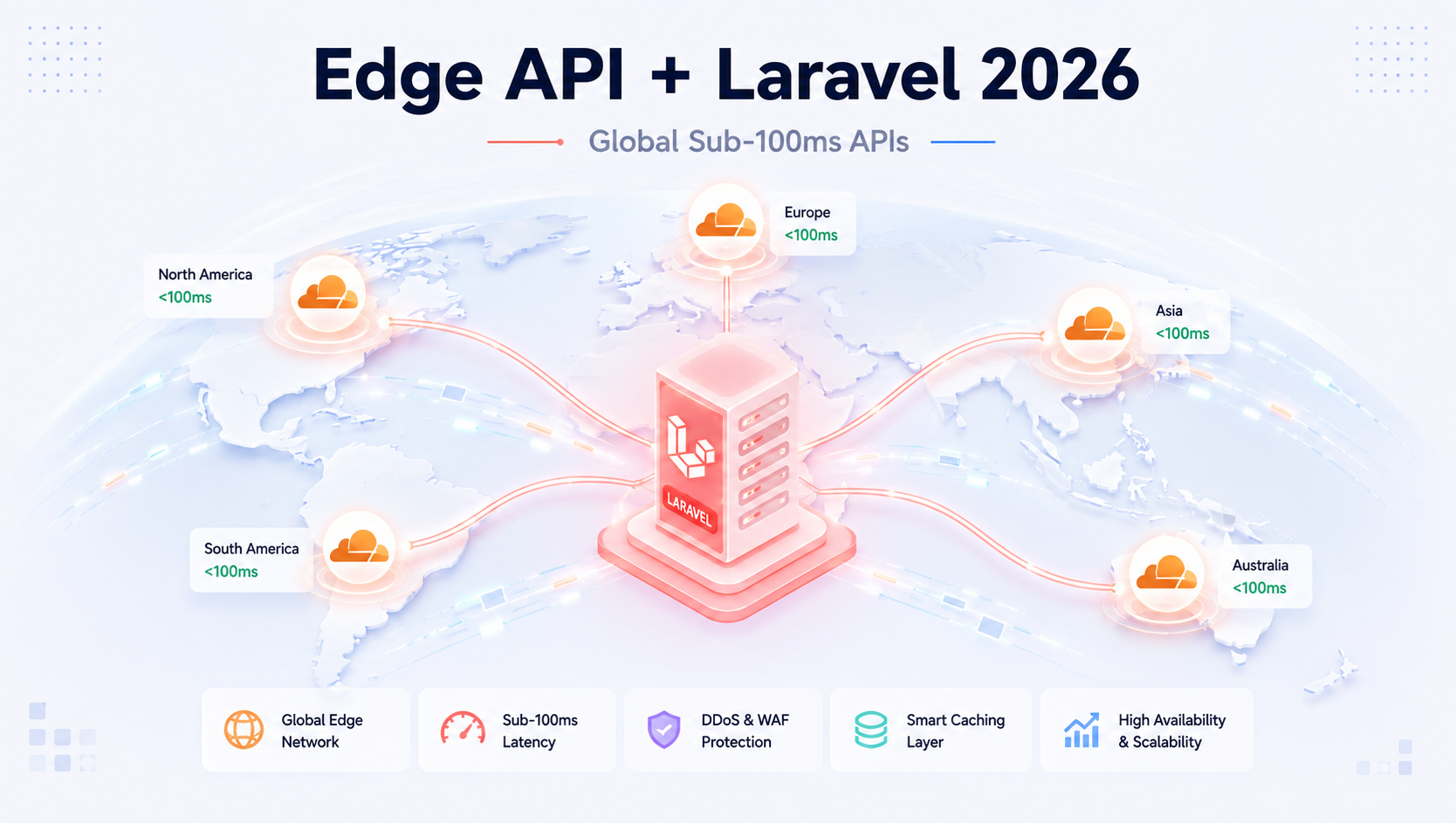
Your API responds in 80ms from your office in Bangalore. A customer in São Paulo reports 800ms. Another in Sydney sees 1.2 seconds. Same endpoint, same code, ten times the latency. Welcome to the geography problem every growing SaaS eventually hits.
In 2026, the answer isn't another origin server in another region. It's edge computing — running your API logic on hundreds of points-of-presence around the world, milliseconds from every user. And the architecture pattern winning production deployments this year is surprisingly elegant: Cloudflare Workers at the edge, Laravel at the origin, with each layer doing what it does best.
This guide walks through that exact stack — when to use it, how to architect it, the code that makes it work, and the production lessons we've learned shipping it for clients.
The Latency Problem Every Global SaaS Hits
Most Laravel applications start with a single origin server. That works beautifully until your customer base spreads geographically. Here's what physics looks like for a single-origin API hosted in Mumbai:
| User Location | Network RTT | API Response Time |
|---|---|---|
| Mumbai | 5–10ms | 80ms |
| Singapore | 60ms | 140ms |
| London | 130ms | 220ms |
| New York | 200ms | 290ms |
| São Paulo | 280ms | 360ms |
| Sydney | 220ms | 310ms |
Add TLS handshakes, retries, and the cost compounds. By the time a Brazilian user fills a dashboard, they've waited 5–8 seconds longer than your Indian users — for the exact same feature.
The traditional answer was multi-region deployment: spin up replicas in each region, replicate the database, manage failover. It works, but it's expensive, complex, and slow to operationalize. Edge computing offers a different path.
Industry Trends Driving Edge-First Architecture in 2026
A few shifts make edge architecture the default for global SaaS in 2026:
- Cloudflare Workers matured dramatically. Smart Placement, Durable Objects, Workers AI, Hyperdrive, and D1 turned Workers from "Lambda-lite" into a real application platform
- JavaScript/TypeScript at the edge is universal. Bun and modern V8 runtimes deliver near-native performance for stateless logic
- Database edge access matured. Cloudflare Hyperdrive, Neon, Turso, and PlanetScale offer edge-aware connection pooling
- Auth providers shipped edge SDKs. Clerk, Auth0, and WorkOS now run identity verification at the edge
- Compliance demands localized processing. GDPR, India's DPDP, and similar laws push data validation and PII handling to the user's region
- Costs cratered. Edge compute is dramatically cheaper per-request than traditional VMs for high-volume, low-CPU workloads
The result: hybrid architectures where stateless logic lives at the edge and stateful business logic stays on Laravel are now the production standard.
Edge vs Traditional API: When Each Wins
| Capability | Edge (Cloudflare Workers) | Traditional Laravel API |
|---|---|---|
| Global latency | 10–50ms anywhere | 80–500ms by region |
| Cold start | None (V8 isolates) | None (long-running PHP-FPM) |
| Complex business logic | Limited | Excellent |
| ORM access | Indirect | Eloquent first-class |
| File system | Limited | Full access |
| Compute time per request | ~30s max | Unlimited |
| Memory per request | 128–512MB | Server-bound |
| Language | JS/TS/Rust/WASM | PHP |
| Best for | Auth, caching, rate limiting, transformation | Business logic, data persistence, AI orchestration |
The mistake teams make is choosing one or the other. The winning architecture in 2026 uses both.
The Hybrid Edge + Laravel Architecture Pattern
Picture three layers:
Layer 1 — Cloudflare Edge (Workers):
- Handles authentication / token verification
- Caches responses for read-heavy endpoints
- Enforces rate limits per IP/user/tenant
- Transforms request/response payloads
- Geo-routes traffic to the closest origin
- Returns cached or computed results without hitting origin when possible
- Validates input before forwarding
Layer 2 — Laravel Origin (one or more regions):
- Handles complex business logic
- Manages database transactions
- Orchestrates AI/LLM calls
- Runs background jobs and queues
- Maintains source of truth
Layer 3 — Database & Storage:
- Primary database (PostgreSQL, MySQL)
- Object storage (S3, R2)
- Cache layer (Redis, KV)
The edge layer absorbs 40–70% of traffic before it ever reaches your Laravel origin. Your origin runs leaner, faster, and cheaper. Users see dramatically lower latency.
Step-by-Step: Building Your First Edge API on Cloudflare Workers + Laravel
Here's the practical implementation walkthrough.
Step 1: Set Up Wrangler and Your First Worker
npm install -g wrangler
wrangler login
wrangler init my-edge-api
cd my-edge-api
You'll get a starter project with TypeScript scaffolding and a wrangler.toml config.
Step 2: Configure Your Worker
# wrangler.toml
name = "saas-edge-api"
main = "src/index.ts"
compatibility_date = "2026-05-01"

[vars]
LARAVEL_ORIGIN = "https://api.yoursaas.com"
ENVIRONMENT = "production"

[[kv_namespaces]]
binding = "CACHE"
id = "your-kv-namespace-id"

[[d1_databases]]
binding = "DB"
database_name = "edge-metadata"
database_id = "your-d1-id"
Step 3: Build the Edge Worker Logic
/// src/index.ts
import { Hono } from 'hono';
import { jwt } from 'hono/jwt';
import { cache } from 'hono/cache';

type Bindings = {
  LARAVEL_ORIGIN: string;
  CACHE: KVNamespace;
  JWT_SECRET: string;
};

const app = new Hono<{ Bindings: Bindings }>();

// 1. Auth at the edge
app.use('/api/*', async (c, next) => {
  const middleware = jwt({ secret: c.env.JWT_SECRET });
  return middleware(c, next);
});

// 2. Rate limit at the edge
app.use('/api/*', async (c, next) => {
  const userId = c.get('jwtPayload').sub;
  const key = `rate:${userId}:${Math.floor(Date.now() / 60000)}`;
  const count = parseInt((await c.env.CACHE.get(key)) || '0');

  if (count > 100) {
    return c.json({ error: 'Rate limit exceeded' }, 429);
  }

  await c.env.CACHE.put(key, String(count + 1), { expirationTtl: 60 });
  return next();
});

// 3. Cache GET requests
app.get('/api/projects', async (c) => {
  const userId = c.get('jwtPayload').sub;
  const cacheKey = `projects:${userId}`;

  const cached = await c.env.CACHE.get(cacheKey, 'json');
  if (cached) {
    return c.json(cached, 200, { 'x-edge-cache': 'HIT' });
  }

  const response = await fetch(`${c.env.LARAVEL_ORIGIN}/api/projects`, {
    headers: { 'Authorization': c.req.header('Authorization') ?? '' }
  });

  const data = await response.json();
  await c.env.CACHE.put(cacheKey, JSON.stringify(data), { expirationTtl: 300 });

  return c.json(data, 200, { 'x-edge-cache': 'MISS' });
});

// 4. Forward writes directly to origin
app.post('/api/*', async (c) => {
  return fetch(`${c.env.LARAVEL_ORIGIN}${c.req.path}`, {
    method: 'POST',
    headers: c.req.raw.headers,
    body: c.req.raw.body,
  });
});

export default app;
Step 4: Configure Laravel to Accept Edge Traffic
// app/Http/Middleware/VerifyEdgeRequest.php

namespace App\Http\Middleware;

use Closure;
use Illuminate\Http\Request;
use Symfony\Component\HttpFoundation\Response;

class VerifyEdgeRequest
{
    public function handle(Request $request, Closure $next): Response
    {
        $edgeSecret = $request->header('X-Edge-Secret');

        if ($edgeSecret !== config('services.cloudflare.edge_secret')) {
            abort(403, 'Origin requests must come through edge layer');
        }

        // Trust the edge-forwarded user context
        $request->attributes->set(
            'edge_user_id',
            $request->header('X-Edge-User-Id')
        );

        return $next($request);
    }
}
Step 5: Forward Auth Context From Edge to Origin
// In your edge worker, after JWT verification
const userId = c.get('jwtPayload').sub;
const tenantId = c.get('jwtPayload').tenant_id;

const response = await fetch(`${c.env.LARAVEL_ORIGIN}/api/projects`, {
  headers: {
    'X-Edge-Secret': c.env.EDGE_SECRET,
    'X-Edge-User-Id': userId,
    'X-Edge-Tenant-Id': tenantId,
    'X-Edge-Region': c.req.cf?.colo ?? 'unknown',
    'Content-Type': 'application/json',
  },
  body: c.req.raw.body,
});
Now Laravel can trust the user context already verified at the edge — no double-authentication round-trip.
Step 6: Deploy
wrangler deployWithin seconds, your Worker is live on Cloudflare's 300+ edge locations globally.
Smart Placement: Letting Cloudflare Optimize Routing
For workers that frequently call your Laravel origin, enable Smart Placement:
# wrangler.toml
[placement]
mode = "smart"
Cloudflare automatically runs your Worker close to your origin when that's faster overall (e.g., when you call origin multiple times per request). For read-heavy cached endpoints, it stays at the user's edge. The platform learns your traffic patterns and optimizes routing per request.
Caching Patterns That Save 60% of Origin Traffic
Pattern 1: Stale-While-Revalidate
async function fetchWithSWR(c: Context, key: string, originUrl: string) {
  const cached = await c.env.CACHE.get(key, 'json');

  if (cached) {
    // Return stale response immediately
    c.executionCtx.waitUntil(refreshCache(c.env, key, originUrl));
    return c.json(cached);
  }

  // Cache miss — fetch and store
  const fresh = await fetch(originUrl).then(r => r.json());
  await c.env.CACHE.put(key, JSON.stringify(fresh), { expirationTtl: 300 });
  return c.json(fresh);
}
Pattern 2: Per-Tenant Cache Tags
Tag cached items by tenant for clean invalidation:
// On cache write
await c.env.CACHE.put(`tenant:${tenantId}:projects`, data, {
  expirationTtl: 300,
  metadata: { tags: [`tenant:${tenantId}`] }
});

// On cache invalidation (triggered by Laravel webhook)
const keys = await c.env.CACHE.list({ prefix: `tenant:${tenantId}:` });
await Promise.all(keys.keys.map(k => c.env.CACHE.delete(k.name)));
Real Business Examples
Case 1 — A global B2B SaaS with users across 40 countries: Migrated read-heavy endpoints (dashboard data, user profile, settings) to Cloudflare Workers with KV caching. P95 latency dropped from 580ms to 90ms. Origin Laravel servers saw 58% less traffic — they downsized infrastructure and saved $4,400/month.
Case 2 — A multi-tenant analytics platform: Used Workers exclusively for authentication, rate limiting, and request shaping. Origin Laravel API focused only on business logic and DB access. Result: 40% faster perceived load times for international users, plus a clean security perimeter at the edge.
Case 3 — A fintech webhook receiver: Moved webhook validation, signature verification, and idempotency checking to Workers. Only validated payloads ever reached Laravel. Eliminated 12,000 invalid webhook hits per day from origin processing — and gained sub-50ms acknowledgment globally.
The pattern: edge handles plumbing, origin handles substance. Done right, this delivers both performance and architectural clarity.
Best Practices for Edge + Laravel Architecture
- Use the edge for everything stateless — auth verification, rate limiting, caching, geo-routing, request validation
- Keep Laravel as the source of truth. Edge is fast cache; origin is authoritative
- Sign edge-to-origin requests with a shared secret to prevent direct origin abuse
- Forward user context via headers so origin doesn't re-verify JWTs unnecessarily
- Use Hono or itty-router for clean Worker code — raw Workers API gets messy fast
- Version your Workers and use staged rollouts (10% → 50% → 100%)
- Test locally with Miniflare before deploying — production debugging at the edge is harder
- Log to Cloudflare Logpush and ship to Datadog/Honeycomb for proper observability
- Set conservative timeouts at edge (5–10s) to fail fast if origin is degraded
- Cache write invalidation must come from Laravel — fire webhooks or use Queue events
Common Mistakes Teams Make
- Putting business logic at the edge. It belongs in Laravel where Eloquent, validation, and policies are first-class
- Forgetting cache invalidation. Stale dashboards lead to support tickets — design TTLs and invalidation hooks from day one
- Trusting client-side headers at origin. Always verify they came through the edge (signed header pattern)
- Skipping CORS configuration on the edge. Edge becomes the new origin from the browser's perspective
- Using fetch() without retries. Network blips between edge and origin happen — implement exponential backoff
- No fallback when origin is down. Edge should return stale-cached responses gracefully when origin returns 5xx
- Ignoring Workers CPU limits. Heavy computation (cryptography, large JSON parsing) can hit the 30s wall — offload to Laravel
- Overcaching dynamic content. Personalized data should never be cached without user-scoped keys
Security Tips for Edge + Laravel
- Sign every edge-to-origin request with an HMAC header — reject unsigned origin requests
- Use mutual TLS between Cloudflare and your origin where possible (Cloudflare offers Origin CA certs)
- Restrict origin access to Cloudflare IP ranges via firewall — block direct internet access
- Verify JWTs at the edge AND honor expiration — short-lived tokens prevent edge cache poisoning
- Rate limit per user, per IP, and per tenant — three independent dimensions
- Use Cloudflare Turnstile for bot detection on auth/signup endpoints
- Audit edge code for secrets — never commit JWT secrets, even in
wrangler.toml - Enable Cloudflare WAF rules for SQL injection, XSS, and OWASP Top 10 detection at the edge
- Run edge logs through SIEM — edge is now part of your security perimeter
Performance Tips
- Use HTTP/3 (QUIC) between client and edge for fastest connection establishment
- Co-locate KV namespaces in regions where your traffic concentrates
- Use Cloudflare Hyperdrive for connection pooling when edge talks directly to PostgreSQL
- Compress responses at the edge (Brotli) — Workers do this automatically with
Accept-Encoding - Stream responses rather than buffering when forwarding large payloads
- Use Durable Objects for stateful edge logic (presence, leaderboards, coordination)
- Minimize cold dependencies — every imported library adds startup cost
- Bundle with esbuild to keep Worker scripts under 1MB compressed
Cost Comparison: Edge Platforms in 2026
| Platform | Best For | Pricing Model |
|---|---|---|
| Cloudflare Workers | General-purpose edge compute | Per-request (very low) + included free tier |
| AWS Lambda@Edge | AWS-integrated workloads | Per-request + per-millisecond |
| Vercel Edge Functions | Next.js apps and frontend-tied APIs | Bundled with Vercel plans |
| Fastly Compute@Edge | Performance-critical workloads | Per-request + per-millisecond |
| Deno Deploy | TypeScript-first teams | Per-request, generous free tier |
| Netlify Edge Functions | Static-site adjacent APIs | Bundled with Netlify plans |
For most Laravel-backed SaaS, Cloudflare Workers wins on cost, global presence, and ecosystem maturity. Check current pricing pages before committing — edge pricing evolves quickly.
Future Trends: Where Edge + Laravel Heads in 2026 and Beyond
- Edge databases mainstream. Cloudflare D1, Turso, and Neon push more read traffic entirely off origin
- Workers AI matures. LLM inference at the edge becomes viable for moderate workloads, cutting AI latency dramatically
- Durable Objects everywhere. Stateful coordination (real-time collaboration, presence, chat rooms) increasingly happens at edge
- Multi-origin smart routing. Cloudflare Workers automatically route to the nearest healthy Laravel origin in multi-region deployments
- Laravel Octane + Edge becomes standard. Octane handles surviving origin traffic; edge handles everything else
- WebAssembly at edge for cross-language code (Rust, Go) embedded in Workers
- Compliance routing. EU users automatically routed through EU edge → EU origin for data residency
When NOT to Use Edge Architecture
Be honest with yourself. Edge isn't always the answer:
- Your user base is concentrated in one geography (single-region deployment is simpler)
- Your API is write-heavy with no cacheable reads (edge adds latency, not removes it)
- You have under 100K requests/day (operational overhead exceeds benefit)
- Your team has no JavaScript/TypeScript bandwidth
- You require complex computation per request (origin is more flexible)
Most SaaS hit the threshold where edge starts paying off around 500K+ requests/day or when their first international customer complains about speed.
FAQs
Q1: Do I need to rewrite my Laravel API to use Cloudflare Workers? No. Most teams adopt edge incrementally — start with one read-heavy endpoint behind a Worker, expand as you see wins. Laravel doesn't change; the Worker simply sits in front of it.
Q2: How much does Cloudflare Workers cost compared to running more Laravel servers? Significantly less for the same workload. Workers price per-request (fractions of a cent per million) versus VM/container hosting that you pay for 24/7 regardless of traffic. Most teams see 50–80% infrastructure cost reduction on shifted workloads.
Q3: Can I use Eloquent or Laravel models in Workers? No — Workers run JavaScript/TypeScript, not PHP. The pattern is: Workers handle edge logic (auth, caching, routing) and forward to Laravel for anything needing Eloquent, validation, or business logic.
Q4: How do I handle database access from Cloudflare Workers? Three options: (1) forward all DB access to Laravel via HTTP, (2) use Cloudflare Hyperdrive to pool connections to your existing PostgreSQL/MySQL, (3) use edge-native databases like D1, Turso, or Neon for cacheable lookups.
Q5: Is edge architecture overkill for a small SaaS? Often, yes. Under 100K daily requests with a single geographic market, traditional Laravel hosting is simpler and cheaper. Reach for edge when international users complain, traffic grows past 500K daily requests, or you're hitting origin CPU limits.
Q6: How do I debug issues in production Workers? Use wrangler tail for live log streaming, Cloudflare Logpush to ship logs to your observability platform, and Workers Trace Events for performance analysis. Local Miniflare environment catches most issues before deploy.
Q7: Can the edge layer break my application if Cloudflare has an outage? It can, which is why critical APIs should have a direct-to-origin fallback DNS path. Configure Cloudflare in "no orange cloud" mode for emergency endpoints, and design Workers to fail open (forward to origin) rather than fail closed on internal errors.
Conclusion
Edge architecture isn't a replacement for Laravel — it's a force multiplier. The right pattern in 2026 puts Cloudflare Workers in front, doing what edge does best (speed, caching, validation, security), and lets Laravel keep doing what it does best (business logic, data, orchestration).
Pick one read-heavy endpoint this month. Put a Worker in front of it. Measure the latency drop. Once you see the gains, the rest of your API will follow naturally.
Global speed used to be an enterprise problem. In 2026, it's a Wrangler deploy command.
CTA Section
Ready to bring your Laravel API to the edge?
Softtechover's senior backend and DevOps team has shipped production edge architectures on Cloudflare Workers, AWS Lambda@Edge, and Vercel Edge Functions — paired with Laravel origins serving global SaaS users. We help you design the right hybrid pattern, ship it incrementally, and measure real performance wins.