
Every SaaS founder integrating AI in 2026 eventually gets the same nasty surprise: the AI API bill. What started as a $200/month experiment becomes a $20,000/month line item by Q3. Suddenly your AI features are the most expensive infrastructure in your stack — and you have no idea why.
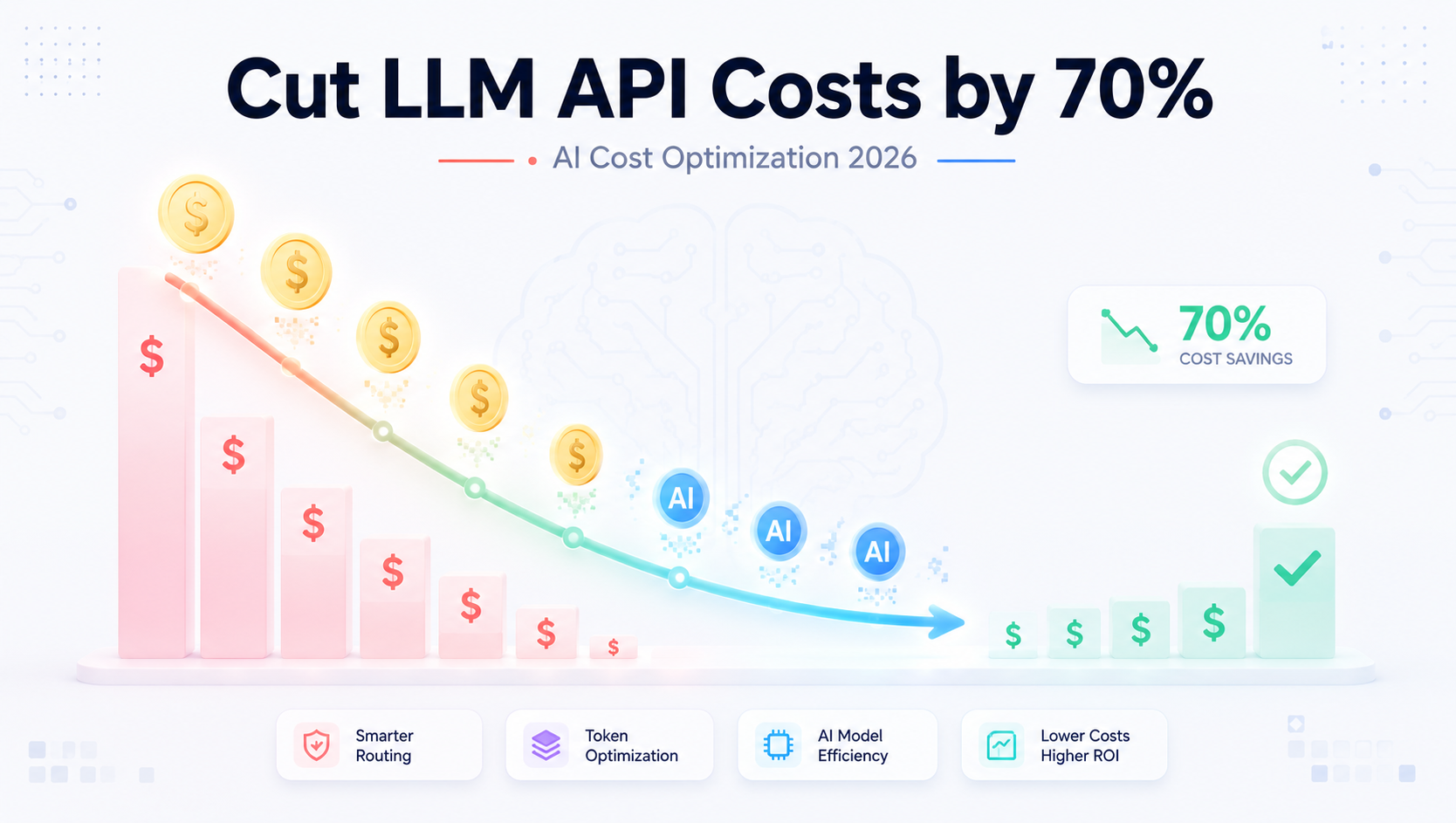
The problem isn't that LLMs are too expensive. It's that most teams use them carelessly. A handful of optimization tactics — applied systematically — routinely cut LLM API bills by 60–80% without sacrificing product quality.
This guide is the practical playbook we walk every client through. Real numbers, real code, real wins. No theory, no hype.
The 2026 LLM Cost Crisis Nobody Talks About
AI hype has subsided. The bills haven't. Three things make 2026 the year of LLM cost reckoning:
- Token consumption exploded. Multi-turn agents, RAG pipelines, and reasoning models burn 10–100x more tokens than 2024-era chat apps
- Reasoning models are expensive. OpenAI's o-series and Anthropic's extended-thinking modes deliver brilliant results — at premium rates per token
- Per-tenant AI is standard. Every SaaS user expects AI features now, multiplying token usage across your entire customer base
- Streaming + tools = compounding costs. Tool-calling loops can quietly consume 20,000 tokens to answer one question
- VCs stopped subsidizing. The "burn now, monetize later" era is over. CFOs want AI margins above 70%
Most SaaS teams discover all of this only after the bill arrives.
Industry Trends Reshaping LLM Economics in 2026
A few shifts have changed how smart teams approach AI cost:
- Open-source models hit parity for many tasks. Llama 4, Mistral Large 3, and Qwen 3 handle 70% of production workloads at fractions of GPT-class pricing
- Inference providers commoditized. Groq, Together AI, Fireworks, and Cerebras compete fiercely on $/token for OSS models
- Prompt caching became standard. Both Anthropic and OpenAI now offer prompt caching that cuts repeated-context costs by 90%
- Model routers emerged. Tools like Portkey, OpenRouter, and Helicone route each request to the cheapest capable model automatically
- Embeddings cratered in price. Vector embeddings now cost so little they enable aggressive semantic caching strategies
The teams that internalize these shifts are paying a tenth of what their competitors are.
Where LLM Costs Actually Come From (Audit First, Optimize Second)
Before optimizing, you need a clear cost breakdown. Most teams discover their bill comes from surprising places:
| Cost Source | Typical % of Bill | Optimization Potential |
|---|---|---|
| Repeated similar queries | 30–40% | Very High (caching) |
| Oversized prompts (RAG bloat) | 15–25% | High (compression, retrieval tuning) |
| Wrong model for the task | 15–20% | High (routing) |
| Multi-turn agent loops | 10–20% | Medium (tool design, max-turn limits) |
| Streaming tokens nobody reads | 5–10% | Medium (UI patterns) |
| Test/dev traffic in production | 5–10% | Easy (environment separation) |
Skip the audit and you'll optimize the wrong thing. Always start with cost attribution.
The 12 Tactics That Cut LLM Bills by 70%
Here's the practical playbook. Apply these in order — each one compounds.
Tactic 1: Implement Aggressive Prompt Caching
Both Anthropic and OpenAI charge dramatically less (often 10% of standard price) for cached prompt tokens. If your system prompt is 4,000 tokens and you call the API 10,000 times a day, caching saves you thousands per month.
# Anthropic prompt caching example
response = client.messages.create(
    model="claude-sonnet-4-5",
    max_tokens=1024,
    system=[
        {
            "type": "text",
            "text": "You are a customer support agent for ACME SaaS...",
            "cache_control": {"type": "ephemeral"}  # Cache this!
        }
    ],
    messages=[{"role": "user", "content": user_query}]
)
Cache anything stable: system prompts, RAG context that doesn't change per query, few-shot examples, tool definitions.
Tactic 2: Add a Semantic Cache Layer
Cache responses by meaning, not exact match. Two slightly different user queries with the same intent should hit the same cached answer.
# Pseudo-code for semantic caching
embedding = get_embedding(user_query)
cached = vector_db.search(embedding, threshold=0.95)

if cached:
    return cached.response  # No LLM call needed
else:
    response = call_llm(user_query)
    vector_db.store(embedding, response)
    return response
Tools like GPTCache, Redis Vector, or pgvector make this straightforward. Hit rates of 30–50% are common in customer-facing SaaS.
Tactic 3: Route to the Cheapest Capable Model
Not every query needs GPT-5 or Claude Opus. Build a router that classifies request difficulty and sends it to the smallest model that can handle it.
// Laravel example: simple difficulty router
class LlmRouter
{
    public function route(string $query): string
    {
        $tokenCount = $this->estimateTokens($query);
        $complexity = $this->classifyComplexity($query);

        return match (true) {
            $complexity === 'simple' && $tokenCount < 500 => 'llama-3.3-8b',
            $complexity === 'medium' => 'claude-haiku-4-5',
            $complexity === 'complex' => 'claude-sonnet-4-5',
            default => 'claude-opus-4',
        };
    }
}
A typical routing setup sends 60% of traffic to cheap models, 30% to mid-tier, and only 10% to flagship models — slashing costs 5–10x.
Tactic 4: Trim Your Prompts Ruthlessly
Every token in your prompt costs money — forever. Audit your system prompts mercilessly:
- Cut redundant instructions
- Replace verbose examples with concise ones
- Move stable content into cached prompt segments
- Compress JSON schemas (use shorter field names where readable)
- Remove polite filler ("Please be helpful, kind, and..." adds nothing)
A typical audit cuts system prompts by 40–60% with zero quality loss.
Tactic 5: Use Structured Outputs Instead of JSON Parsing Loops
When you ask an LLM to "return JSON" and it returns malformed JSON, you retry. Each retry doubles your cost. Use native structured output features (OpenAI's response_format, Anthropic's tool use schemas) to eliminate retry loops.
response = client.chat.completions.create(
    model="gpt-4o-mini",
    messages=[...],
    response_format={
        "type": "json_schema",
        "json_schema": {
            "name": "extraction",
            "schema": {
                "type": "object",
                "properties": {
                    "title": {"type": "string"},
                    "tags": {"type": "array", "items": {"type": "string"}},
                },
                "required": ["title", "tags"]
            }
        }
    }
)
Guaranteed valid JSON = no retries = predictable costs.
Tactic 6: Cap Multi-Turn Agent Loops
Agentic workflows can quietly spin in tool-calling loops, burning 50,000+ tokens to answer a question. Hard-cap maximum turns and fail gracefully:
MAX_AGENT_TURNS = 8
TOKEN_BUDGET_PER_REQUEST = 30_000

turn = 0
total_tokens = 0
while turn < MAX_AGENT_TURNS and total_tokens < TOKEN_BUDGET_PER_REQUEST:
    response = call_agent(...)
    total_tokens += response.usage.total_tokens
    turn += 1
    if response.stop_reason == "end_turn":
        break
else:
    return fallback_response()
This single check has saved clients thousands in runaway-agent costs.
Tactic 7: Use Open-Source Models for Bulk Workloads
Tasks that aren't customer-facing (background classification, summarization, embeddings prep, internal labeling) rarely need flagship models. Run them on hosted OSS providers:
- Groq for ultra-fast Llama 4 inference
- Together AI for cheap Mixtral / Llama variants
- Fireworks for fine-tuned OSS deployment
- Cerebras for blazing-fast OSS inference
Typical savings: 80–95% vs flagship API pricing for the same tasks.
Tactic 8: Implement Token Budgeting Per Tenant
In multi-tenant SaaS, one heavy tenant can blow your monthly AI budget. Set per-tenant quotas:
class TenantTokenBudget
{
    public function canConsume(Tenant $tenant, int $tokens): bool
    {
        $monthlyLimit = $tenant->plan->monthly_token_limit;
        $consumed = $tenant->tokens_consumed_this_month;

        return ($consumed + $tokens) <= $monthlyLimit;
    }

    public function track(Tenant $tenant, int $tokens): void
    {
        $tenant->increment('tokens_consumed_this_month', $tokens);

        if ($tenant->isApproachingLimit()) {
            event(new TenantApproachingTokenLimit($tenant));
        }
    }
}
This also unlocks usage-based pricing — turning your cost center into revenue.
Tactic 9: Optimize RAG Retrieval to Reduce Context Bloat
Most RAG pipelines stuff 10–20 chunks into every prompt, "just in case." Most of those chunks are irrelevant — and you pay for every token.
- Retrieve fewer, better chunks. 3–5 high-quality chunks beat 15 mediocre ones
- Use reranking (Cohere Rerank, Voyage AI) to filter retrieval results before LLM submission
- Compress chunks with a small model before passing to the expensive one
- Truncate aggressively based on relevance scores
- Skip RAG entirely for queries the LLM can answer from its training data
A typical RAG optimization cuts context tokens by 50–70%.
Tactic 10: Stream Only When Users Will See It
Streaming feels great but costs the same as non-streaming. Worse, users often navigate away mid-stream — and you're still billed for every token generated. For background processing (summaries, batch tagging), skip streaming entirely. For chat UIs, abort streaming when the user leaves the page.
Tactic 11: Separate Dev/Test from Production Keys
Audit your API keys. Most teams have CI/CD, local dev, staging, and integration tests all hitting production billing. Use distinct keys with strict spend limits per environment:
- Production: full budget
- Staging: 10% of prod
- CI/CD: 1% of prod, with cached fixtures for repeat tests
- Local dev: $50/dev/month hard cap
Tactic 12: Monitor With Real LLM Observability Tools
You can't optimize what you can't measure. Modern LLM observability platforms have transformed cost management in 2026:
- Helicone — request-level cost analytics, caching layer included
- Langfuse — open-source LLM tracing and cost monitoring
- Portkey — AI gateway with caching, routing, and analytics
- OpenRouter — unified API with built-in cost tracking across providers
Install one in week one of any AI project. The visibility alone usually unlocks 20–30% in obvious wins.
Real Business Examples
Case 1 — A customer support SaaS: Was paying $34,000/month for OpenAI. Implemented semantic caching (40% hit rate), prompt caching on a 2,500-token system prompt, and model routing. New bill: $9,200/month. Saved $300,000 annually.
Case 2 — A legal AI startup: Multi-turn agents were averaging 14 turns per query at $0.40 each. Capped at 6 turns + added reranking to RAG retrieval. Per-query cost dropped from $5.60 to $1.10. Customer-facing latency also improved.
Case 3 — A B2B analytics SaaS: Moved 80% of background summarization workloads to Llama 4 on Groq. Flagship GPT model kept only for final customer-facing report generation. AI infrastructure spend dropped 76% with no measurable quality difference in user satisfaction scores.
The pattern across all three: systematic optimization beats hero engineering. No single tactic saved them — the compounded application of multiple tactics did.
LLM Pricing Comparison (2026 Snapshot)
| Model | Input ($/1M tokens) | Output ($/1M tokens) | Best For |
|---|---|---|---|
| Claude Opus 4.7 | $$$ | $$$$ | Complex reasoning, premium UX |
| Claude Sonnet 4.6 | $$ | $$$ | Balanced production workhorse |
| Claude Haiku 4.5 | $ | $$ | High-volume customer queries |
| GPT-class flagship | $$$ | $$$$ | Complex agents |
| GPT-class mid-tier | $$ | $$ | General SaaS features |
| Llama 4 (Groq) | $ | $ | Bulk classification, summaries |
| Mistral Large 3 | $ | $$ | European compliance + reasoning |
| Gemini Flash | $ | $ | Cheapest mass-market option |
(Exact pricing changes monthly — always check provider pricing pages before locking in architecture.)
Best Practices for LLM Cost Management
- Treat tokens like dollars in the codebase. Every prompt edit should consider cost impact
- Build an internal AI gateway rather than calling provider APIs directly from app code
- Log every LLM call with tenant ID, model, tokens, and cost
- Set monthly budget alerts at 50%, 80%, and 95% thresholds
- Run quarterly cost audits — patterns shift as users grow
- Negotiate volume pricing with providers once you exceed $10K/month
- Test new models in shadow mode before swapping — quality regressions are real
- Build "expensive query" detection so engineers see warnings during development
- Document model selection rationale for every feature — future you will thank present you
Common Mistakes Teams Make
- Defaulting to the flagship model "to be safe." Costs 10x more than necessary for most tasks
- No prompt versioning. You'll never know which version is more expensive
- Inline API keys in app code instead of through a gateway — no central cost control
- Skipping caching because "every query is unique." Most queries aren't. Measure first
- Streaming everything by default. Background jobs don't need it
- Treating prompt engineering as a one-time task. Prompts decay. Audit quarterly
- Forgetting embedding costs. They're tiny per call but enormous in bulk
- Building features without cost budgets. "Will this feature be profitable?" should always have an answer
Security and Compliance Tips for AI Cost Optimization
- Never log full prompts or responses in plaintext if they contain PII — use redaction
- Apply rate limiting per tenant and per user to prevent runaway abuse
- Audit who has API key access — over-provisioned keys leak through Slack and CI logs
- Use cloud provider audit logs (AWS CloudTrail equivalents) on Bedrock/Vertex AI calls
- Implement spending circuit breakers — automatic shutoff if hourly burn exceeds threshold
- For regulated industries, verify caching layers comply with data retention rules
- Consider self-hosted OSS models for genuinely sensitive workflows (data sovereignty + cost win)
Performance Tips That Also Cut Costs
- Batch embedding generation instead of one-at-a-time
- Pre-compute embeddings asynchronously rather than at query time
- Cache tokenizers and clients to avoid initialization overhead
- Use HTTP/2 keep-alive connections to provider APIs to reduce latency overhead
- Co-locate your app with model providers when possible (e.g., AWS Bedrock + AWS app servers)
- Implement request deduplication — identical concurrent queries become one upstream call
- Use async/queued processing for non-realtime AI workloads — easier to throttle and batch
Future Trends: LLM Economics Heading Into 2027
- Per-task model fine-tuning becomes cheap enough that small task-specific models replace flagship calls
- Edge inference matures. On-device LLMs handle 30–50% of queries with zero API cost
- Speculative decoding mainstream, cutting inference costs at provider level
- Stronger negotiated pricing as the market matures and providers compete for enterprise contracts
- AI cost FinOps becomes a discipline — expect "AI FinOps Engineer" job titles by mid-2027
- Open-source models matching flagship quality for 80%+ of tasks at 5–10% the cost
- Hybrid local + cloud routing as the default architecture pattern
A Practical 30-Day Cost Reduction Plan
If you're staring at a scary AI bill right now, here's the recommended sequence:
Week 1: Install observability (Helicone, Langfuse, or Portkey). Audit costs by feature, model, and tenant.
Week 2: Implement prompt caching on stable system prompts and RAG context. Cut prompt sizes 30–50%.
Week 3: Add semantic caching for repeat-pattern queries. Build a simple model router for clearly-tiered workloads.
Week 4: Migrate bulk/background workloads to OSS providers. Set per-tenant quotas. Establish ongoing cost alerts.
Most teams see 50%+ savings by day 30 with this sequence.
FAQs
Q1: What's the single biggest LLM cost optimization? For most SaaS, it's prompt caching combined with semantic caching. The two together routinely cut bills 40–60% before any other change. Cache aggressively before optimizing anything else.
Q2: Should I switch entirely to open-source models? No — use them strategically. OSS models excel at bulk classification, summarization, embeddings, and well-defined narrow tasks. Keep flagship models for complex reasoning, premium customer experiences, and high-stakes accuracy needs.
Q3: How do I justify LLM costs to investors or CFOs? Frame AI cost as a percentage of revenue per feature, not as absolute infrastructure spend. A feature costing $3 per active user per month is fine if the feature lifts retention by 15%. Track unit economics, not raw bills.
Q4: What's the ROI of building an internal AI gateway? Significant. A simple internal gateway (one engineer-week to build) typically delivers 20–30% cost savings through centralized caching, routing, and observability. Tools like Portkey or LiteLLM let you skip building from scratch.
Q5: How often should I re-audit my LLM costs? Monthly at minimum, weekly at scale. AI usage patterns shift fast as users discover new features. What worked in Q1 will look wasteful by Q3.
Q6: Should startups use AI gateways like Portkey or LiteLLM in production? Yes. The reliability, multi-provider failover, and built-in caching alone justify it. The cost analytics are a major bonus. Most teams adopt one within their first six months of meaningful AI usage.
Q7: Does caching ruin response quality or freshness? Not if implemented correctly. Cache stable content (system prompts, RAG context), not query-specific freshness-sensitive responses. Set TTLs appropriately and invalidate on relevant data changes.
Conclusion
LLM costs aren't fundamentally unmanageable — they're systematically mismanaged. The teams that win in 2026 treat AI spend with the same rigor they apply to cloud infrastructure costs: monitor, attribute, optimize, repeat.
Pick three tactics from this guide. Implement them in the next two weeks. Watch your bill drop. Then come back for the next three.
The AI features customers love don't have to be the line item that kills your margins. Engineer them like any other production system — with cost awareness baked in from day one.
CTA Section
Watching your LLM API bill spiral out of control?
Softtechover's AI engineering team helps SaaS companies systematically reduce AI costs while improving product quality. We audit your current spend, implement caching and routing strategies, build cost-aware AI architectures, and deliver measurable savings — typically 50–80% within 30 days.