
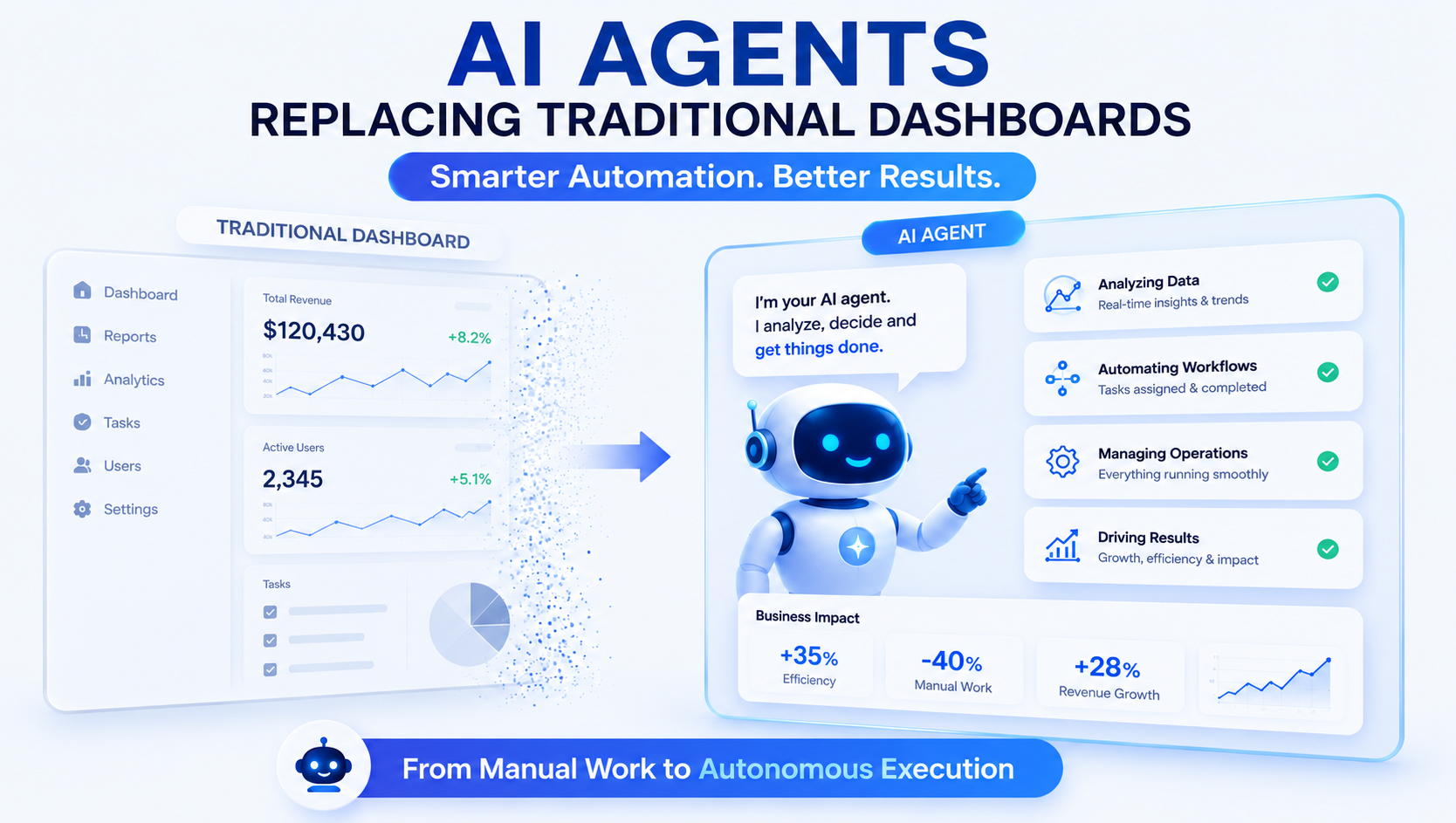
The dashboard was once the heart of every SaaS product.
Rows of charts. KPI widgets. Filters. Export buttons. Navigation menus. Businesses spent the last decade building software around dashboards because users needed a visual way to analyze data and manage workflows.
But in 2026, something fundamental changed.
Users no longer want to “operate software.” They want software to operate for them.
Instead of opening a dashboard to manually generate reports, assign tasks, filter records, or analyze trends, companies are now deploying AI agents that perform these actions automatically through natural conversation and autonomous workflows.
The shift is happening faster than most SaaS founders expected.
From CRMs and analytics tools to HR platforms and customer support systems, AI agents are beginning to replace traditional SaaS interfaces entirely.
Why Traditional SaaS Dashboards Are Starting to Break
For years, dashboards solved an important problem:
They centralized information.
But modern users are overwhelmed by complexity.
Most SaaS dashboards now suffer from:
- Too many navigation layers
- Information overload
- Manual workflows
- High onboarding friction
- Poor mobile usability
- Feature fatigue
- Endless clicks for simple actions
A modern sales manager doesn’t want to:
- open 7 tabs
- export CSV files
- filter reports
- compare spreadsheets
- manually assign leads
And they expect the software to answer instantly.
That expectation shift is what’s driving the rise of AI-native interfaces.
What AI Agents Actually Do
AI agents are not simple chatbots.
Modern AI agents can:
- understand goals
- access multiple systems
- retrieve context
- execute workflows
- make decisions
- automate repetitive operations
- continuously learn from user behavior
In SaaS products, agents are becoming:
- workflow copilots
- autonomous assistants
- intelligent operators
- conversational interfaces
Instead of users navigating dashboards manually, agents become the new operational layer.
The Rise of Conversational SaaS
In 2026, SaaS UX is shifting from:
Dashboard-first → Agent-firstInstead of clicking through menus, users interact with software using:
- chat
- voice
- commands
- task requests
- natural language prompts
Examples:
Traditional SaaS
- Open analytics dashboard
- Filter date range
- Export report
- Email team
Real SaaS Products Already Moving This Direction
Several major platforms have already begun transitioning toward AI-native experiences.
| Platform | AI Direction |
|---|---|
| Notion | AI workspace assistant |
| HubSpot | AI sales copilots |
| Salesforce | Einstein AI agents |
| Intercom | AI customer support agents |
| ClickUp | AI workflow automation |
| Zendesk | Autonomous support resolution |
| Slack | AI knowledge assistant |
The common trend:
AI is moving from “feature” to “interface.”
The New SaaS Architecture in 2026
Traditional SaaS architecture focused on:
- databases
- dashboards
- CRUD operations
- admin panels
AI-native SaaS now adds:
- vector databases
- agent memory
- orchestration layers
- RAG pipelines
- workflow engines
- AI action systems
A modern AI SaaS stack often includes:
| Layer | Technology |
|---|---|
| Frontend | Next.js / Vue / React |
| Backend | Laravel / Node.js |
| LLM APIs | OpenAI / Claude / Gemini |
| Vector DB | pgvector / Pinecone / Qdrant |
| Agent Framework | LangGraph / CrewAI |
| Workflow Engine | Temporal / Trigger.dev |
| Memory Layer | Redis + Vector Storage |
The dashboard is no longer the center of the product.
The AI orchestration layer is.
Why Businesses Love AI Agents
1. Reduced Operational Friction
Employees spend less time navigating software.
2. Faster Decision Making
AI summarizes data instantly.
3. Lower Training Costs
New employees learn conversational systems faster than complex dashboards.
4. Increased Automation
Agents complete repetitive work automatically.
5. Higher Productivity
Teams focus on outcomes instead of software operations.
Where Traditional Dashboards Still Matter
Dashboards are not disappearing completely.
They still matter for:
- financial reporting
- compliance
- operational visibility
- executive monitoring
- data-heavy analysis
But their role is changing.
Dashboards are becoming:
Secondary reference systemsAI agents are becoming:
Primary interaction systemsThe Biggest Technical Challenges
Building AI-agent SaaS platforms introduces new complexity.
Agent Reliability
Hallucinations and incorrect decisions remain risks.
Context Management
Agents require memory systems and retrieval pipelines.
Permission Control
Agents must respect tenant security boundaries.
Cost Explosion
LLM usage can become expensive at scale.
Workflow Orchestration
Multi-step autonomous workflows require careful engineering.
Multi-Agent Systems Are Emerging
The next evolution is:
AI teams inside SaaS platforms
Instead of one assistant, products now deploy:
- analytics agents
- customer support agents
- finance agents
- onboarding agents
- automation agents
Each handles specialized workflows.
This architecture is becoming common in:
- enterprise SaaS
- healthcare platforms
- legal tech
- fintech
- developer tools
AI Agents vs Traditional Dashboards
| Feature | Traditional Dashboard | AI Agent System |
|---|---|---|
| User interaction | Manual clicking | Natural conversation |
| Workflow speed | Medium | Fast |
| Learning curve | High | Low |
| Automation | Limited | High |
| Personalization | Static | Dynamic |
| Scalability | Human-dependent | Autonomous |
| User experience | Complex | Adaptive |
The Economics Behind the Shift
AI agents are not just UX improvements.
They directly affect SaaS economics.
Benefits include:
- lower support costs
- reduced onboarding time
- fewer manual workflows
- improved customer retention
- higher product stickiness
AI-native SaaS products often achieve:
- better engagement
- lower churn
- higher expansion revenue
Customers increasingly prefer software that “does the work.”
FAQs
Q1: Are dashboards completely disappearing?
No. Dashboards still matter for visibility and analytics, but AI agents increasingly handle operational workflows.
Q2: What’s the difference between a chatbot and an AI agent?
Chatbots answer questions. AI agents can reason, retrieve data, execute tasks, and automate workflows.
Q3: Are AI-agent SaaS products expensive to build?
They can be, especially at scale. Infrastructure costs include LLM APIs, vector databases, orchestration systems, and monitoring.
Q4: Which backend stack works best for AI-agent SaaS?
Laravel, Node.js, Python FastAPI, and Go are all common choices depending on workload requirements.
Q5: What role do vector databases play?
They power semantic retrieval, long-term memory, personalization, and contextual AI responses.
Q6: Can small SaaS startups adopt AI agents?
Absolutely. Many startups now launch AI-native from day one using OpenAI APIs and modern orchestration tools.
Q7: What industries are adopting AI agents fastest?
Customer support, healthcare, finance, legal tech, analytics, HR tech, and developer tooling are leading adoption.
Conclusion
The SaaS dashboard isn’t dying overnight.
But in 2026, it’s no longer the center of the product experience.
AI agents are changing software from:
tools users operatesystems that operate on behalf of usersThat shift fundamentally changes:
- product design
- infrastructure
- onboarding
- workflow automation
- customer expectations
The companies winning this transition are not simply adding AI buttons to existing dashboards.
They are rebuilding SaaS products around autonomous workflows, conversational UX, and intelligent orchestration.
The next generation of SaaS will not be defined by better dashboards.
It will be defined by software that works like a digital employee.
CTA Section
Building an AI-native SaaS platform or planning to integrate AI agents into your existing product?
Softtechover’s senior AI and SaaS engineers help startups design production-grade AI architectures, autonomous workflows, vector search systems, multi-agent platforms, and scalable backend infrastructure using Laravel, OpenAI, pgvector, Pinecone, and modern orchestration tools.