
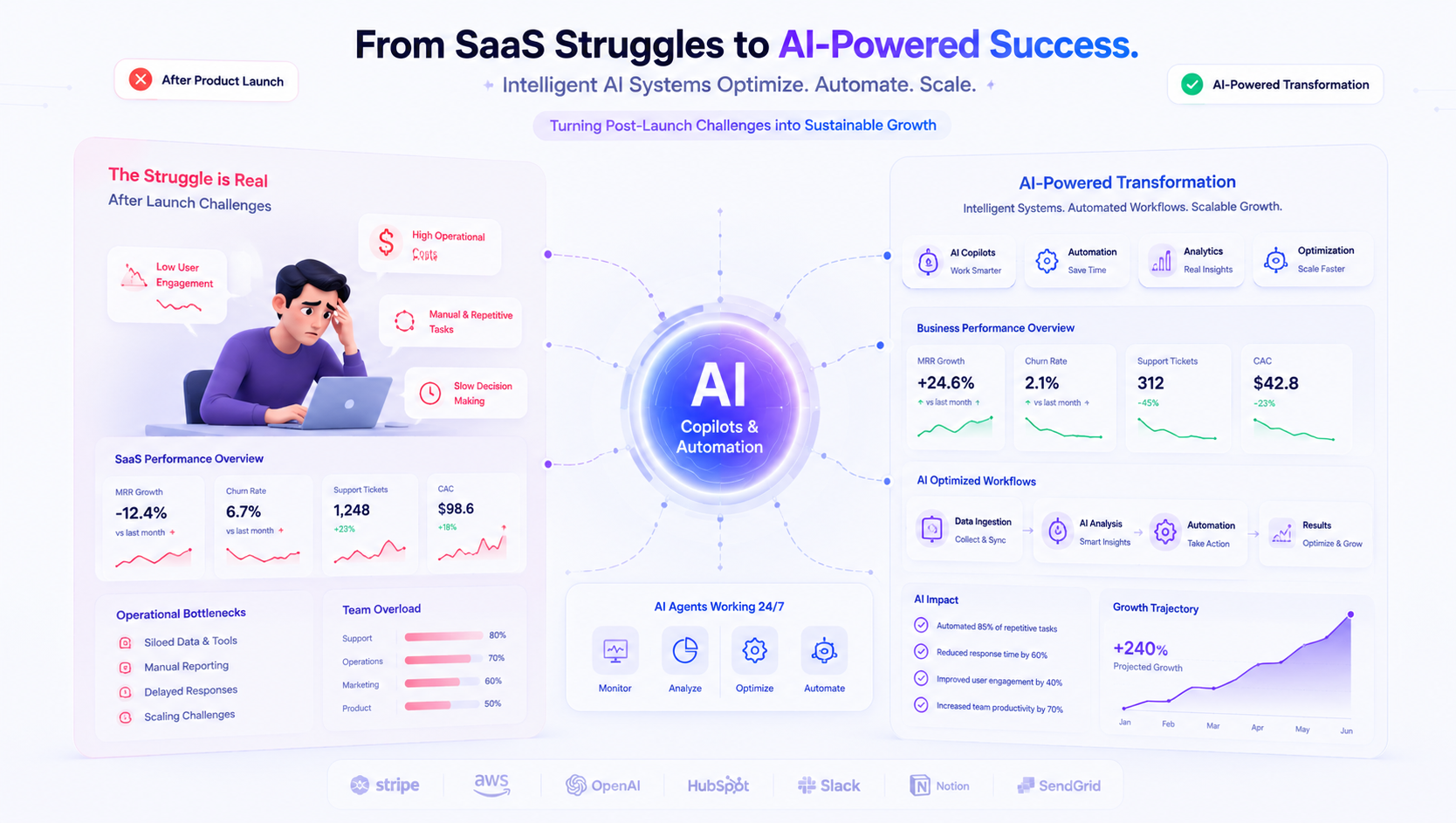
Launching a SaaS startup feels exciting.
The product goes live, users begin signing up, and the first customers arrive.
Then reality hits:
Growth slows
Retention drops
Support tickets increase
Infrastructure costs rise
Customer acquisition becomes expensive
Users stop returning
The challenge is no longer:
“How do we build the product?”
It becomes:
“How do we keep the business alive?”
Most SaaS startups fail after launch — not before it.
In 2026, building software is easier than ever thanks to AI tools, cloud infrastructure, and modern frameworks.
But retention, scaling, and operational efficiency remain difficult.
The Biggest Myth About SaaS
Most founders believe:
Building the product is the hardest part.
It isn’t.
The hardest phase starts after launch when startups suddenly need to manage:
Onboarding
Support
Retention
Analytics
Infrastructure
Marketing
Product iteration
Operational scaling
Most teams are unprepared for this transition.
Why Most SaaS Startups Fail
Several common problems appear repeatedly.
1. Poor Customer Retention
Acquiring users is expensive.
Keeping them is harder.
Many SaaS startups focus heavily on:
Signups
Traffic
Launch metrics
while ignoring:
Activation
Engagement
Customer success
The Real Problem
Many users never fully understand the product’s value.
Complicated onboarding and workflow friction hurt retention early.
How AI Helps
AI onboarding assistants can:
Guide users interactively
Answer questions instantly
Personalize onboarding
Automate support
Modern SaaS products increasingly use AI copilots instead of static tutorials.
2. Feature Overload
Many founders continue adding features hoping users will stay.
This creates:
Bloated dashboards
Confusing UX
Operational complexity
Slower products
How AI Helps
AI simplifies workflows by:
Automating repetitive tasks
Surfacing relevant actions
Reducing dashboard complexity
Personalizing interfaces
The trend in 2026 is AI-first SaaS experiences.
3. High Customer Support Costs
As user growth increases, support becomes expensive.
Many startups:
Hire support too early
Scale inefficiently
Struggle with response times
How AI Fixes This
AI support systems can now handle:
FAQs
Onboarding questions
Account management
Workflow guidance
Knowledge retrieval
This dramatically reduces:
Ticket volume
Staffing costs
Response times
4. Weak Product Feedback Loops
Most startups don’t fully understand:
Why users churn
Which features matter
Where friction exists
Why This Is Dangerous
Founders often build based on assumptions instead of real behavior.
How AI Helps
AI analytics systems can:
Analyze user behavior
Detect churn risk
Identify friction points
Summarize customer feedback
Surface operational insights
This improves iteration speed significantly.
5. Infrastructure Costs Spiral Out of Control
Many startups underestimate scaling costs.
Common problems include:
Cloud overspending
Inefficient APIs
Database bottlenecks
AI inference costs
Poor queue systems
AI Can Reduce Costs
AI automation reduces:
Manual operations
Repetitive workflows
Support staffing
Administrative overhead
But products still need proper architecture.
Otherwise AI costs become the next scaling problem.
Biggest Shift in 2026: AI-Native SaaS
Traditional SaaS requires users to manually navigate dashboards and workflows.
AI-native SaaS changes this completely.
Users increasingly expect:
Conversational interfaces
AI copilots
Autonomous workflows
Intelligent automation
The best SaaS companies are evolving from software tools into operational AI systems.
Where AI Improves SaaS Retention
| SaaS Problem | AI Solution |
|---|---|
| Poor onboarding | AI onboarding agents |
| Slow support | AI customer support |
| Feature complexity | Conversational UX |
| Churn risk | Predictive AI analytics |
| Operational overhead | Workflow automation |
| User confusion | AI copilots |
| Manual reporting | AI-generated insights |
Why SaaS Economics Are Changing
Historically, SaaS scaled through:
Support teams
Operations staff
Account managers
AI changes this model.
One AI-assisted team can now support:
More users
Faster workflows
Lower operational costs
This changes:
Margins
Scalability
Staffing models
Rise of AI Copilots
One of the biggest trends in 2026 is embedded AI copilots.
Examples include:
AI CRM assistants
AI onboarding systems
AI analytics assistants
AI workflow agents
Users increasingly expect software to help them operate workflows instead of forcing them to learn complex systems.
Common Founder Mistakes
Building Generic AI Features
Random AI buttons do not improve retention.
Ignoring Workflow Design
AI should reduce friction — not increase complexity.
Over-Automating Too Early
Users still need visibility and trust.
No Cost Monitoring
AI API costs can grow aggressively.
Weak Infrastructure
AI workloads require:
Queues
Monitoring
Caching
Vector search
Async processing
Modern AI SaaS Stack
| Layer | Technology |
|---|---|
| Backend | Laravel / Node.js |
| AI APIs | OpenAI / Claude |
| Vector Search | pgvector / Pinecone |
| Queues | Redis + Horizon |
| Analytics | PostHog / Mixpanel |
| Workflow Engine | Temporal |
| Infrastructure | AWS / Hetzner |
Modern SaaS winners optimize operations — not just features.
AI Agents Are Changing SaaS
Older SaaS systems required users to manually operate workflows.
AI-native systems increasingly use agents to:
Generate reports
Manage workflows
Qualify leads
Summarize meetings
Automate onboarding
Trigger actions
This dramatically improves:
Retention
Engagement
Operational efficiency
What Successful SaaS Companies Focus On
The fastest-growing SaaS companies prioritize:
Automation
AI workflows
Simplicity
Reduced friction
Personalized experiences
They build software that works for users instead of software users must manually operate.
Practical AI Adoption Framework
Phase 1 — AI Support
AI onboarding
Support agents
Knowledge retrieval
Phase 2 — AI Analytics
Churn prediction
Customer insights
Behavior analysis
Phase 3 — Workflow Automation
Reporting automation
Repetitive task execution
Operational workflows
Phase 4 — AI Copilots
Conversational product experiences.
Phase 5 — Autonomous AI Systems
AI becomes part of the operational infrastructure itself.
Future Trends Beyond 2026
Several trends are accelerating rapidly:
AI-first interfaces
Multi-agent SaaS systems
Personalized product experiences
Predictive SaaS
Autonomous operations
Dashboards are increasingly becoming secondary to intelligent AI workflows.
FAQs
Why do most SaaS startups fail after launch?
Poor retention, weak onboarding, operational inefficiency, and scaling challenges are major reasons.
How can AI improve SaaS retention?
AI can personalize onboarding, automate support, simplify workflows, and improve engagement.
Is AI becoming mandatory for SaaS?
Increasingly yes. Users now expect intelligent automation and conversational workflows.
What is an AI copilot?
An embedded AI assistant that helps users complete workflows and automate tasks.
Does AI reduce SaaS operational costs?
Yes. AI can significantly reduce support, onboarding, and workflow management costs.
Can small SaaS startups compete using AI?
Absolutely. AI allows smaller teams to scale with far greater efficiency.
Conclusion
Most SaaS startups do not fail because they cannot build software.
They fail because they struggle to:
Retain users
Scale operations
Reduce friction
Manage infrastructure
Operate efficiently after launch
AI is changing this equation.
The next generation of SaaS products will increasingly:
Automate workflows
Simplify interfaces
Personalize experiences
Operate intelligently
The companies that win will focus on:
Operational efficiency
Smart automation
Better customer experiences
Lower friction
AI is no longer just a feature layer.
It is becoming the operational infrastructure of modern SaaS.
CTA
Building an AI-native SaaS platform or optimizing your SaaS product with AI automation?
Softtechover’s Laravel and AI engineering team helps startups build scalable SaaS architectures, AI copilots, workflow automation systems, vector search infrastructure, and production-grade AI applications.