
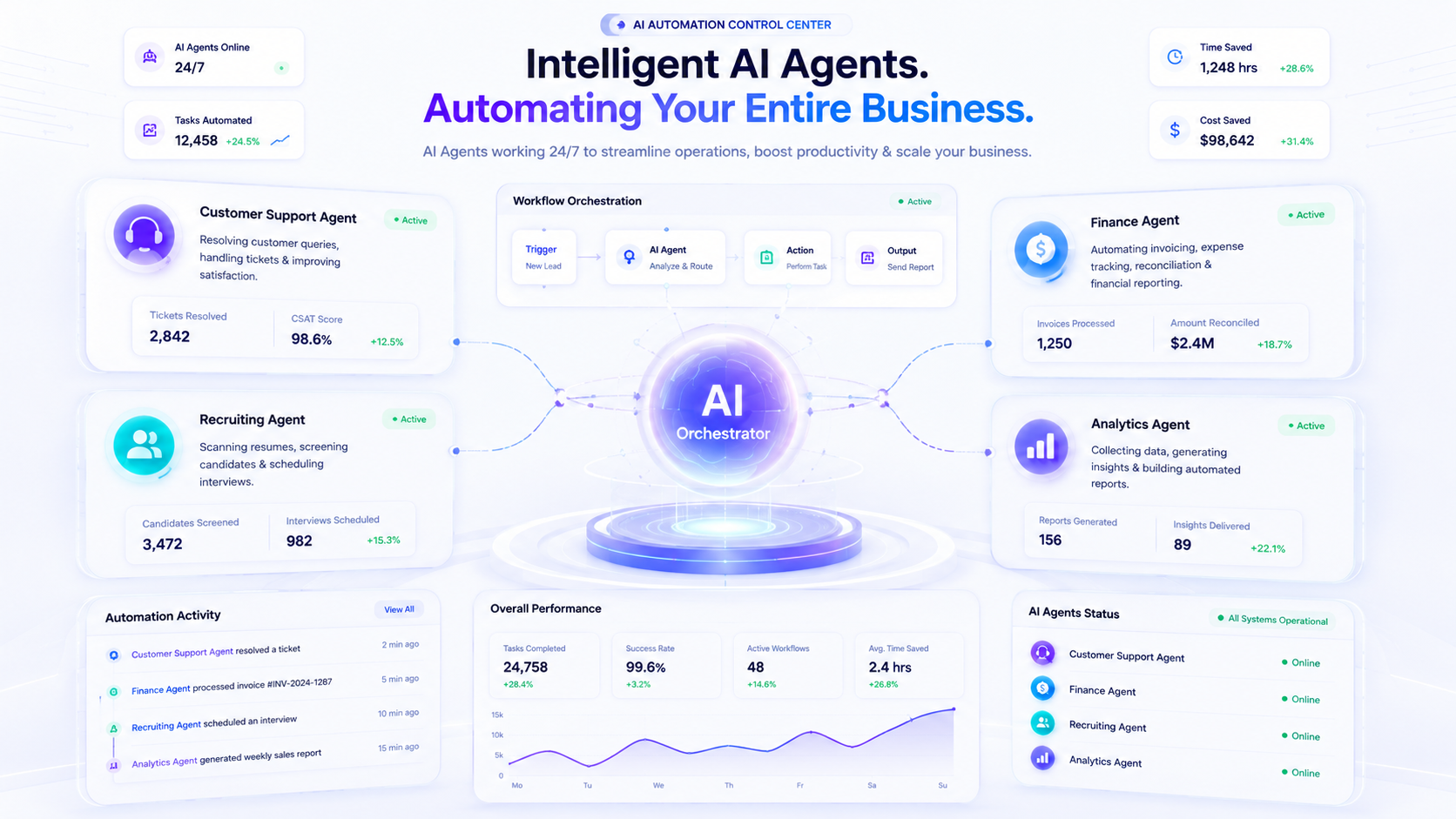
For years, software helped employees work faster.
In 2026, businesses increasingly want software that works instead of employees.
This shift is driving massive growth in AI automation.
Companies are actively investing in systems that can:
Automate workflows
Reduce operational costs
Eliminate repetitive tasks
Improve productivity
Increase response speed
Reduce hiring pressure
Businesses no longer want simple chatbots.
They want:
AI workflows
AI agents
Autonomous systems
Operational automation
Intelligent business processes
Why AI Automation Is Growing Fast
Several major trends accelerated adoption:
Rising labor costs
Faster customer expectations
Better AI models
Easier API access
Operational complexity
Remote workforce growth
Businesses now view AI as operational infrastructure — not experimental technology.
Biggest Trend in 2026
In the past:
Software helped humans work.
Now:
AI increasingly performs the work itself.
Companies want systems capable of:
AI customer support
AI scheduling
AI lead qualification
AI onboarding
AI reporting
AI workflow orchestration
This creates major opportunities for SaaS founders and AI agencies.
1. AI Customer Support Agents
Customer support remains one of the biggest AI automation markets.
Modern AI support systems can:
Answer tickets
Retrieve documentation
Escalate complex issues
Summarize conversations
Automate replies
Support multiple languages
Why Businesses Pay For It
AI support agents reduce:
Support costs
Response times
Staffing pressure
while improving customer experience.
Common Tech Stack
| Layer | Technology |
|---|---|
| Backend | Laravel / Node.js |
| LLM | OpenAI / Claude |
| Vector DB | pgvector / Pinecone |
| Chat Layer | WebSocket APIs |
| Knowledge Base | RAG pipelines |
2. AI Sales Qualification Systems
Companies waste huge amounts of time on unqualified leads.
AI now automates:
Lead scoring
CRM enrichment
Sales qualification
Follow-up workflows
Personalized outreach
Example Workflow
Lead submits form
↓
AI analyzes intent
↓
CRM updated automatically
↓
Sales priority assigned
↓
Outreach generated
Businesses love this because it directly impacts revenue.
3. AI Internal Knowledge Assistants
Modern companies suffer from:
Documentation overload
Disconnected systems
Lost information
AI search systems solve this by providing instant contextual answers.
Fastest Adopting Industries
SaaS
Healthcare
Legal
Consulting
Fintech
4. AI Workflow Automation
One of the most profitable AI categories today.
Businesses automate:
Approvals
Scheduling
Reporting
Invoice handling
Task assignment
Compliance workflows
Why This Market Is Huge
Most operational workflows are:
Repetitive
Rule-based
Expensive
AI dramatically reduces operational friction.
5. AI Content Automation Systems
Businesses still require large amounts of content:
Blogs
Emails
Product descriptions
SEO pages
Landing pages
Ads
Modern AI systems automate large parts of this workflow.
Modern AI Content Features
SEO optimization
Publishing pipelines
Brand tone control
Workflow approvals
Analytics integration
Businesses now want operational content systems — not simple AI writers.
6. AI Document Processing
Document-heavy industries are rapidly adopting AI.
Examples include:
Legal contracts
Invoices
Medical forms
Financial statements
Insurance claims
Common AI Capabilities
OCR extraction
Summarization
Classification
Workflow routing
Anomaly detection
7. AI Recruiting Automation
Hiring workflows are increasingly AI-assisted.
Automation includes:
Resume screening
Interview scheduling
Candidate summaries
Skill matching
Outreach generation
Why Businesses Invest
Hiring is:
Slow
Expensive
Operationally heavy
AI reduces recruiting bottlenecks significantly.
8. AI Meeting & Productivity Assistants
Modern AI meeting tools can:
Summarize calls
Generate action items
Assign tasks
Update CRMs
Schedule follow-ups
This market exploded alongside remote work growth.
Businesses want less administration and more execution.
9. AI Finance & Reporting Automation
Finance teams spend huge amounts of time generating reports.
AI systems now automate:
KPI reporting
Forecasting
Expense categorization
Financial summaries
Anomaly detection
Why It Matters
Executives increasingly expect:
Real-time reporting
Predictive insights
Automated summaries
without manual spreadsheet work.
10. AI Multi-Agent Business Systems
The newest category in 2026:
AI teams.
Businesses now deploy:
Support agents
Workflow agents
Analytics agents
Finance agents
Onboarding agents
working together autonomously.
AI is evolving from:
software tools
into:
digital workforces.
Highest-Growth AI Automation Area
The fastest-growing category currently is:
AI agents + workflow automation.
Why Businesses Spend Aggressively on AI
Companies are under pressure to:
Reduce costs
Improve efficiency
Scale faster
Handle staffing shortages
AI automation solves all four.
Many businesses now achieve measurable ROI within months.
Common Startup Mistakes
Building Generic AI Tools
Businesses want workflow solutions — not random AI features.
Ignoring Integration
AI systems must connect with:
CRMs
ERPs
Internal databases
APIs
No Human Approval Layer
Critical workflows still require oversight.
Weak Security
AI systems often handle sensitive operational data.
Security & Compliance Best Practices
AI automation introduces risks like:
Prompt injection
Unauthorized actions
Data leakage
Workflow abuse
Best Practices
Role-based permissions
Audit logging
Human approval systems
Tenant isolation
Every AI-generated action should be logged carefully.
Modern AI Automation Stack
| Layer | Technology |
|---|---|
| Backend | Laravel / Node.js |
| AI APIs | OpenAI / Claude |
| Vector Search | pgvector / Qdrant |
| Workflow Engine | Temporal / Trigger.dev |
| Queue System | Redis |
| Frontend | Next.js / Vue |
| Hosting | AWS / Hetzner |
Future Trends Beyond 2026
Several trends are accelerating rapidly:
Voice-based AI workflows
Autonomous business operations
AI operating systems
AI employee infrastructure
Industry-specific AI automation
Businesses increasingly want AI systems capable of independently executing workflows.
Practical Strategy for Founders
The best AI automation startups usually:
Solve one painful workflow
Integrate deeply
Automate repetitive tasks
Deliver measurable ROI
The opportunity is not building:
general AI.
The opportunity is building:
workflow-specific AI systems.
FAQs
What is the most profitable AI automation idea in 2026?
AI workflow automation and AI agents are currently the fastest-growing categories.
Are businesses really paying for AI automation?
Yes. Companies are aggressively investing in automation systems that improve efficiency and reduce costs.
Which industries adopt AI fastest?
SaaS, healthcare, finance, legal, recruiting, and customer support are leading adoption.
Do AI startups need machine learning expertise?
Not always. Many successful startups use API-first architectures with OpenAI or Claude.
Why are AI agents becoming important?
Businesses increasingly want systems that execute workflows autonomously.
Is AI replacing employees?
AI mainly automates repetitive operational work while improving team productivity.
Conclusion
The AI automation market in 2026 is growing rapidly.
Businesses are actively paying for systems that:
Automate workflows
Improve productivity
Reduce operational friction
Increase response speed
Scale operations efficiently
The biggest opportunities are not generic AI tools.
They are AI systems deeply integrated into real business workflows.
The companies winning this market are building:
AI agents
Workflow automation systems
Operational copilots
AI-native SaaS platforms
that solve measurable business problems.
This shift is only accelerating.
CTA
Planning to build AI automation systems, AI agents, or workflow automation platforms?
Softtechover’s AI and Laravel engineering team helps startups and enterprises build scalable AI automation systems, workflow orchestration pipelines, AI agents, vector search infrastructure, and production-grade SaaS platforms.