
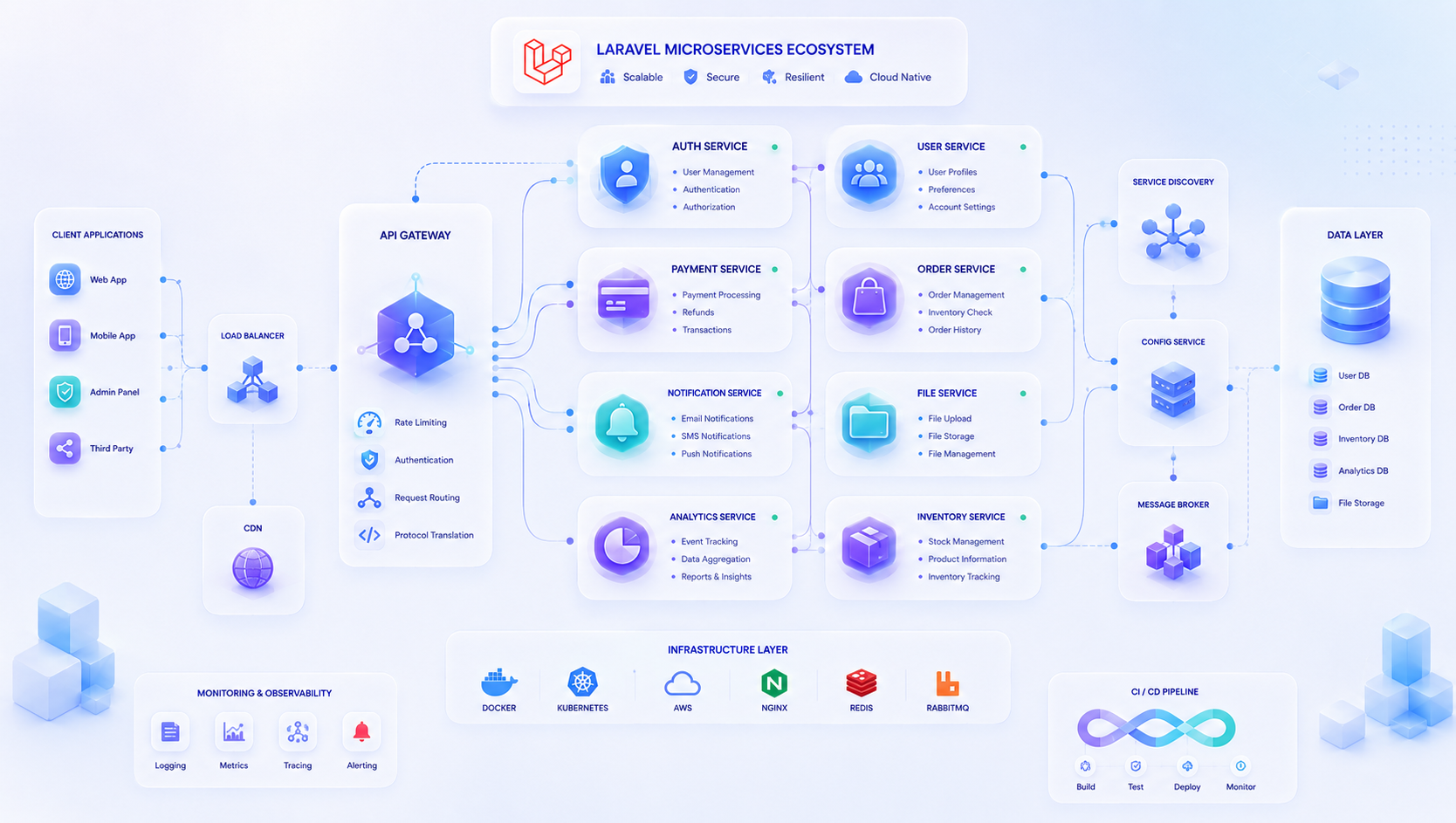
As SaaS platforms continue growing in 2026, businesses are facing a major challenge: scaling applications without affecting performance and stability. Traditional monolithic systems often become difficult to maintain as traffic increases. That’s why many companies are now adopting laravel microservices architecture to build scalable and high-performance applications.
Microservices allow developers to divide large applications into smaller independent services that can scale individually. In this guide, we’ll explore how Laravel microservices work, their advantages, real-world use cases, and how businesses are using them to handle high-traffic systems efficiently.
Quick Summary
- Laravel microservices improve scalability and flexibility
- Services can scale independently based on traffic
- Microservices simplify large application management
- APIs and queues are important in microservice systems
- Proper architecture planning is critical for success
What Is Microservices Architecture?
Microservices architecture is a software design approach where an application is divided into smaller independent services.
Each service handles a specific business function such as:
- Authentication
- Payments
- Notifications
- User management
- Analytics
These services communicate using APIs or message queues.
Why Businesses Are Moving to Laravel Microservices
Modern SaaS platforms require:
- Faster scaling
- Better reliability
- Independent deployments
- Improved team collaboration
Laravel microservices help businesses achieve these goals while keeping development manageable.
Monolith vs Microservices
| Monolithic Architecture | Microservices Architecture |
|---|---|
| Single large application | Multiple independent services |
| Difficult to scale partially | Individual services scale independently |
| Slower deployments | Faster deployments |
| Tightly coupled system | Loosely coupled architecture |
| Easier initially | Better for large-scale systems |
Common Laravel Microservices Components
API Gateway
Handles requests and routes them to correct services.
Authentication Service
Manages login, JWT tokens, and user access.
Payment Service
Processes subscriptions and transactions separately.
Notification Service
Handles emails, SMS, and push notifications.
Queue System
Processes background jobs asynchronously.
Example Architecture Flow
A modern SaaS application may use:
- Laravel API Gateway
- Authentication microservice
- Billing service
- Notification service
- Analytics engine
- Redis queue system
Each service can run independently and scale based on workload.
Technologies Commonly Used
| Technology | Purpose |
|---|---|
| Laravel | Backend framework |
| Redis | Queue and caching |
| Docker | Containerization |
| RabbitMQ | Message queues |
| Kubernetes | Service orchestration |
| MySQL/PostgreSQL | Databases |
Benefits of Laravel Microservices
Better Scalability
High-traffic services can scale independently.
Faster Development
Teams can work on different services simultaneously.
Improved Reliability
Failure in one service does not crash the entire platform.
Easier Maintenance
Smaller services are easier to debug and update.
Challenges of Microservices
Microservices also introduce complexity:
- Service communication management
- Deployment complexity
- Monitoring multiple services
- API security management
- Infrastructure costs
Proper planning is necessary before migrating from monolith to microservices.
Example Laravel API Communication
$response = Http::get('https://api.example.com/users');
Laravel services commonly communicate through APIs like this.
Real Case Study
A SaaS platform handling over 2 million monthly users migrated from a monolithic Laravel system to microservices architecture.
Results after migration:
- API response time improved by 45%
- Downtime reduced significantly
- Independent deployments increased development speed
- System scaling became more cost-efficient
The company also improved reliability during traffic spikes.
Checklist Before Moving to Microservices
- Identify system bottlenecks
- Separate business domains properly
- Implement API security
- Use queues and caching efficiently
- Monitor services continuously
- Automate deployments with CI/CD
FAQ
Q1: Is microservices architecture suitable for small projects?
Usually microservices are better for medium to large applications.
Q2: Does Laravel support microservices?
Yes, Laravel works well with API-based microservices systems.
Q3: Are microservices faster than monoliths?
They can scale more efficiently for large systems.
Q4: Which queue systems are popular with Laravel microservices?
Redis and RabbitMQ are commonly used.
Conclusion
Laravel microservices architecture is helping businesses build scalable, reliable, and high-performance SaaS platforms in 2026. While microservices introduce additional complexity, they offer major advantages for high-traffic applications and fast-growing businesses.
Companies that invest in scalable architecture early can handle future growth more efficiently and deliver better user experiences.
CTA
Planning to scale your Laravel application using microservices architecture? Get a 30-minute free consultation to discuss your backend scaling strategy.